The All Blacks entered 2025 with anticipation, curiosity, and a sense of renewal.
A fresh era under Scott “Razor” Robertson promised new energy, new systems, and the start of a rebuild that could define New Zealand rugby for the next decade.
But what unfolded was a season that constantly swung between hope and frustration.
Some weeks, the All Blacks looked like a team rediscovering their identity.
Other weeks, they looked vulnerable, unsettled, and nowhere near the giants they once were.
This All Blacks season wasn’t a failure — but it wasn’t the revival fans expected either.
It was a year full of truth, lessons, and hard reality.
Below is the full review: what went right, what went wrong, and what absolutely must change for the All Blacks in 2026.
✅ WHAT WENT RIGHT FOR THE ALL BLACKS
1. New All Blacks Talent Rose to the Occasion
One of the biggest positives of the 2025 All Blacks season was the emergence of new players who didn’t just survive Test rugby — they embraced it.
Fabian Holland became one of the standout young forwards.
Every appearance carried signs of a future All Blacks leader: strong in the lineout, physical in contact, and mentally tough despite being thrown into difficult matches.
Several young props, flankers, and locks also impressed when given minutes.
The All Blacks didn’t just expand their squad — they found real building blocks.
2. Razorball Finally Showed Glimpses of Life
When the All Blacks clicked, the rugby was beautiful.
Quick tempo.
Support play.
Innovative shape.
Momentum waves that forced defenses into panic.
These moments weren’t consistent yet, but they were reminders of what the All Blacks could become under Razor.
3. The All Blacks’ Work Rate Never Died
Even in bad performances, the All Blacks played with heart.
They chased kicks, defended in numbers, and kept pushing even when momentum swung against them.
This resilience is the foundation for any rebuild.
4. Leadership Remained Strong Inside the All Blacks Squad
Despite pressure from fans and media, senior All Blacks kept the team grounded.
Culture wasn’t the problem in 2025.
Execution was.
❌ WHAT WENT WRONG FOR THE ALL BLACKS
First-Half Fire, Second-Half Fade”
1. All Blacks Second-Half Problems: From Fast Starts to Fading Finishes
If there’s one theme that sums up the All Blacks in 2025, it’s this:
they start like contenders and finish like a team still figuring itself out.
Look at the big games:
- Against South Africa in Wellington, the All Blacks actually led 10–7 at half-time before the Springboks smashed them 43–10 with a 36-point second-half avalanche – the worst defeat in All Blacks history.
- At Murrayfield vs Scotland, they were cruising 17–0 up at the break. By the 60th minute, it was 17–17, after a Scottish comeback and three yellow cards against New Zealand. Only Damian McKenzie’s late magic saved them in a 25–17 win.
- At Twickenham vs England, the All Blacks exploded to a 12–0 lead with two early tries and still somehow walked off 33–19 losers, conceding 25 unanswered points around half-time as their Grand Slam dream died.
It’s not just a feeling either. Across all tests in 2025, New Zealand had a –64 point differential in the third quarter of matches. That 40–60 minute window – the part where champion sides usually pull away – is exactly where the All Blacks keep falling apart.
That’s not a talent problem.
That’s a concentration, adjustment and mentality problem – and Razor will know that until the All Blacks fix their second-half game, they’re not really “back”, no matter how good the first 20 minutes look.
2. The All Blacks Pack Lost Its Bite
The most worrying trend of 2025 was the regression of the All Blacks forward pack.
Depth was tested, combinations rotated, injuries disrupted momentum — and the pack simply never settled.
That created:
- unstable scrums
- inconsistent lineouts
- weak maul defense
- patchy breakdown presence
The All Blacks were once feared for their set-piece dominance.
Not this year.
3. The England Match Exposed All Blacks Weaknesses
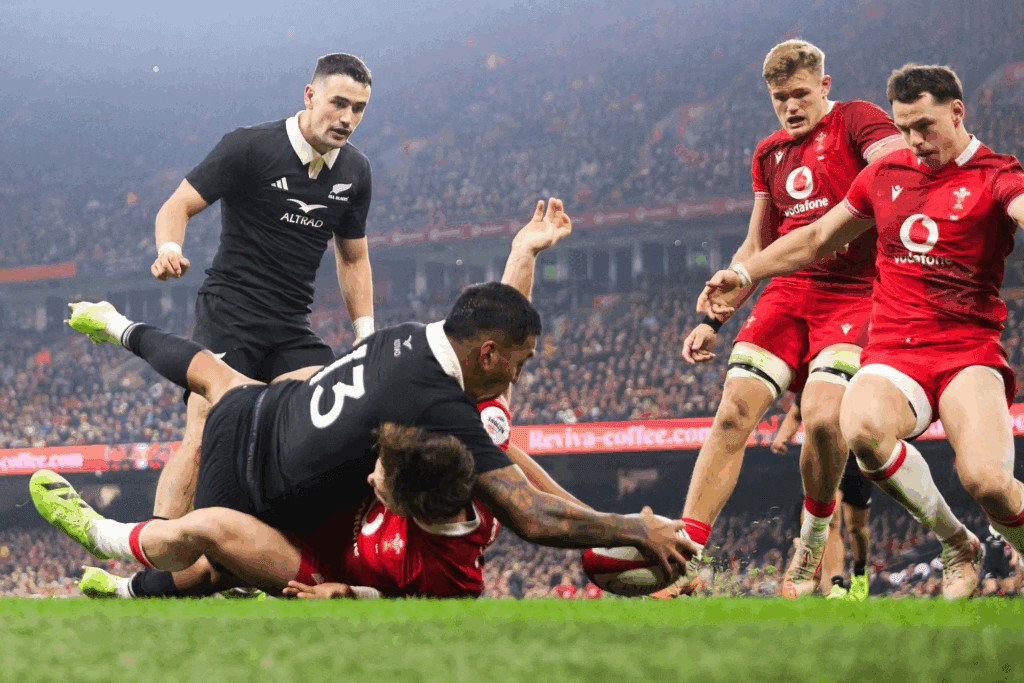
The All Blacks’ 33–19 loss to England at Twickenham became the defining moment of the season.
For the first time in over a decade, the All Blacks were beaten in London not because of magic from the opposition — but because New Zealand collapsed under pressure.
Mistakes in that match included:
- reckless discipline
- soft-edge defence
- poor kicking decisions
- losing control of territory
- repeated set-piece failures
- lack of game management
This wasn’t an off-day.
It was a reality check for the All Blacks.
4. The All Blacks Midfield Never Settled
A Test team cannot build structure without a stable midfield pairing, and the All Blacks proved that again in 2025.
They tried:
- ball carriers
- distributors
- second playmakers
- defensive specialists
Nothing stuck.
Without a reliable 12–13 axis, the All Blacks suffered in:
- attack shape
- defensive communication
- kicking strategy
- tempo control
This remains one of the biggest issues heading into 2026.
5. Too Much Rotation, Not Enough Continuity
Rebuilds require experimentation — but in the All Blacks’ case, it became excessive.
Constant changes meant:
- no chemistry
- no rhythm
- no consistency
- no clear identity
The All Blacks looked like a different team almost every week.
⭐ ALL BLACKS STANDOUT PLAYERS OF 2025
Fabian Holland — The Breakthrough All Black
A bright light in a difficult season. Calm, physical, intelligent — a real prospect for the future.
Ardie Savea — The All Blacks’ Heartbeat
Whether at 7 or 8, Savea delivered. Turnovers, desperation tackles, leadership — he was the most consistent All Black all season.
Impact Bench Forwards
Several new All Blacks props and locks contributed meaningful minutes, offering hope for 2026 depth.
🔥 THE MOMENT THAT DEFINED THE ALL BLACKS SEASON
Twickenham. England 33 – All Blacks 19.
It wasn’t the scoreline — it was the symbolism.
The All Blacks were:
- outmuscled
- outsmarted
- out-disciplined
- and out-executed
The All Blacks aura didn’t just crack — it faded.
For a nation built on dominance, that was the hardest lesson of 2025.
🧠 WHAT THE ALL BLACKS MUST FIX IN 2026
- Stabilise the pack
- Fix the set-piece
- Settle the midfield
- Improve discipline under pressure
- Choose a consistent starting XV
- Strengthen breakdown and tackling systems
- Give Razor’s attack a real identity, not flashes
The All Blacks don’t need a full overhaul — just clarity, continuity, and smarter structures.
🏁 FINAL VERDICT — A NECESSARY YEAR FOR THE ALL BLACKS
This season wasn’t the great All Blacks comeback.
It wasn’t the disaster some fans feared either.
It was something more important:
an honest picture of where the All Blacks really are, and what they must become.
A new identity is forming.
The talent pipeline is alive.
The lessons were painful — but essential.
If the All Blacks fix their core issues, 2026 could be the beginning of a true resurgence.
If not, the rugby world will continue moving on without waiting.
Either way, 2025 will be remembered as the year the All Blacks faced reality — and decided what they want to be next.