The draw for Rugby World Cup 2027 is complete, with the Wallabies facing a brutal Bledisloe battle in Pool A and old rivalries reignited across the new 24-team format.
The wait is over and the battle lines have been officially drawn. The pools for the 2027 Rugby World Cup have been confirmed in Sydney, mapping out the road to glory for the first-ever 24-team tournament.
In a reveal that has instantly dramatically altered the tournament landscape, host nation Australia has been handed the ultimate test: a Pool A showdown with three-time champions New Zealand. It marks the first time the trans-Tasman rivals will meet in the pool stages, guaranteeing a blockbuster start to the campaign but placing immense pressure on the Wallabies immediately.
Elsewhere, the “Six Nations” intensity bleeds into the World Cup, with England and Wales locking horns in Pool F, while Ireland and Scotland are destined to collide yet again in Pool D. With the expansion to six pools and the introduction of a Round of 16, the margin for error has changed, but the stakes have never been higher.
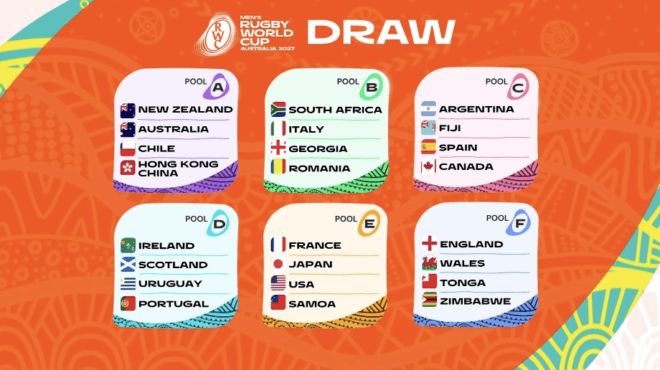
Here is the full breakdown of the confirmed RWC 2027 Pools.
1. Rugby World Cup 2027 Full Pool Breakdown
Pool A: The Bledisloe Pressure Cooker
- Teams: New Zealand, Australia, Chile, Hong Kong China
- Analysis: The headline act. Australia, currently languishing in the rankings after a winless European tour, must face the All Blacks immediately. While both should comfortably progress to the Round of 16, this matchup is a psychological minefield for the hosts. Chile will bring South American grit, and Hong Kong China makes a welcome appearance, but all eyes are on the trans-Tasman giants.
- Danger Rating: 9/10 (for the narrative), 2/10 (for upset risk to the big two).
Pool B: The Physical Gauntlet
- Teams: South Africa, Italy, Georgia, Romania
- Analysis: A brutal draw for the bodies. The Springboks’ power game will be met by an Italian side playing their best rugby in history—fresh off wins over Australia and Wales in 2025. The real intrigue lies in Italy vs. Georgia. The Lelos have long demanded a Six Nations spot at Italy’s expense; this is their chance to prove it on the world stage.
- Danger Rating: 8/10.
Pool C: The Entertainers
- Teams: Argentina, Fiji, Spain, Canada
- Analysis: If you love running rugby, this is your home. Los Pumas are flying after their 2024 Rugby Championship heroics, and Fiji are the Pacific Nations Cup champions. Spain and Canada will struggle to contain the offloading tempo here. Argentina look favourites to top this group, but Fiji remains the ultimate wildcard.
- Danger Rating: 6/10.
Pool D: Deja Vu
- Teams: Ireland, Scotland, Uruguay, Portugal
- Analysis: Cruel for Scotland, who seem destined to be forever paired with Ireland in World Cups. With the “best 3rd place” rule now in effect, the Scots can breathe easier than in 2023, but they face a tricky test against Portugal—the darlings of the last World Cup who love to move the ball. Ireland’s tactical discipline should see them safe, but this is a slippery group.
- Danger Rating: 7/10.
Pool E: The Strategic Battle
- Teams: France, Japan, USA, Samoa
- Analysis: A fascinating mix of styles. France’s structure versus the chaotic energy of Japan and Samoa. The USA, building toward hosting in 2031, will view the Japan fixture as a must-win to reach the knockouts. For France, this looks like a manageable path to the knockouts, allowing them to manage squad rotation early.
- Danger Rating: 5/10.
Pool F: The Old Enemy
Danger Rating: 7/10.
Teams: England, Wales, Tonga, Zimbabwe
Analysis: England, resurgent and ranked 3rd, will relish a crack at a Welsh side currently in a deep rebuilding phase. However, Warren Gatland (or his successor) loves nothing more than an ambush on the English. Tonga brings the physicality that can derail a campaign with injuries, while Zimbabwe returns to the world stage looking to disrupt.
The New Knockout Landscape: How the Round of 16 Works
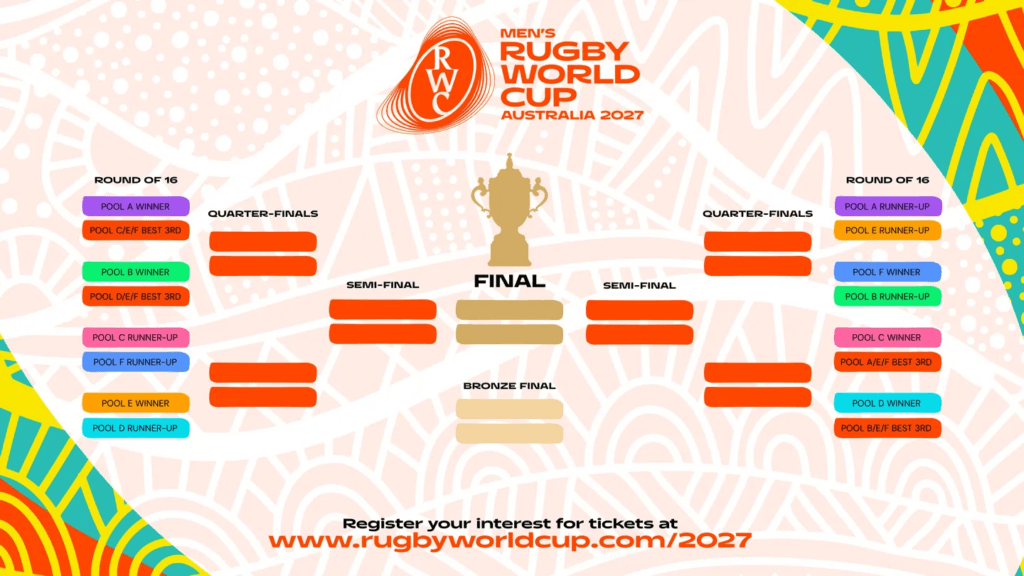
For the first time in Rugby World Cup history, the straightforward leap from pools to quarter-finals is gone. The expansion to 24 teams necessitates a Round of 16, introducing a layer of tactical complexity—and potential controversy—that fans and coaches will need to navigate carefully.
In previous tournaments, the equation was simple: win your pool, play a runner-up. With six pools now feeding 16 knockout spots, the mathematics have shifted.
The Inequality of the Draw
The bracket is not created equal for all pool winners.
- The “Premium” Path (Pools A, B, C, D): The winners of these four pools are rewarded with a Round of 16 clash against a third-placed qualifier. Theoretically, this offers a softer entry into the knockouts.
- The “Hard” Path (Pools E, F): The winners of these pools do not get the luxury of facing a third-placed side. Instead, they are immediately pitted against a pool runner-up.
The Quarter-Final Equaliser
While the Round of 16 appears unbalanced on paper, the bracket is designed to self-correct by the quarter-final stage. World Rugby has essentially front-loaded the difficulty for some and back-loaded it for others.
Take Pool A and Pool E as the prime examples of this trade-off:
- The Pool A Winner (likely New Zealand or Australia) enjoys a seemingly easier Round of 16 tie against a third-place team. However, their reward for winning that match is a potential quarter-final against the Winner of Pool B (South Africa’s pool). They get an easier start, but a brutal obstacle awaits in the last eight.
- The Pool E Winner (likely France) faces a tougher Round of 16 match against a runner-up. However, if they survive that, their quarter-final opponent would be the winner of a clash between two other runners-up. They face a harder initial knockout game, but potentially avoid a fellow pool winner until the semi-finals.
The Verdict
There is no longer a “golden ticket” to the semi-finals. The format ensures that whether you face your toughest test in the Round of 16 or the Quarter-Finals, the road to the Webb Ellis Cup balances out. For teams like Ireland and South Africa, the strategy remains unchanged: just keep winning. But for the statisticians, the route to glory has never been more intricate.