Springboks 2025 Season Review: Evolution, Domination, and a Near-Perfect 9/10 Year
Rassie Erasmus and Tony Brown orchestrated a tactical revolution that delivered the Rugby Championship and a 9/10 season, proving the world champions can evolve without losing their brutal soul
In the high-stakes world of Test rugby, transition years are supposed to be messy. They are usually defined by jagged performances, experimental failures, and a dip in win percentages as coaches sacrifice today’s results for tomorrow’s vision.
The Springboks didn’t get the memo.
The 2025 season will go down as one of the most sophisticated campaigns in South African rugby history. Under the master puppeteering of Rassie Erasmus and the tactical ingenuity of attack coach Tony Brown, the Boks didn’t just win; they mutated. They took the sledgehammer that won back-to-back World Cups and attached a laser sight to it.
With a win ratio of 87%, the Freedom Cup locked away for another year, and the Rugby Championship title secured, the verdict is undeniable. This was a season of devastating competence. It earns a 9/10 rating—not because it was flawless, but because achieving this level of dominance while fundamentally rewriting your attacking DNA is a feat of sporting engineering.
Springboks 2025 Season: Key Stats & Achievements
If you strip away the narrative and look purely at the balance sheet, the Springboks 2025 season review reads like a warning shot to the rest of the world.
- Matches Played: 15 (Including the Barbarians curtain-raiser)
- Record: 13 Wins, 2 Losses
- Win Ratio: 87%
- Trophies Retained: The Rugby Championship, The Freedom Cup, The Mandela Challenge Plate.
- World Ranking: Finished the year firmly at #1.
The statistics reveal a team that has become more clinical. The average winning margin increased by six points compared to 2023, driven largely by a spike in try-scoring output. The “Brown Effect” saw the Boks average 3.4 tries per game, up from 2.6 in the previous cycle.
Crucially, the depth chart is now terrifyingly robust. Erasmus utilized 42 players across the 15 matches, handing out seven new caps without destabilizing the core system.
The Two Blemishes: Anatomy of Defeat
In a 15-match calendar, perfection is a ghost. The Springboks suffered two defeats, and while they were painful, they offered vastly different lessons.
The Ellis Park Collapse (vs Australia) The loss to the Wallabies in Johannesburg was the solitary “fail” mark on the report card. It remains the season’s most baffling anomaly. Leading 22–5 at halftime, the Boks looked set for a routine demolition job. What followed was a complete capitulation of focus.
In a second half where they scored zero points, the Springboks fell victim to their own hubris. The defensive line speed dropped, the exits became lazy, and Joe Schmidt’s Wallabies exploited the narrow “jamming” defense out wide. Losing 22–38 at home wasn’t a talent issue; it was a mental short-circuit. It served as a brutal reminder that the new, expansive game plan requires 80 minutes of cognitive sharpness.
The Arm-Wrestle (vs New Zealand) The 17–19 defeat at Eden Park was a different beast entirely. This was Test rugby at its visceral peak. The Boks didn’t lose this game through incompetence; they lost it on the margins. A late penalty, a missed lineout at a critical juncture, and a refusal to take three points when on offer cost them.
Unlike the Wallabies disaster, Rassie Erasmus publicly stated this was a “good loss.” It highlighted the growing pains of the new territorial strategy—sometimes, you have to stop playing beautiful rugby and just take the points. The adjustment was immediate: they won the return leg in Cape Town by suffocating the All Blacks in the final quarter.
Tactical Analysis: Why This Season Felt Different
The primary debate of the Springboks 2025 season review is no longer “are they boring?” It is “how do you stop them?”
The Brown/Flannery Hybrid The integration of Tony Brown (attack) and Jerry Flannery (defense) has created a hybrid monster.
- Attack: The 1-3-3-1 pod system allowed tight-five forwards to act as pivots. We saw Eben Etzebeth and RG Snyman throwing tip-passes at the line, isolating defenders and creating seams for the speedsters. The Boks finally have an attack that matches their physicality.
- Defense: Flannery’s system is high-risk. By jamming the wingers in to shut down overlap plays early, the Boks invited cross-kicks. While Italy and Australia exploited this early on, by November, the scramble defense had adjusted, turning those interceptions into counter-attacking gold.
Springboks Scrum Dominance: The Weapon That Broke Dublin
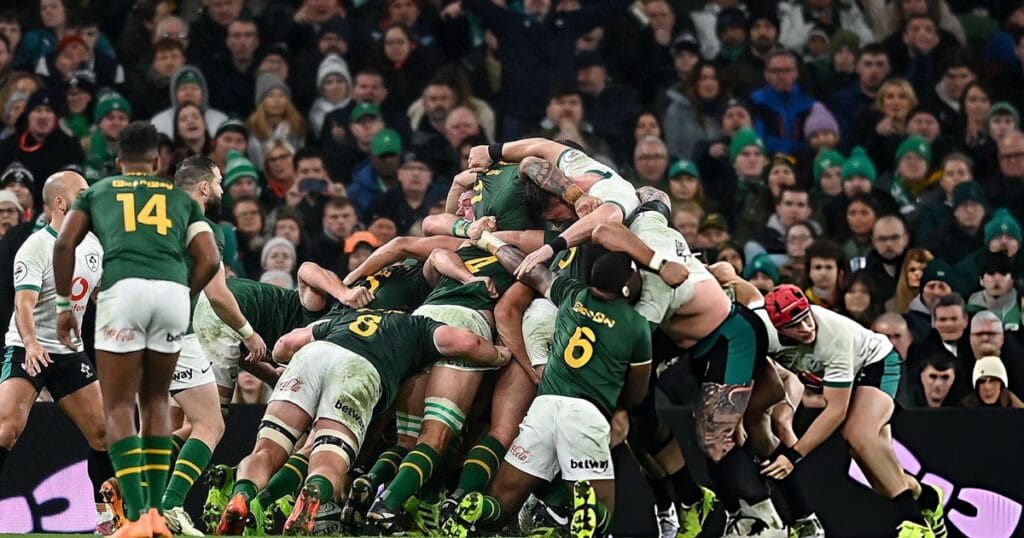
If the “Brown Effect” provided the Springboks with a new artistic flair in 2025, the scrum remained their bludgeon—a non-negotiable weapon of mass destruction that defined their season. Nowhere was this more evident than in the defining 24–13 victory over Ireland in Dublin, a match where the set-piece ceased to be a restart and became a mechanism for psychological and tactical disintegration.
At the Aviva Stadium, the Springbok pack didn’t just win scrums; they weaponized them to dismantle the Irish game plan. With “regulars” like Ox Nche rotated out, the depth chart flexed its muscles as Wilco Louw and Thomas du Toit tormented the Irish front row. The Boks extracted six scrum penalties, forcing English referee Matthew Carley to reach for his pocket repeatedly. The sin-binning of both Irish looseheads, Andrew Porter and later his replacement Paddy McCarthy, for persistent crumbling under pressure was the turning point. It wasn’t just about the three points; the dominance yielded a critical Penalty Try and, crucially, sucked the Irish defense so narrow that it created the acres of space for Sacha Feinberg-Mngomezulu’s try. In 2025, the scrum was the Springboks’ primary playmaker, and in Dublin, it was the reason the world number ones finally ended their 13-year drought in the Irish capital.
Set-Piece Supremacy For all the talk of “running rugby,” the scrum remained the anchor. The Boks won 94% of their own scrums and generated an average of 3.8 penalties per game at set-piece time. This dominance allowed them to dictate territory even when their handling game wasn’t clicking.
The Territory Control A fascinating trend was the Boks’ willingness to play without the ball. In key wins against Ireland and France, they held less than 48% possession but controlled 65% of the territory. They have mastered the art of “pressure rugby”—kicking to compete, not just to clear, and trusting their defense to force errors in the opposition’s red zone.
Player Arcs: The New Guard Arrives
The true success of 2025 lies in the personnel. The torch is being passed, not dropped.
Sacha Feinberg-Mngomezulu: The Chosen One If there was a “Breakout Player of the Year” award, it would already be on his mantelpiece. Sacha Feinberg-Mngomezulu has transitioned from a promising utility back to the heartbeat of the Springbok attack. His ability to slot in at 10 or 15 gave the Boks a dual-playmaker axis that paralyzed defenses. His vision, coupled with a booming boot, makes him the undisputed future face of the franchise.
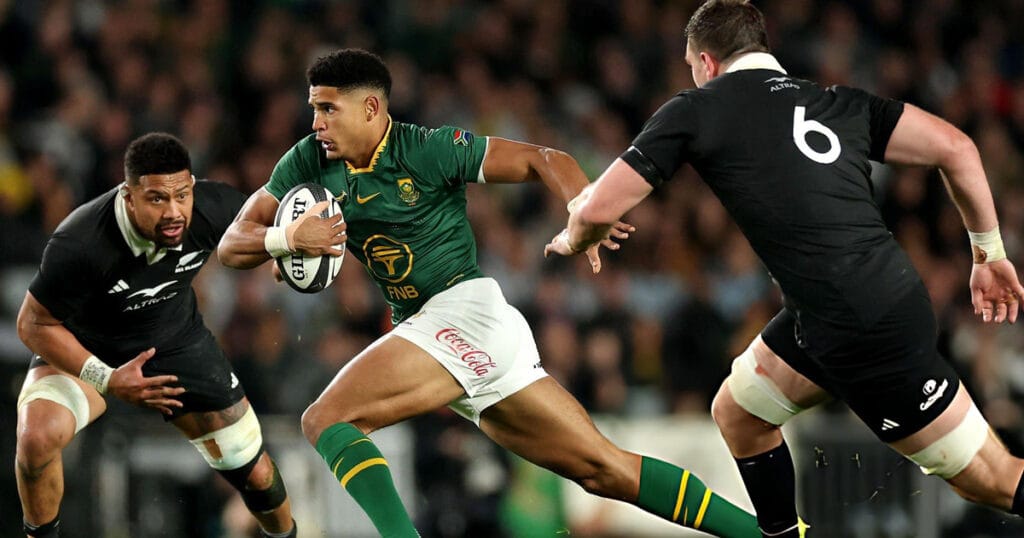
André Esterhuizen: The Concrete Wall With Damian de Allende managed carefully, Esterhuizen stepped into the 12 jersey and made it his own. He offered more than just crash-ball dominance; his distribution out of the tackle was a key component of the “Brown Effect,” linking the brutal pack with the flying outside backs.
The Malcolm Marx Player of the year: Bittersweet Glory
The season concluded with individual honours. Malcolm Marx was rightfully named World Rugby Player of the Year, capping a season where he redefined the role of a modern hooker. His prowess at the breakdown, where he won more turnovers than any specialist openside flanker in the Rugby Championship, was unmatched.
However, the award ceremony itself became a headline for the wrong reasons. Rassie Erasmus was conspicuously absent from the podium, barred from presenting or accepting the award on Marx’s behalf due to the ongoing, frosty standoff with World Rugby over previous disciplinary sanctions.
While the diplomatic tension remains unresolved, it couldn’t overshadow Marx’s achievement. He was the engine of the Springbok machine—accurate in the lineout, immovable in the scrum, and a menace in the loose.
Conclusion: What This Means for 2026
The Springboks leave 2025 in a stronger position than they entered it. They have successfully diversified their game plan, blooded a new generation of superstars, and retained the silverware that matters.
The “boring Boks” narrative is dead. In its place is a team that can beat you in an arm wrestle or a sprint.
The challenge for 2026 will be consistency. The mental lapse against the Wallabies proved that this high-octane style requires total concentration. If they can iron out those 20-minute dips and keep the “Bomb Squad” firing, the road to a World Cup hat-trick in 2027 looks wide open.
For now, South African fans can rest easy. The green and gold machine isn’t just running; it’s flying