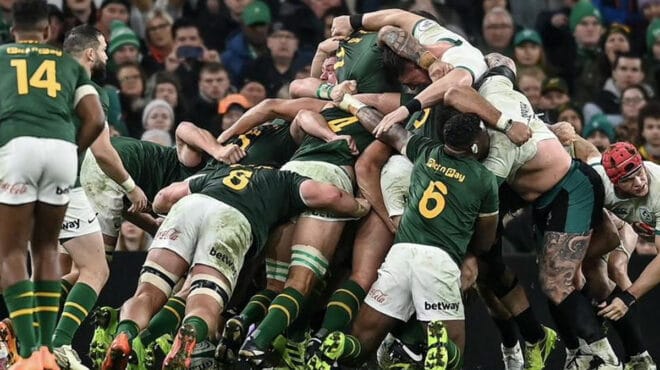
Why the Springboks Scrum Has Become South Africa’s Most Reliable Pressure Point
When South Africa overpower an opponent on the scoreboard, the focus usually drifts toward the finishers. The tries, the breaks, the moments out wide. But for Bismarck du Plessis, the foundation of the Springboks’ recent dominance sits somewhere far less glamorous.
Why the Scrum Has Become South Africa’s Most Reliable Pressure Point
Speaking on The Good, The Bad & The Rugby, the former Springbok hooker was characteristically direct when asked about South Africa’s pack. For du Plessis, the scrum has become the most dependable way the Boks control Test matches — not because it looks good, but because it changes how games are refereed, how opponents behave, and how pressure accumulates.
“It’s not about one guy being tough,” he said. “You’re scrumming as a collective and as a unit.”
Read Also:Eddie Jones on Springboks: The ‘Simple Essence’ Behind South Africa’s Success
WATCH:VIDEO:Christian Wade KO Horror: Newcastle Return Cut Short by Serious Injury
Scrummaging as a Collective: How the Springboks Generate Their Power
There is an assumption that scrummaging dominance lives and dies with the front row. Du Plessis pushes back against that idea. While players like Ox Nché and Malcolm Marx naturally attract attention, he argues the real work starts behind them.
“If you look at the back five, they are really scrumming powerfully,” he explained. “You can see how they almost put their boots in the turf.”
That traction matters. With locks and loose forwards fully committed, the front row is freed up to do what it does best — drive square and straight. There is no scrambling for survival, no need to chase angles.
“You’re not scrumming on your own,” du Plessis said. “Together you’re a lot stronger than what you are alone.”
It is a point he returns to repeatedly. Scrums, in his view, cannot be reduced to individual battles. They only function when eight players are aligned, technically and mentally.
Read Also:Bryan Habana: Family betrayal, the ‘sausage factory’ of sport, and life after the Springboks
The detail that separates good from dominant
Du Plessis is careful not to overstate the gap between Test packs. In raw strength terms, he believes most international sides are close enough. What separates South Africa is precision.
“I don’t think there’s a massive difference between the best and the worst scrum,” he said. “It’s about that one percent.”
That one percent, he suggests, comes down to timing. In particular, what happens the moment the ball enters the scrum.
“When the ball comes in on opposition ball, that immediate shove,” he said. “That’s where it changes.”
It is a detail he credits to scrum coach Daan Human. Hours spent refining small movements, alignment, and reaction time. Eight players committing to the same action at exactly the same moment. The opposition rarely collapses instantly, but they destabilise just enough for referees to notice.
Over a match, that adds up.
Read Also:‘I Hated Rugby’: How Joe Heyes Rebuilt His England Career
Why Six Scrum Penalties Matter More Than One Line Break
One of du Plessis’ more pointed observations concerned how forwards are judged in the modern game. The emphasis on mobility and handling has changed perceptions, particularly around props.
He is unconvinced.
“I would always pick those SA props,” he said. “The penalties they win are more influential.”
His reasoning is blunt. A line break is an opportunity. A penalty is certainty.
“Winning six or seven penalties for your team gives you six or seven opportunities to score points directly,” he explained. “One line break won’t necessarily do that.”
It is an argument rooted in pragmatism rather than aesthetics. Penalties deliver territory, scoreboard pressure, and control. They also remove options from the opposition.
The Ireland Series and the Accumulating Effect of South Africa Scrum Pressure
Du Plessis pointed to the recent series against Ireland as an example of how this plays out in practice.
“They made Ireland scrum like 16 times,” he said.
The outcome was not simply possession. The repeated resets drained tempo, produced two yellow cards, and disrupted Ireland’s attacking rhythm. Even when the ball was finally in play, the damage had already been done.
“You’re scrumming against them and you’re already three or four penalties down,” du Plessis said. “That takes a lot of what you want to do around the field off the table.”
Why Penalty Count Still Decides Test Matches
There is an old rule of thumb in Test rugby that still holds relevance: keep your penalty count under nine and you give yourself a strong chance of winning.
South Africa understand this better than most. By forcing penalties at the scrum, they tilt that equation before the match has properly settled.
“It’s not even you conceding penalties,” du Plessis said. “They’re gaining them.”
Once that happens, teams become cautious. Kick selection changes. Breakdown decisions tighten. Referees arrive at the next scrum already expecting infringement.
For South Africa, that expectation is part of the plan.
How Scrum Penalties Shape Discipline and Referee Perception
What stands out in du Plessis’ analysis is that he never treats the scrum as an isolated event. It is a habit built through repetition, cohesion and trust. That is why the Springboks can rotate personnel without losing effectiveness.
The structure remains. The standards do not shift.
“When we need a penalty,” du Plessis said, “we get a penalty.”
It may not always produce highlight clips, but in Test rugby, reliability has its own value. And as long as the Springboks continue to treat the scrum not as a restart but as a pressure tool, it will remain one of the quiet reasons they keep winning matches.