The Wallabies Season Review 2025 begins with a year defined by extremes — a stunning miracle at Ellis Park on one end, and the low point in Udine on the other. Joe Schmidt’s transitional squad offered flashes of genuine promise, yet the same familiar, self-inflicted wounds repeatedly dragged them back into chaos.
Wallabies Season Rating: 4/10
If 2025 was supposed to be the year the Wallabies rediscovered their identity, the answer remains frustratingly elusive. It was a season that oscillated violently between the sublime and the ridiculous, leaving supporters with severe emotional whiplash. At times, Joe Schmidt’s men looked like world-beaters, capable of overturning a 22-point deficit against the world champions on their own turf. At others, they looked rudderless, surrendering historically to Italy and Ireland while discipline evaporated.
The final ledger—five wins, ten losses—reads poorly. It marks one of the lowest win rates in professional Wallaby history and confirmed a first winless European tour since 1958. Yet, raw numbers fail to capture the nuance of a campaign defined by its schizophrenia.
For Rugby Australia, the challenge now is interpreting this chaos. As detailed in our recent analysis on why Rugby Australia is betting on stability over panic, the governing body is looking beyond the scoreboard. But for the fans staring at the 2025 results, patience is wearing thin. The verdict for 2025 is clear: the ceiling is higher than it has been in years, but the floor is terrifyingly low.
The Numbers That Matter
The statistical footprint of the 2025 Wallabies reveals a team that could score but couldn’t stop bleeding. They posted 337 points across 15 Tests—a respectable return fueled by late-game surges—but conceded 411, averaging nearly 28 points against per game. Defense was the primary ailment, with the side conceding over 50 tries, including a record 46 points leaked to Ireland in Dublin.
Discipline, initially a strength, collapsed spectacularly as fatigue set in. The Wallabies conceded over 150 penalties, spiking to double digits in every major loss from the Rugby Championship onwards. Most damning was the disciplinary disintegration on the Northern Tour, where the team received a yellow card in four consecutive Test matches.
Set-piece stability provided a rare constant, with the scrum win rate holding near 90% despite the mid-season departure of veteran James Slipper. However, the lineout deteriorated into a liability, operating at a competition-low 82.9% in the Rugby Championship and imploding completely against Ireland and France.
The Matches That Defined the Year

South Africa 22–38 Australia (Ellis Park, Johannesburg) The peak of the mountain. Trailing 22–0 after just 18 minutes, Australia looked destined for humiliation. What followed was arguably the greatest comeback in Wallabies history. Led by a relentless Fraser McReight and a brace of tries from captain Harry Wilson, Australia scored 38 unanswered points to stun the world champions. It was their first win at Ellis Park since 1963, a performance of pure grit that briefly convinced the world this team had turned a corner.
Australia 26–29 British & Irish Lions (2nd Test, Melbourne) The heartbreaker. After being outmuscled in Brisbane, the Wallabies arrived at the MCG with a point to prove. For 79 minutes, they were the better side, leading 26–22 thanks to Ben Donaldson’s flawless boot and a ferocious defensive effort. Then came the TMO drama: a potential clearout by Jac Morgan on McReight went unpunished, play continued, and Hugo Keenan crossed for the match-winning try at the death. It was a cruel lesson in closing out games against elite opposition.
Italy 26–19 Australia (Udine) The reality check. If Johannesburg was the dream, Udine was the nightmare. Despite holding a rare halftime lead, the Wallabies were dismantled in the second stanza by an Italian side featuring Australian-born wingers Monty Ioane and Louis Lynagh. The visitors looked clueless in attack and soft in defense, conceding the decisive try to Ioane in the 75th minute. It was a second consecutive loss to the Azzurri, signaling that the gap between Australia and the “tier two” nations has fully closed.
Tactical Evolution: A Search for Structure
Joe Schmidt’s tactical imprint was visible but faint. The attack frequently operated in a 1-3-3-1 pod formation, which looked fluid in high-tempo games like the 33–48 loss to France but stagnant against rushed defenses like England’s. The Wallabies struggled to generate momentum from slow ball, often relying on individual brilliance—such as Tom Wright counter-attacking—rather than systemic manipulation of the defense.
Defensively, the switch to a high-line speed system under Brett Hodgson yielded mixed results. When it worked, as seen in the second Lions Test, it rattled opponents and forced errors. Too often, however, the integrity of the line fractured. Wingers were repeatedly caught jamming in, exposing the edges to cross-kicks (exploited ruthlessly by Ireland’s Mack Hansen) and overlaps.
The kicking game remains a significant work in progress. Without a dedicated long-range specialist, the team lacked the ability to exit their half cleanly. Tactical kicking in wet conditions improved slightly—notably in the narrow win over Japan—but basic errors, such as missing touch from penalties or kicking out on the full, repeatedly released pressure valves for the opposition.
Player Arcs: The Guard Changes
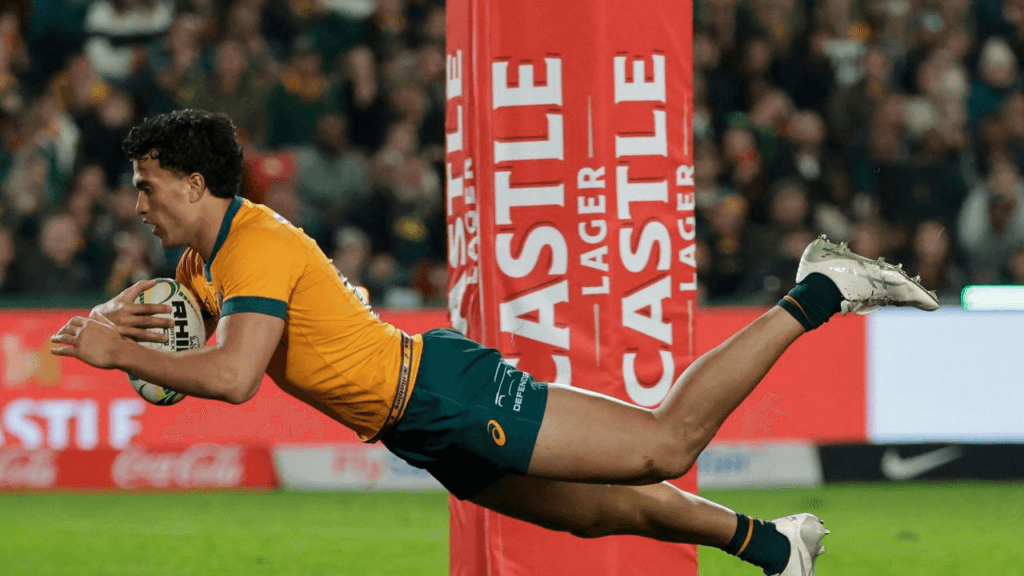
Captain Harry Wilson grew into the role, leading by example with five tries and a willingness to make bold calls, such as turning down draws to chase wins. However, his discipline wavered under pressure, a trait shared by the fiery but penalty-prone Tom Hooper, whose yellow cards became a costly habit on the European tour.
In the backline, Joseph-Aukuso Suaalii justified the hype. The league convert endured growing pains in defense but proved to be a lethal weapon with ball in hand, sparking the comeback against Argentina in Townsville.
Conversely, the playmaking axis remains unresolved. Noah Lolesio, Tom Lynagh, Ben Donaldson, and a recalled James O’Connor all wore the No. 10 jersey without making it their own. The reluctance to back Carter Gordon until the dying weeks of the tour baffled many, leaving the fly-half position as the single biggest question mark heading into 2026.
Coaching & Direction
Joe Schmidt’s tenure was always billed as a rescue mission, but it ended with the ambulance still stuck in traffic. To his credit, Schmidt prioritized development over short-term preservation, handing out 13 debuts and refusing to rely on aging stars overseas. His pragmatism stabilized the scrum and instilled a degree of fight that prevented total blowouts in the Lions series.
However, the team’s inability to play for 80 minutes suggests a failure in conditioning or mental preparation. The “slow starts” became endemic, with Australia conceding the first try in 10 of 15 Tests. Schmidt’s frustration with officiating—voicing concerns publicly after the New Zealand losses—seemed to seep into the players, who often looked distracted by the whistle rather than focused on the game.
With Schmidt stepping down, incoming coach Les Kiss inherits a squad with more depth but shattered confidence. The transition needs to be seamless; the experimental phase is over.
Public & Media Reaction
The public sentiment has shifted from anger to exhaustion. The “woeful Wallabies” narrative dominated the back pages following the Italy and Ireland defeats, with Fox Sports labeling the Udine performance “clueless.” Social media was less forgiving, with memes comparing the Wallabies’ current ranking (hovering between 7th and 9th) to their glory days circulating widely.
The frustration was compounded by dashed hopes in the Bledisloe Cup. Following the heroic win in Johannesburg, fans genuinely believed 2025 would be the year the 24-year drought finally ended. Instead, the fortress of Eden Park held firm, and the subsequent loss in Perth extinguished the brief flicker of optimism, leaving the fanbase disheartened by another year of “so close, yet so far.”
Yet, the reaction to the Ellis Park win proved that the passion hasn’t died—it’s just dormant. For one week, “Wallabies” trended for the right reasons, with clips of Wilson’s tries going viral. The frustration stems from the inconsistency; fans can handle rebuilding, but they cannot stomach the volatility of beating the world number one and losing to Italy within the same season.
What 2025 Means for 2026
The Wallabies end 2025 at a crossroads. The floor has been established: this team can lose to anyone if their discipline fails. But the ceiling—a road win over South Africa and near-misses against the Lions—proves the talent is there.
For 2026, the mandate is simple: stability. The fly-half carousel must stop. The defensive system needs to be simplified. And the discipline must be non-negotiable. Les Kiss doesn’t need to find new players; he needs to teach the current ones how to hold their nerve.
The stakes have never been higher. With the recent 2027 Rugby World Cup pool draw placing Australia in the same group as the All Blacks, the path to a home World Cup final runs directly through their oldest rival. The rebuild is messy, painful, and far from over, but amidst the wreckage of a five-win season, the foundations of a competitive squad have been poured. The question is whether they can dry before the next World Cup cycle truly begins.