



Bordeaux’s attack coach says France’s national team got the Top 14’s bench rule changed. He also explained why Ben Tameifuna at lock skewed his scrum at Kingsholm.
“that’s changed this year at the behest of… the French national team because they felt it disadvantaged them when it came to international rugby.”
Noel McNamara, attack coach at Union Bordeaux-Bègles, was talking about the Top 14 replacement rules. For eight seasons, Top 14 clubs could make 12 changes a game. This season they get eight, the number used in Europe and in Tests.
He said it on RTÉ Sport’s Howler podcast, released on Monday 19 October. McNamara coached Ireland’s Under-20s to the 2019 Grand Slam before moving to the double European champions.
Three days before he spoke, his tighthead Ben Tameifuna wore No 5 in the 36-36 draw at Kingsholm, because four Bordeaux second-rowers were injured.
Should a national team get to set the rules for club rugby? Have your say in the comments.
What the old Top 14 replacement rules let a coach do
“generally speaking, you were allowed to make 12 changes in the top 14, so people could come on and off.”
“There were some players that were conditioned um to play, you know, 40 minutes basically because you could bring a prop [off] after 40 minutes, you could bring him back on for the last 10 minutes.”
The system came in for 2018. Up to four players taken off for tactical reasons could come back on to replace an injured team-mate, French outlet Rugbyscope explains.
McNamara’s prop played a half, rested, then came back for the last ten minutes. Now a replaced player returns only to cover an injured front-rower, a bleeding player or a head injury assessment.
The league gives a different reason
The Ligue Nationale de Rugby’s public explanation does not mention Les Bleus.
The league told Midi Olympique the change came out of a French “Shape of the Game” review in the spring.
The federation and the league ran it with the clubs’ staffs, the players’ union, the coaches and the referees. The aim, the league said, was to bring the Top 14 into line with the eight-change rule used in Europe and in Tests.
Both bodies also said the twelve-change rule had not protected players any better.
The federation runs the national team and co-ran the review, so the two accounts overlap. McNamara’s version names who gains: France, whose coaches felt club props conditioned for 40 minutes cost them in Test rugby.
He pointed to the bench as the first sign.

“So, we’re probably seeing it that, you know, the 6-2 is certainly much more common here.”
Why Ben Tameifuna at lock skewed Bordeaux’s scrum
Kingsholm, on Friday 16 October, was a Champions Cup match, and Europe already uses eight changes, so the Top 14 rule played no part. The trouble started with injuries in the second row.
“we had, you know, as I said, Big Ben in in in second row. There’s a little bit of needs must. Uh we had four second rows who were injured.”
Big Ben is Ben Tameifuna, the 148kg tighthead. He wore No 5 next to Cameron Woki, on his first Bordeaux appearance of the season, according to the RugbyPass team sheet. Bordeaux also went six-two on the bench, with no specialist half-back.
Gloucester’s scrum won penalties off them. A lost Bordeaux feed set up Max Llewellyn’s try.
“The area where we struggled a little bit was in the scrum, which ironically you would have thought that it should have been an advantage for us, but um I think it might have skewed things a little bit.”
“you know the height of Cameron [Woki], the height of Ben, there was probably some some challenges for us around that as well.”
Tameifuna is 1.82m, short for a lock. Woki is a back-rower who became a Test lock.
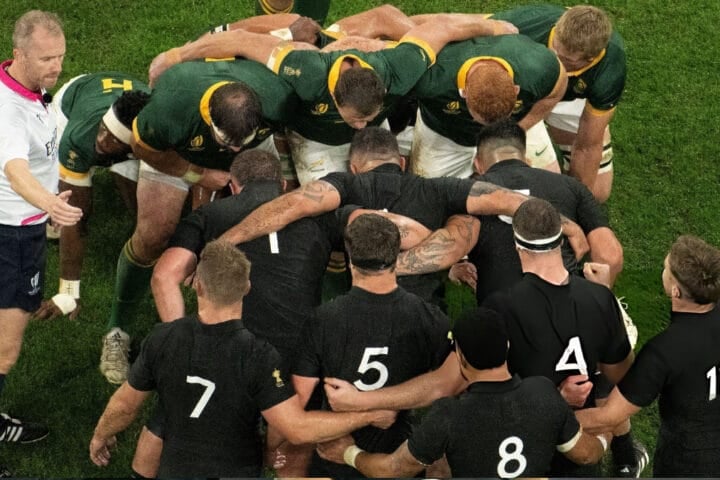
Each lock puts a shoulder under the hips of the prop in front and drives through him. With two locks of very different heights, the two props get pushed at different angles. One side of the pack drives up, the other drives along, and the scrum starts to turn.
Next time Bordeaux are short of locks, watch the set. Before the engagement, look at the hips of the two props. If one sits visibly higher, the second row behind is uneven, and the scrum will move before the ball goes in.
Bordeaux now put wingers in the restart pod
McNamara’s wider point is that eight changes and no returns force clubs to pick players who cover more than one job.
“we’ve played tight head props in the second row… [Arthur Retière] has started 9 10 13 on the wing. So I think that versatility piece is probably much more common over here.”
The aerial game has pushed it further.
“because of the aerial game and how it’s refereed now that the wingers are are becoming better and better over their head to the point that, you know, restart receives and things like that that, you know, we’re using wingers in our blocks.”
He also gave a story about Pete Samu, the former Wallabies back-rower, from his time at Bordeaux.
“Pete Samu, when he was here with us, it used to be a debate sometimes with Pete. He’d be like, ‘Uh, no, do I do I train with the backs today or the forwards?'”

The clock McNamara would leave alone
The same summer the league cut the bench, it cut the conversion clock from 60 seconds to 45. McNamara is not convinced that one matters.
“for me, the speed of the game, we’re chasing things that probably aren’t that important. You know, we’re chasing the the 45 seconds for a conversion. I’m not sure that that makes a a massive uh difference.”
He would rather the game looked at the medical staff. Physios, he said, come on “telling someone to take a knee because there’s momentum with the opposition”.
Kickers had their own complaint about the clock. In September, Thomas Ramos said the kickers were never asked.
RTÉ Sport has the full Howler episode on YouTube.


Your turn: club rules or Test rules?
Bordeaux’s next European match is at home to the Stormers in December. Whether any of the four injured second-rowers are back by then decides who packs down at No 5.
Eight changes keeps the Top 14 on the same rule as Europe and Test rugby. Twelve let clubs manage a prop’s minutes. Which should French clubs play under? Have your say in the comments.
Frequently asked
What are the Top 14 replacement rules for 2026-27?
Eight replacements, the same as the bench. A replaced player can return only to cover an injured front-rower, a bleeding player or a head injury assessment. From 2018 to 2026 the Top 14 allowed 12 changes.
Why did the Top 14 cut replacements from 12 to eight?
The league said the aim was to match the rule used in Europe and in Tests, after a review run with the federation. Bordeaux’s Noel McNamara said on Howler it was “at the behest of… the French national team”.
Why did Ben Tameifuna play lock for Bordeaux at Gloucester?
McNamara said Bordeaux had four second-rowers injured. Tameifuna, a tighthead, wore No 5 alongside Cameron Woki in the 36-36 draw at Kingsholm on Friday 16 October.



Comments
No one has weighed in yet.
Be the first - what did you make of it?