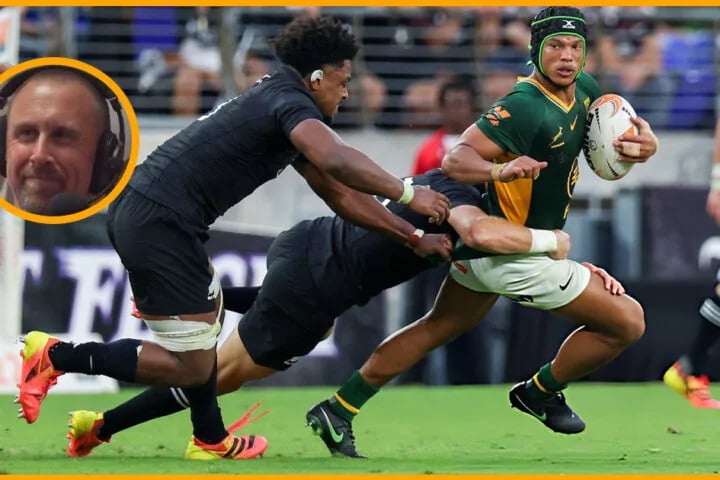
Two front-rowers watched all blacks scrums again. New Zealand weren’t beaten, they were panicking
Angus Ta’avao and James Parsons went to the video wall on The Breakdown and found something more interesting than a beaten pack: New Zealand were not being out-muscled early at Ellis Park. They were panicking.
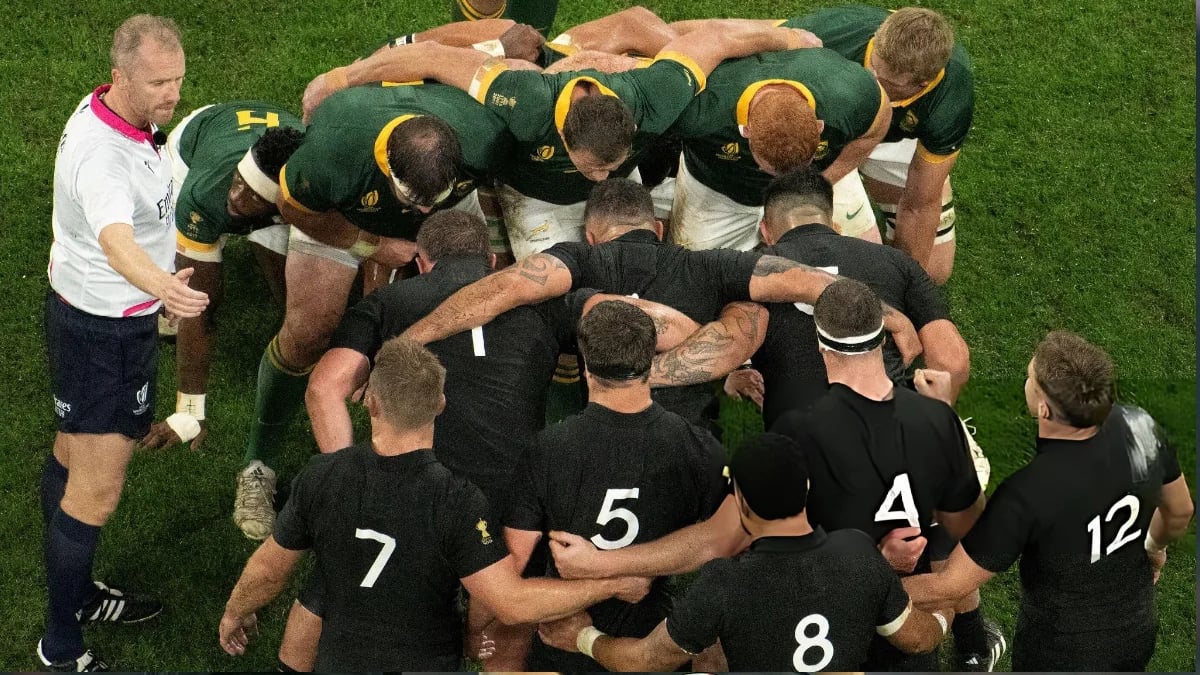
For fifty minutes South Africa did to New Zealand what they have done to almost everyone since 2019. Scrum penalty after scrum penalty. Three All Blacks scrums taken on New Zealand’s own feed, which is the cardinal sin of the set piece.
The Springboks led 13-12 at the break, and lost 33-16.
One scrum did most of it. Five metres from the New Zealand line, fresh front row on, and the All Blacks did not just survive it — they won the penalty. From there the whole Test tilted. Dominance at scrum time is not a bank balance you build up over an hour. It is momentum, and it can change hands inside a single set piece.
So Sky Sport NZ’s The Breakdown sent two men who have lived in there to the wall: Angus Ta’avao, 23 caps as an All Blacks prop, and James Parsons, the former Blues and All Blacks hooker. Well over 500 first-class games between them. What they found is the most useful piece of rugby analysis of the week.
Tell us in the comments whether you buy it — because plenty of people spent Saturday blaming one jersey number, and these two think that is the wrong argument entirely.~
The four things Ta’avao checks on every scrum
Ta’avao is upfront that nobody masters this. He has been in what he calls the dark arts a long time and still reduces it to four questions, asked in order, every single time he packs down.
- Stability. Coming down into the crouch, is he settled, or is something still moving?
- The brace. On the bind, is he strong, or are the hips drifting backwards out of the fight? Ta’avao’s phrase for losing that battle is
Am I going over the cliff?
- The hit. On the set call, is he travelling forward through the punch of force — and does he keep loading after it?
- The second shunt. What happens next. A deliberate second drive once the engagement has settled.
That fourth one is where Ellis Park was decided, and almost nobody at home watches for it.
Ox Nché v Tyrel Lomax: the hit was even
Ta’avao’s first clip is Ox Nché against Tyrel Lomax, and it is not the picture most people assume. The hit is dead level. Both sides arrive simultaneously. Nothing is lost on impact.
Then he asks you to watch the feet. South Africa produce a collective drop and go, the New Zealand feet come out of the ground, and the Springboks are suddenly marching.
That is the second shunt. The All Blacks did not lose that scrum to a bigger man. They lost it two seconds after the contest appeared to be even, because one pack drove again and the other had stopped.
The real problem: they were rushing
This is the part that did not make the clips, and it is the best thing either of them said.
Parsons went back through the early scrums, the ones New Zealand were losing, and found the same fault every time. They were rushing the sequence. Quick hook, Ardie Savea scrambling to get the ball out of the back, everybody trying to survive the scrum rather than win it. Feet not pushing. Shoulders not connected.
When they settled down, they stopped trying to get the ball in and out. They loaded, went together, and let the ball come back naturally.
As Parsons put it, it is always easy for spectators to shout that you should just hook the ball straight back to the number 8’s feet. You have to actually scrummage first.
It reframes the entire first half. A pack in trouble speeds up. A pack in control slows down. New Zealand’s problem was not strength, it was composure — and composure is fixable inside eighty minutes in a way that a strength deficit is not.
A post shared by Sky Sport NZ (@skysportnz)
What Parsons watches before the ball goes in
Parsons’ contribution is the half nobody films. His argument is that a scrum is largely decided before contact, in the spacing and stability of the eight as they set up.
Get the pre-engage picture right and every player can plant his knees and feet underneath his own body. Everyone pushes from a loaded position instead of reaching, and nobody starts on the back foot. From there the pack controls its height, which is the currency of the exchange. Parsons flags the moment South Africa dip in height as the point their platform starts to go.
His shorthand is sixteen feet on the deck. Not arms, not shoulders. The feet of all eight, still and planted.
On the good New Zealand scrum, nothing moves. No feet dance, no gaps open, and Savea’s backside never rises. The number 8 stays flat and all eight travel as one unit.
That last detail is the single most useful thing for anyone watching on television, because a rising backside at the base of a scrum is far easier to see on a broadcast than anything happening between the props. When a number 8 pops up, he has stopped transmitting force forward and started holding his own bodyweight. The pack has quietly become seven men and a passenger.
The five-metre scrum that flipped the Test
Mils Muliaina picked it as the moment of the match. New Zealand had a fresh front row on, the scrum was five metres from their own posts, and everything about the previous hour said South Africa were about to score. Instead the All Blacks held, then won the penalty.
That for me was a massive moment,
Muliaina said. New Zealand cleared, built a drive at the other end, and the pressure never came back.
His counterfactual is the interesting bit. Had that scrum gone the other way, South Africa are five metres out with their chests puffed and a stadium behind them. Same set piece, same eight men, opposite Test match.
Fletcher Newell talked afterwards about a night of solutions. Ta’avao’s summary was that this group found the fix inside the match instead of waiting for the Monday review — and that the bench arrived already knowing what they were being sent on to repair, after Jason Ryan had broken it down at half-time.
That is the part worth holding onto. Replacements who have been watching properly, rather than sitting there as spectators, are worth more than replacements who are simply fresher.
Why the referee gave that penalty the other way
Plenty of Springboks supporters could not believe the call. Ta’avao’s explanation is the clearest you will hear.
Referees go into a Test with a short list: stability, front rows not going long or bellying out, and both sides driving forward. South Africa had spent an hour establishing dominance, and a pack that has done that can usually get away with plenty. But on that scrum they went looking for something that was not there and started walking around it. Wheeling, rather than shoving.
Matthew Carley judged the picture in front of him rather than the hour behind it, and pinged them.
Parsons rated that as one of the hardest calls in the game, because officials so often keep pinging the same side once a narrative has set in. Taking each scrum on its own merits, against the emotion of the contest, is the whole job.
Leave Ethan de Groot alone
De Groot took most of the online blame. He had been ill enough to pull out of the captain’s run and played anyway, before going off with a head knock.
Ta’avao’s response was blunt: this is a man who has been among the best All Blacks of recent months, and you do not write him off on one game — and one in which he was plainly unwell.
Parsons made the technical version of the same argument. It just takes one person out of eight and it falls apart.
One foot slipping is enough. Which is why singling out a jersey number after a scrum penalty is usually wrong, and always unprovable from the couch.
He also described the trap South Africa set. They lock and wait rather than overextending, so the opposition wins the hit, believes the scrum is theirs, and gets squatted straight back out. Fool’s gold. Parsons named Owen Franks as the best he ever came across at it.
Read also: why the Springboks scrum remains South Africa’s key Test advantage.
The challenge does not go away on Saturday
Parsons still rates this South African pack as the best scrum in the world, and the numbers back him. Opta’s measure of the props who most often turn a scrum into a penalty for their side, since the 2023 World Cup and with a minimum of 50 involvements, reads like a Springboks team sheet.
| Prop | Nation | Scrums producing a penalty won |
|---|---|---|
| Gerhard Steenekamp | South Africa | 26.0% |
| Jan-Hendrik Wessels | South Africa | 24.1% |
| Wilco Louw | South Africa | 23.6% |
| Vincent Koch | South Africa | 22.4% |
| Ellis Genge | England | 22.0% |
Four of the top five are South African. The leader turns roughly one scrum in four into three points or a lineout in the opposition 22.
With de Groot unavailable, Ta’avao believes George Bower’s performance off the bench earned him the number one jersey for the second Test. Sea level in Cape Town will change the fatigue equation, but it will not change what New Zealand are packing down against.
Read also: South Africa’s team for the second Test and Rassie Erasmus on the selection behind it.
Bower, who came off the bench into that 56th-minute scrum, now wants the fight. Ahead of the third Test he told the media in Sandton that he loves to scrum, and that “it comes down to that first scrum”.
Your turn
So which is it? Did the All Blacks solve the Springboks scrum, or did South Africa hand it to them by chasing a dominance that had already peaked?
Ta’avao and Parsons say composure won it. Half of South Africa says the referee did. Settle it below.