


Twenty minutes after full time in a Test between South Africa and New Zealand, Conrad Smith found himself being handed a beer by the man who had spent the afternoon lying on top of him.
He could not make the two things fit. “This is the same guy that was just holding me down in the ruck,” he remembered thinking.
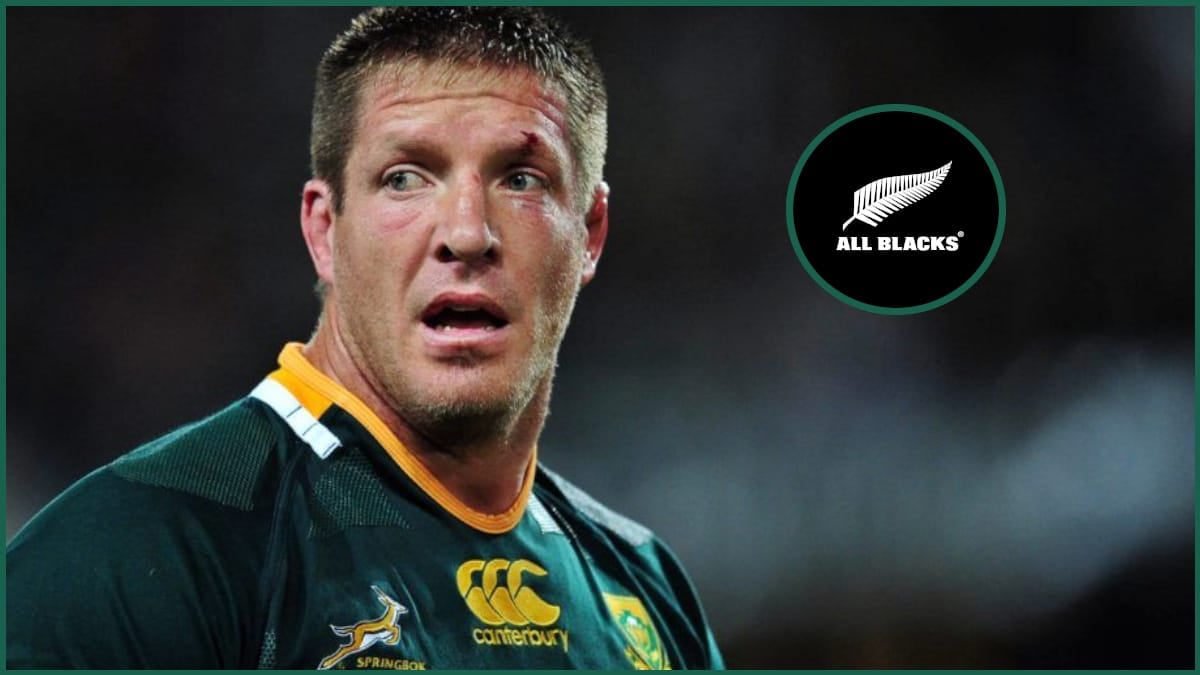
Bakkies Botha, on the field
The Springbok lock’s reputation needs no restatement. What Smith added, on The Aftermatch podcast, was the detail — and it is the sort only an opponent would notice.
Botha had worked out that Smith’s whole game depended on getting back to his feet. A centre lying in a ruck is a gap in the defensive line. So Botha pinned him. “He just knew he’d pin me down for as long as he could hold me,” Smith said, describing himself squirming underneath, which was precisely the intention.
That is not thuggery. That is homework.
Botha also took it upon himself to police Smith’s manners. If the New Zealander raised his voice at a referee — which Smith conceded “did happen from time to time” — Botha let him know about it in terms Smith declined to repeat, then pointed at him, then followed through at the next breakdown. Freelance refereeing, from a man not everyone would have nominated for the job.
And then after match, twenty minutes later
The custom Smith described had lapsed and was deliberately revived around the middle of his career: after full time, players from both sides in each other’s changing rooms.
Twenty minutes is nothing. These were matches, in his words, where both teams had run themselves ragged and beaten each other up. And yet what turned up in that room was, he said, “an insane level of camaraderie” — something he was careful to point out he never found anywhere else. He had hard games against Australia and huge respect for Ireland. It was different with South Africa.

Botha was the clearest example of it. Off the field, Smith said, he was “so lovely” — and then, with the faint exasperation of a man who would have preferred a simpler villain, described the South Africans as “almost annoyingly” nice once the whistle had gone.
Why this fixture produces that and others don’t
Smith’s explanation is better than the usual one about history and tradition.
Both countries, he argued, think they play the game the way it is supposed to be played — and they mean different things by it. “We both think we play the game in the right way,” he said. Neither is going to concede the point. It gets settled on a Saturday and then it is open again, which is why the fixture has never gone flat.
The respect is not in spite of the argument. It exists because both sides are arguing seriously about something they both care about more than almost anything.
Seven or eight out of ten
Asked for the matches that stayed with him, Smith did not hedge much: seven or eight of his ten favourite All Blacks Tests, he estimated, were played in South Africa.
He picked out a Johannesburg Test the All Blacks won with a score at the death. What he remembered was not the celebration but the opposite dressing room — it was a milestone appearance for the Springbok captain John Smit, a man Smith called a legend, and Smit was crushed. Winning was the ultimate, he said. It just was not simple.
He also lost plenty there, and one of the better tries of his career — a set-piece move in Bloemfontein, off a short ball from Stephen Donald — came in a beaten side. He remembers beating a few defenders. He remembers the result too.
Frequently asked questions
What did Conrad Smith say about Bakkies Botha?
That Botha pinned him in rucks and abused him for backchatting referees, then brought him a beer in the changing room afterwards — and was, off the field, a genuinely likeable man.
What is Bakkies Botha doing now?
Botha retired after a career with the Bulls and then Toulon in France, and has kept a lower profile since than many of his contemporaries.
How does Bakkies Botha compare to Eben Etzebeth?
Both are physically dominant Springbok locks and the comparison is a fixture of South African rugby debate. Botha’s era was defined by the 2007 World Cup side, while Eben Etzebeth has become one of the most-capped Springboks in history.

Comments
No one has weighed in yet.
Be the first - what did you make of it?