



Two World Cups, and the opponent Conrad Smith found easiest to prepare for was the one that hit hardest.
Why Conrad Smith found the Springboks the easiest side to prepare for
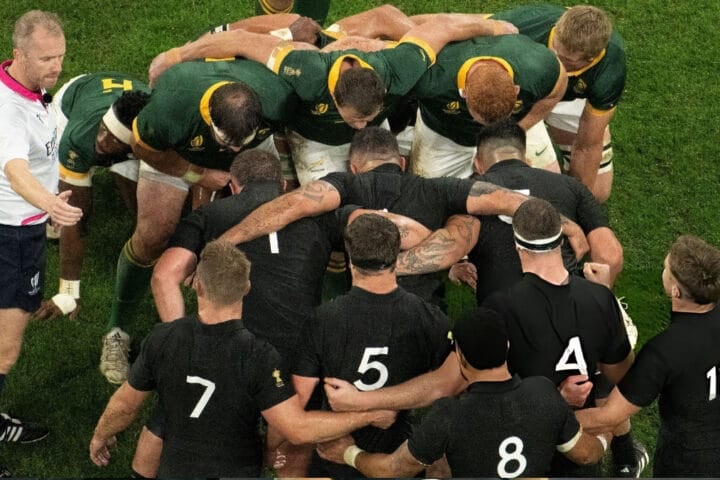
Conrad Smith, the All Blacks centre who won the Rugby World Cup in 2011 and 2015, says South Africa were in one specific sense the most straightforward opponent of his career: he always knew exactly what was coming. Speaking on The Aftermatch podcast, Smith explained that the Springboks never let you down — they were going to come at you physically and try to beat you into submission, and they were very good at it. The certainty of that made the week’s preparation simpler than it was against sides who might do anything.
This is not the insult it might read as. Smith was describing consistency of threat, not a lack of it, and he applied the same observation to Super Rugby: whether it was the Bulls, the Sharks or a trip to Cape Town, the intent never varied.
The counter: back yourself and wear them down
Smith’s description of the All Blacks response is almost disarmingly simple. Front up to the physicality, then back yourself to play your own game and wear the opposition down.
He credited the conditions for making that viable. South Africa’s weather — sun roughly ninety per cent of the time, in his estimate — and the altitude on the highveld suited a midfield back who wanted ball, space and time. For Smith it was close to the ideal environment, which is why he rates it the best place in the world to play rugby.
The exception, when it came, was total. Smith’s memory of South African weather is that it offered no middle ground: either a beautiful day, or biblical rain that flooded the pitch for days. There was never a gentle breeze and a bit of cloud.
The tactical problem: a miss-three at altitude
Here is the section that will interest anyone who watches defensive systems, and it is the part of Smith’s account that has aged into a genuine historical document.
The All Blacks of Smith’s era used an out-and-out drift, not the up-and-in system common now. A modern centre starting at 13 often ends up tackling a midfielder or a blindside winger coming back inside. Smith’s job was the opposite: start at 13 and arc outwards, frequently ending up chasing down a fullback.

Which is why, he said, a simple miss-three pass at altitude sent shivers down his spine. Thin air carries a long pass further and faster. Throw one early in the phase and Smith — a player whose speed was a running joke among his own team-mates — had to cover a large amount of ground sideways to reach a fast, athletic fullback.
Australia, he noted, worked this out and attacked it deliberately from inside their own half. South Africa did the same during his later years: playing from almost any lineout inside their own half, declining to box-kick, throwing it wide and asking the question of the drift.
That last detail is worth pausing on, because it inverts the modern stereotype. The Springbok side Smith faced in those years wanted to play, and it is the New Zealand defensive structure that now looks dated. Smith’s verdict on his own team’s system was drily self-aware: they knew what was coming.
Touring life: no safaris, no golf
The romance of a South African tour did not extend to the Monday-to-Friday, which Smith conceded was the hard part.
All Blacks trips were typically a single week, which ruled out anything ambitious. Golf, standard on modern tours, would have been questioned in his day. The safari parks he did visit were, in his description, tourist traps where the lion lived in a concrete shed rather than anything resembling Kruger.
Cape Town and Durban he rated highly. Johannesburg and Pretoria offered thinner pickings, though Smith sought out the Apartheid Museum, which he recommends without hesitation.
The Tests he remembers
Smith’s summary of the rivalry’s place in his career is the strongest possible endorsement: seven or eight of his ten favourite All Blacks Tests, by his own estimate, were played in South Africa.
His first exposure came before he had played a Test there. Travelling with the squad early in his career as a non-playing member of the party, he was sent into the stand with a video camera — no analysis department, just two spare players filming the game. He walked through the crowd without an All Blacks tracksuit, trying not to be noticed, and found the passion around him genuinely unnerving.
Returning as a player, the thing that stayed with him was the crowd surrounding the team bus on the way to the ground.
Frequently asked questions
What position did Conrad Smith play?
Outside centre. He played 13 for the All Blacks, most famously in partnership with Ma’a Nonu at 12.





Comments
No one has weighed in yet.
Be the first - what did you make of it?