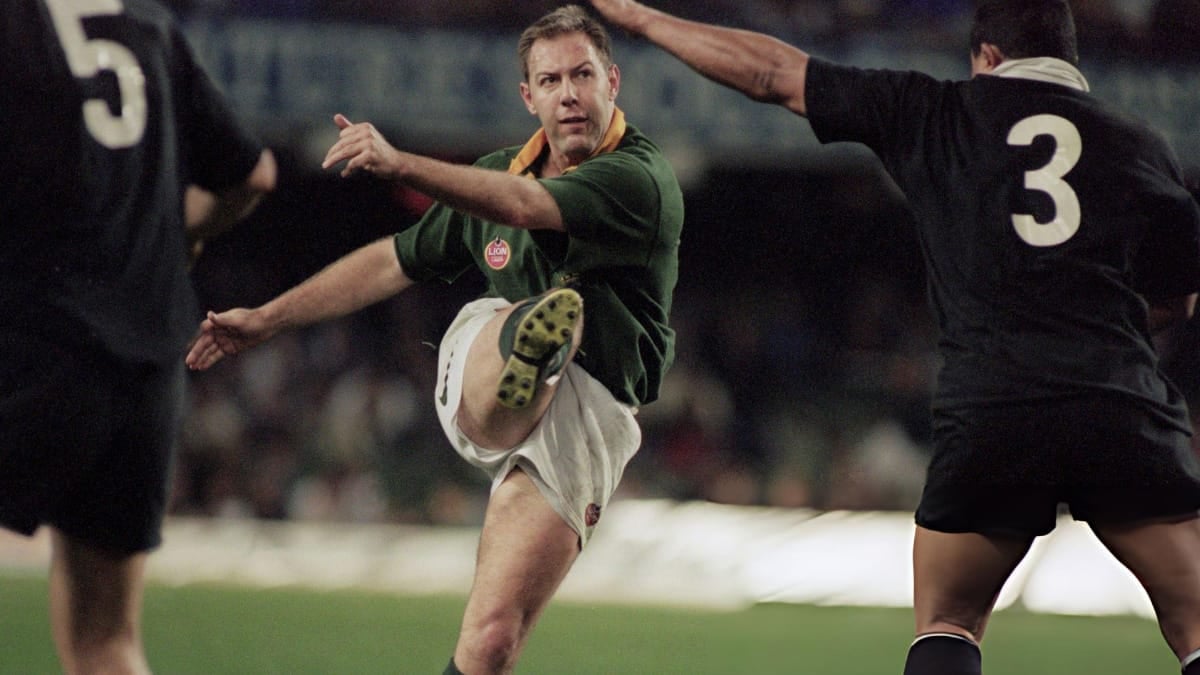
Johan Roux won a World Cup. Twelve caps, Springbok number 607, a start against Romania, a start against Canada, a reserve’s seat for the semi-final in Durban. Thirty-one years later, two men who played the same game are still waiting on €500,000 he talked them into.
The money never went near France, where the rugby club was supposed to be. €120,000 of it went to Poland — a personal-name account at Alior Bank, in the name of a man the sender had met exactly once, on a video call, 24 hours earlier.
Every retired player gets the phone call. Someone who knows someone, a number that sounds slightly wrong, and behind it the specific quiet panic of being forty-one with no contract, a body that’s finished and no idea what you’re worth outside a changing room. That’s the room this deal walked into. Both men are in their early forties. One played fullback for South Africa, the other was a forward at the Sharks, and both spoke to Rapport on condition of anonymity — with documents, call recordings and WhatsApp transcripts behind them.
€120,000, one video call, and a name on a bank transfer
The former Sharks forward met Roux for the first time on 28 October 2021, on a video call. Agent Anthony Johnson was on it too, and laid out the problem: another investor had walked, and Global Sport Capital — the vehicle Roux runs with former coach Rudy Joubert — was €120,000 short.
The terms were not subtle.
“For the 120, we are prepared to pay back 200.”
Johan Roux, on a video call on 28 October 2021, as reported by Rapport and News24
A 67% return inside 30 days, possibly 15. The loan agreement landed that same day on a Eurokredit Merchant Bank letterhead. Next morning he sent roughly R2 million — his life savings — to an account at Alior Bank in Poland held in the name of Antonino Pane, the man said to head Eurokredit.
Not to a club. Not to a lawyer’s trust account — to a name on a bank transfer.
The €300,000 that went the long way round
The fullback got there first, in July 2021. He’d done what every player does in the eighteen months after the last game: asked around, quietly, whether anyone knew of anything. He asked Johnson. Two days later he was on a call with Roux and Joubert about buying a French club.
Terms: €300,000 in, capital back inside 90 days, plus €100,000 on top. About R5 million at that week’s rate. And a job at the end of it — kicking coach, once the deal closed.
If you’ve ever wondered why a retired player says yes to something like this, it isn’t the €100,000. It’s the job. It’s being useful again.
The money didn’t go to Eurokredit. It went to Le Cap Sports, Johnson’s own company, and Johnson forwarded it on — because, he told Rapport, paying Eurokredit directly ran into problems. Nobody has explained what those problems were.
One number the reporting leaves open: the transfers described total €420,000, while both mastheads put the combined investment at €500,000. The missing €80,000 isn’t itemised anywhere.
Three countries, two billionaires and a €500m credit line
What followed, according to the material the players handed over, was a ladder of reasons. The excuse changed at least five times.
By late December 2021 it was three deals closing — two in China, one in Singapore — which would activate a €20 million facility in Poland, held up only by a man in the UK slow to deliver £350,000. By January it was a €500 million credit line at Pekao Bank, days away.
In February 2022 it was Warren Buffett. Roux told the player that Pane had entered a major transaction with the American investor, and that Buffett and Charlie Munger had decided against fortnightly payouts in favour of reinvesting everything — so Pane would have to wait until March.
Then, July 2023: all payments are in. A week later the account was frozen again.
“Time and again I heard: wait two weeks, wait a month, be patient…”
the former Sharks forward, to Rapport
Then Putin invaded, and the Johan Roux story changed
Asked by Rapport on Friday 21 August why the men still have nothing, Roux gave one explanation: Russia’s invasion of Ukraine in February 2022 froze the account holding their money. The original investment, he said, formed part of a transaction Eurokredit had with Russia and a very large investor. Four weeks after the balance went across, everything locked. It’s still locked.
He puts the total frozen at Eurokredit between €3 million and €3.5 million, says he has more than €400,000 of his own in it, on a promised return of roughly 50%.
Roux takes responsibility for bringing the deal to the players — it was his idea, he told Rapport, and they shouldn’t look at Johnson or Joubert. He also says he’s neither a shareholder nor a director of Eurokredit: he speaks to Pane, he relays the messages, and the players were kept informed throughout.
“Any investment carries risk – risk and return is what it’s all about.”
Johan Roux, to Rapport
He added that nobody held a gun to anyone’s head.
What Eurokredit’s own website tells you — and doesn’t
Eurokredit Merchant Bank still has a live site. Checked on 24 August 2026, it calls itself a leading European investment bank offering asset management, project finance and private equity to high-net-worth clients, and gives one registration line: registered in Italy, NA-999207.
It names no regulator. No directors. No physical address — an email address and office hours in CET.
That’s the entity behind the loan agreement, on the letterhead a South African rugby player read before wiring his savings to Poland.
The club did get bought — by a different set of ex-players
This is the part that would keep me up.
The target shifted from Stade Niçois — then a third-tier Nationale side — to AS Béziers Hérault within weeks. Béziers was bought. Just not by them, and not for another three years.
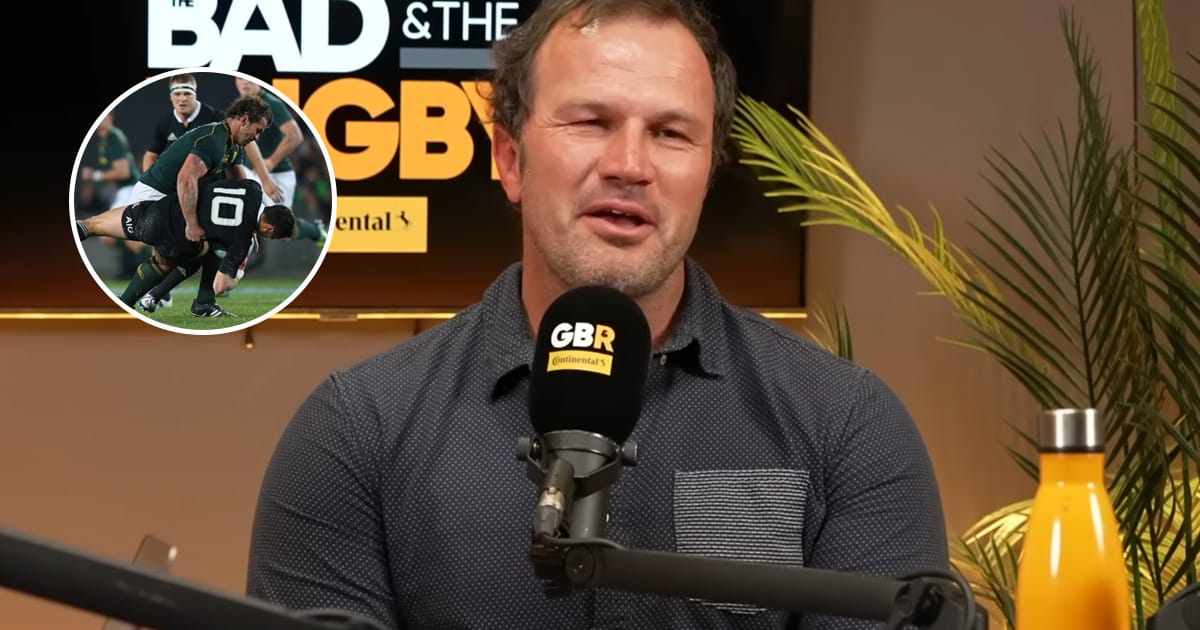
In November 2024 a consortium fronted by former Springboks captain Bob Skinstad and All Blacks first five-eighth Andrew Mehrtens, alongside the late Formula One team owner Eddie Jordan, completed a takeover of Béziers backed by Northern Irish private equity firm Strangford Capital. Eleven-time French champions, last title 1984, sitting seventh in Pro D2.
Named backers, a named fund, and a transaction you can go and read about. Buying a professional club is a documented, regulated, heavily scrutinised process — as anyone who’s watched a Premiership club’s finances get picked apart will recognise. It doesn’t usually start with a wire to somebody’s personal account.
READ ALSO: What the WRU actually demanded before it would let anyone buy Cardiff — the due-diligence gauntlet a real club purchase runs.
The timeline
| Date | What happened |
|---|---|
| Jul 2021 | Ex-Springboks fullback invests €300,000 (~R5m) via Le Cap Sports. Capital + €100,000 promised in 90 days |
| 28 Oct 2021 | Ex-Sharks forward meets Roux on a video call. Told €120,000 is needed by tomorrow, repaid as €200,000 |
| 29 Oct 2021 | €120,000 (~R2m) sent to a personal account at Alior Bank, Poland |
| Nov 2021 | Assurances the deal is on track. No payment arrives |
| Dec 2021 – Jan 2022 | Reasons cited: deals in China and Singapore, a €20m Polish facility, a €500m Pekao credit line |
| Feb 2022 | Buffett and Munger cited. Then Russia invades Ukraine; funds said to be frozen |
| Jul 2023 | “All payments are in.” Frozen again a week later |
| Nov 2024 | Béziers is bought — by Skinstad, Mehrtens and Eddie Jordan’s consortium |
| Jun 2026 | Complaint to SA Rugby. Declined as outside its framework |
| 22 Aug 2026 | Rapport and News24 publish. Roux says the money is still frozen |
SA Rugby said it wasn’t theirs to fix
In June the former Sharks forward lodged a formal complaint with SA Rugby against Johnson, alleging the agent had used trust and standing built inside professional rugby to obtain a substantial sum, and naming Roux and Pane alongside him.
Willemien van der Merwe, SA Rugby’s head of legal affairs, replied that on the face of it the complaint fell outside the governing body’s regulatory framework, and was more appropriately a civil or criminal matter.
So nobody in rugby owns this. The money is in Poland and the door in Cape Town is shut.
The counter-case
Johnson’s position is that he’s a victim too. He told Rapport he put €100,000 of his own in — the strongest argument that he believed it — and that he’s since spent tens of thousands of rands on lawyers and private investigators trying to establish what’s actually going on with Pane and Eurokredit.
“I’m working myself to the bone behind the scenes, trying to find a way to sort us all out.”
Anthony Johnson, to Rapport
He says recent developments have him believing the end is near. He also concedes he’s no longer entirely sure the promises can be trusted. Joubert could not be reached.
Roux’s defence has something in it, too. These were grown men chasing an unusually large number, and they signed.
What happens next
SA Rugby has shut its door, which leaves civil litigation or a criminal complaint — and both hit the same wall. The money is in Poland, the counterparty says it’s Italian, and the asset is said to be frozen inside a Russian transaction nobody outside it can see. There’s no charge, no court date and no regulator publicly attached to any of it.
I’ll say the unpopular part. 67% in thirty days is not an investment, it’s a tell, and two professional sportsmen in their forties were old enough to read it. That doesn’t make what happened to them fair. It makes it preventable, which is worse.
And that’s my actual problem with SA Rugby’s answer. Van der Merwe is probably right in law — this isn’t a rugby matter. But if a former Springboks fullback and a Sharks forward can be walked into a €500,000 introduction by an agent from inside the game, and the governing body’s position is take it to a civil court, what exactly is a 23-year-old on his first Currie Cup contract supposed to do? Every union in the world runs a welfare programme that’ll teach a player to strap an ankle and rehab a shoulder, and almost nothing about where his money goes after the last game.
Roux says risk and return is what it’s all about. He’s right. Nobody ever taught these men to price the risk.
So tell me I’m wrong: is SA Rugby entitled to wash its hands of this, or is financial literacy part of player welfare? I don’t think it’s close — and I don’t think most of you will agree with me.
FAQ
Who is Johan Roux?
A South African scrum-half born in 1969 who won 12 Test caps between 1994 and 1996 and was part of the Springboks squad that won the 1995 Rugby World Cup. He started against Romania and Canada in the pool stage and came on as a reserve in the semi-final against France. He was not involved in the final. He made 111 appearances for Transvaal and won two Currie Cups, and now runs Global Sport Capital.
How much money is involved?
Rapport reports a combined €500,000 from two former players. The itemised transfers are €300,000 in July 2021 and €120,000 in October 2021 — roughly R7 million at the rates of the time. Roux says he has over €400,000 of his own in the deal, and puts the total frozen sum at €3–3.5 million.
Which French club were they buying?
Stade Niçois initially, then AS Béziers Hérault within weeks. Neither was purchased by Global Sport Capital. Béziers was taken over in November 2024 by a separate consortium including Bob Skinstad and Andrew Mehrtens.
Has anyone been charged?
No. As of 24 August 2026 there is no reported criminal charge or civil judgment. A complaint to SA Rugby in June 2026 was declined as falling outside its regulatory framework. Roux denies being a shareholder or director of Eurokredit Merchant Bank and says the funds are frozen, not lost.
What is Eurokredit Merchant Bank?
An entity presenting itself online as a European investment bank offering project finance and private equity, listing an Italian registration number and no named regulator, directors or physical address. Antonino Pane is described in the reporting as heading it.
Read next
- The word Bryan Habana used about how his career ended — and who he aimed it at
- What the best-paid job in world rugby actually pays — the number nobody at SA Rugby will confirm
- Why Siya Kolisi’s Kobe move made more sense than anyone admitted — the part that wasn’t about rugby