


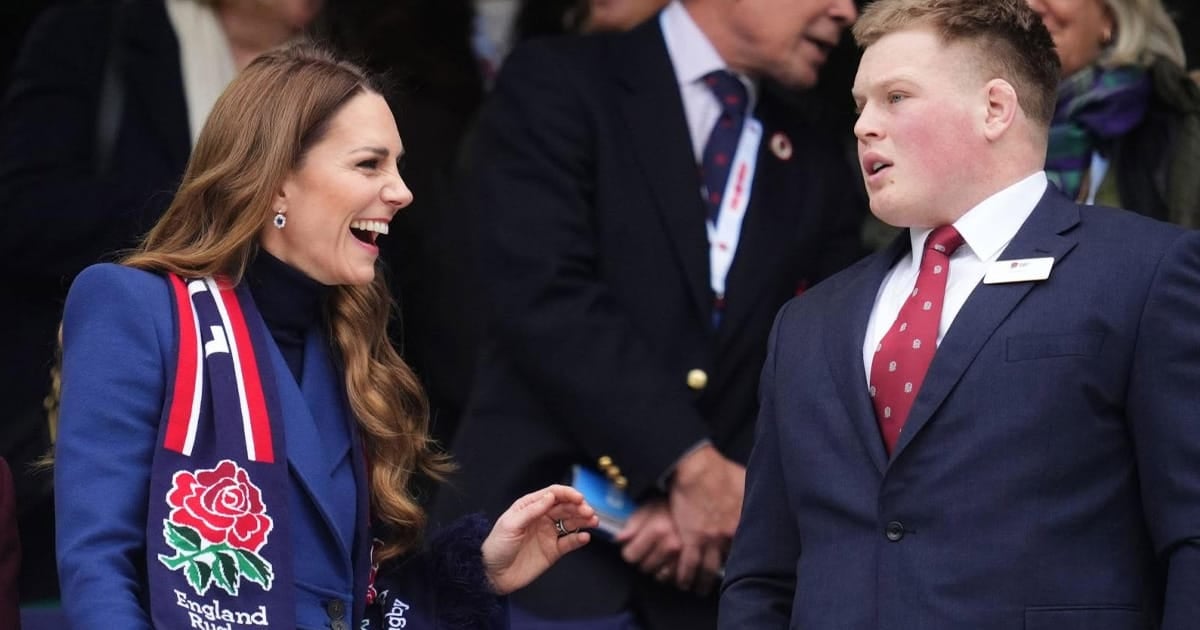
Fin Baxter told TNT Sports that the Princess of Wales, sitting beside him at England’s 42-21 defeat to Ireland, asked him why the team kicks so much. The championship’s own numbers answer her, and it is not the answer 81,953 people were jeering for.
“She asked why we kick.”
Fin Baxter was still enjoying it this week. Eighty minutes beside the Princess of Wales at Twickenham on Saturday 21 February, briefed to field whatever rugby questions came up. The best one she asked was the one the whole ground had been shouting at George Ford from the 14th minute on.
The room laughed. Somebody said everyone was asking that. And the clip, posted by TNT Sports Rugby on Tuesday 8 September, will travel for a week as a warm story about a prop and a princess.
It is a better story than that, because the question has an answer. One number. The uncomfortable part is what that number says about the England team she was watching.
Does England’s kicking deserve the jeers? Yes or no in the comments, then read the number.
Baxter is 24, a Harlequins loosehead with 18 England caps, and the second player at the club after Marcus Smith to be handed an enhanced England contract.
He watched Ireland in a suit. Foot surgery took him out of the Six Nations. A second operation in May took the summer. Seven club games all season.
Your Royal Highness, until she says otherwise
The TNT interviewer wanted the protocol first. Baxter had been briefed.
“Well, I got told, you call her your Royal Majesty until she says, call me Kate.”
Did she? “Immediately.”
The form of address is Your Royal Highness, for the record. Baxter got the part that mattered right.
“It was so cool. I got a week’s notice. I didn’t know whether to prep or not. That would be weird, just having stuff to roll off, so I went into it blind. But at no point was it like awkward or anything… she must meet loads of people for the first time, but it was really impressive and she’s, yeah, really nice. I was there to kind of answer any rugby questions.”
A week’s notice and one instruction: answer the rugby questions. The Princess of Wales has been RFU patron since Prince Harry handed the role back, five championships now. On her other side sat Deborah Griffin, the RFU’s first female president. Six Nations Rugby posted the two of them together eleven minutes after kick-off.
The stadium had already asked her question
Ireland scored three tries inside half an hour, through Jamison Gibson-Park, Robert Baloucoune and Tommy O’Brien, and led 22-0 on the day Maro Itoje won his 100th cap.
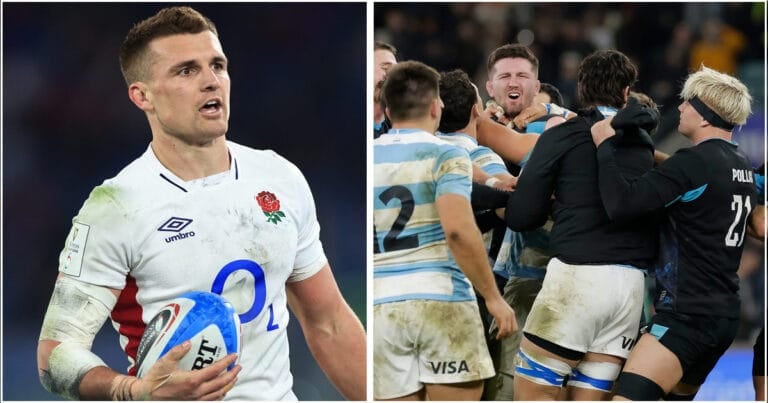
The kicking had gone wrong before any of that. Inside the first 14 minutes, with England in Ireland’s half, Ford had two penalties to put into the corner. He undercooked the first and it stayed in play. He kicked the second dead. When one finally went out later on, ESPN’s Tom Hamilton logged the noise: sarcastic cheers, from a home crowd, for a fly-half finding touch.
Freddie Steward was sin-binned, came back, and was immediately replaced by Marcus Smith before half-time. A kicking full-back off, a running one on.
Fraser Dingwall scored on the stroke of the break, Ollie Lawrence and Sam Underhill after it, and Ireland still finished 42-21, their biggest win at the ground. The Princess posted “Congratulations Ireland. Always a pleasure to see @englandrugby in action at Twickenham” afterwards.
So what she put to Baxter was what the whole ground was asking, and any of the 81,953 would have answered it the same way. Nobody knows. Kick it and hope.
This is where the crowd and the data go different ways.

The answer to her question, in one number
Fourteen.
In 14 of the 15 matches in this year’s championship, the side that kicked for more metres won. Nathan Johns of The Irish Times ran the numbers when it was over, in a tournament that broke the try record with 111. Coaches kick because the boot wins, and the try count says it does not even cost the spectacle.
Why the boot wins is a question about defence, not attack. A modern Test line comes off its mark together and fast, and a carry into it gains a metre and costs a body on the floor. Every phase spent doing that organises the defence better, not worse. More forwards get into the spots where they feel safe, and the attack ends up running at a wall it helped build.
So the kick moves the whole argument forty metres up the pitch and makes the other side play it standing still and looking up while the chasers arrive.
Steve Borthwick has never pretended otherwise. In the week of the All Blacks Test in November, when Scott Robertson suggested England would rain kicks on his back three, the England coach answered in one sentence.
“I would refer you to go back and look at the way they played the two Tests we played down in New Zealand last year and how many times they kicked the ball.”
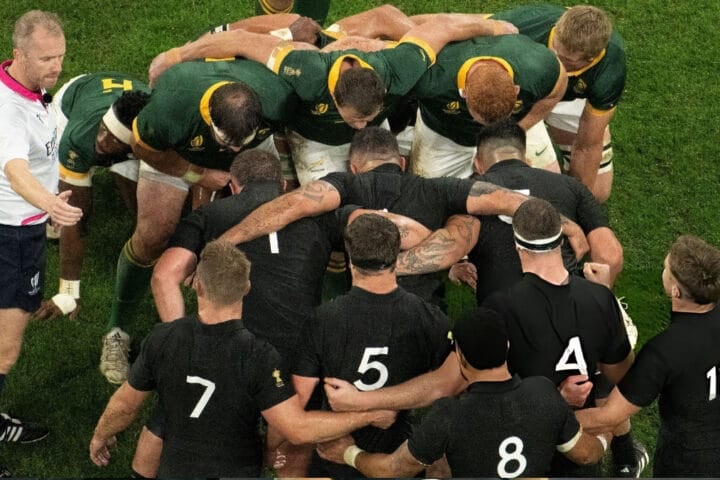
And the best defence in the world is beaten the same way, from the other direction. Aaron Smith, 124 caps at halfback for New Zealand, gave the whole method against South Africa on the Aotearoa Rugby Pod in August.
“That was always the game: win the momentum, stop their momentum, and then squeeze them, and then they’ll kick it. If you can squeeze them the first three phases they’ll generally kick it.”
The kick is also what a team does when it is losing the collision. England were doing both in February.
The part the crowd got wrong
England did not lose to Ireland because they kicked. They lost the kicking.
| Championship | Kicks in play | Kick metres | Rank |
|---|---|---|---|
| Last year, five rounds | 183 | 4,969 | 1st for both |
| This year, first three rounds | 86 | 2,446 | 4th for both |
Source: The Irish Times, Wednesday 4 March.
The side that won eleven games kicked more than anyone in the championship. The side that won one game had dropped to fourth by the time it went to Rome.
And what it did kick, it kicked differently.
A contestable kick with a chase is a 50-50 for forty metres. Through the first two rounds Opta had England at 29.8 metres per kick, the longest in the tournament, with three contestable kicks retained.
James While of Planet Rugby put it plainly: England “generated the fewest contestable kicks of any side through the opening two rounds, a striking retreat from the kick-and-contest identity that had driven their 12-match winning run.”
Long and uncontested. That is the kick the crowd hates, and it is right to. A long kick with the chase arriving late is a swap: territory for possession, and a back three with the whole field in front of them. Any Test back three takes that swap every time.
England kicked for 1,332 metres in beating Wales 48-7 in round one and for 568 in Paris, where they lost 48-46. Put the 14-of-15 rule against England’s five games and the arithmetic is unkind: in at least three of the four defeats, the other side kicked further.
England kick because the side that kicks further wins. The question nobody in that stand asked, and the one Borthwick has to answer before the autumn, is why England stopped being that side.
The tell, next time: ignore the kick and watch the first chaser. If he is within ten metres of the catcher when the ball arrives, England contested it. If the catcher has taken two steps before anyone in white is near him, the ball was given away, and the jeers are earned.
The pack Fin Baxter walks back into
Harlequins boss Jason Gilmore’s version of the injury, given to RugbyPass on Friday 4 September, is that the summer was the price of the first operation.
“They wanted to get him back for the England tour. And he had screws and plates put in his foot, which was aggravating the joint. So they’ve taken all of that out, and since they’ve done that, he’s come on really quickly.”
“He’s almost a new recruit for us because he missed most of last year.”
He is pencilled in for the friendly against Edinburgh and then Bath at the Stoop on Friday 25 September, the opening night of the Premiership season. The timeline is tight: the autumn squad is named in late October, and England’s coaches have already told two returning veterans this month how narrow the door is.
On the day he sat with the Princess, Ellis Genge and Joe Heyes, the tighthead who once hated rugby started in the front row, with Will Stuart and Asher Opoku-Fordjour also injured. Three props short, England started the men they had, and Heyes made twelve tackles in 73 minutes, the most of anyone in white by RugbyPass’s count.
A loosehead’s part in a kicking game happens three seconds before the kick. Quick ball off a scrum or a ruck near the line is what gives a nine time to kick with a chase attached. Slow ball is what turns a contestable kick into a hoof. None of that is Baxter’s to fix. The ball he delivers to the nine is.

Frequently asked
Who is Fin Baxter?
A 24-year-old loosehead prop for Harlequins with 18 England caps, a former England Under-20 captain who made his Test debut against New Zealand in Dunedin two summers ago and holds an enhanced RFU contract. Two foot operations limited him to seven club games last season.
Why was the Princess of Wales at England v Ireland?
She is patron of the Rugby Football Union and attended the Six Nations match on Saturday 21 February in that capacity. Baxter, injured, sat beside her to answer rugby questions.
Why do England kick so much?
Because kicking wins. In 14 of the 15 games in this year’s Six Nations the side that kicked for more metres won, and England’s eleven-win season was built on the highest kicking volume in the championship.
When does Fin Baxter play again?
Harlequins expect him to feature against Edinburgh in pre-season, then Bath at the Stoop on Friday 25 September. England’s autumn squad is named in late October.
Your turn
Two ways to hear the Princess’s question. Either she asked the one every England fan asks, and the answer is “too much”; or she asked the wrong one, and the question England should be fielding is why they kicked worse than every side that beat them. Pick a side below.


Comments
No one has weighed in yet.
Be the first - what did you make of it?