

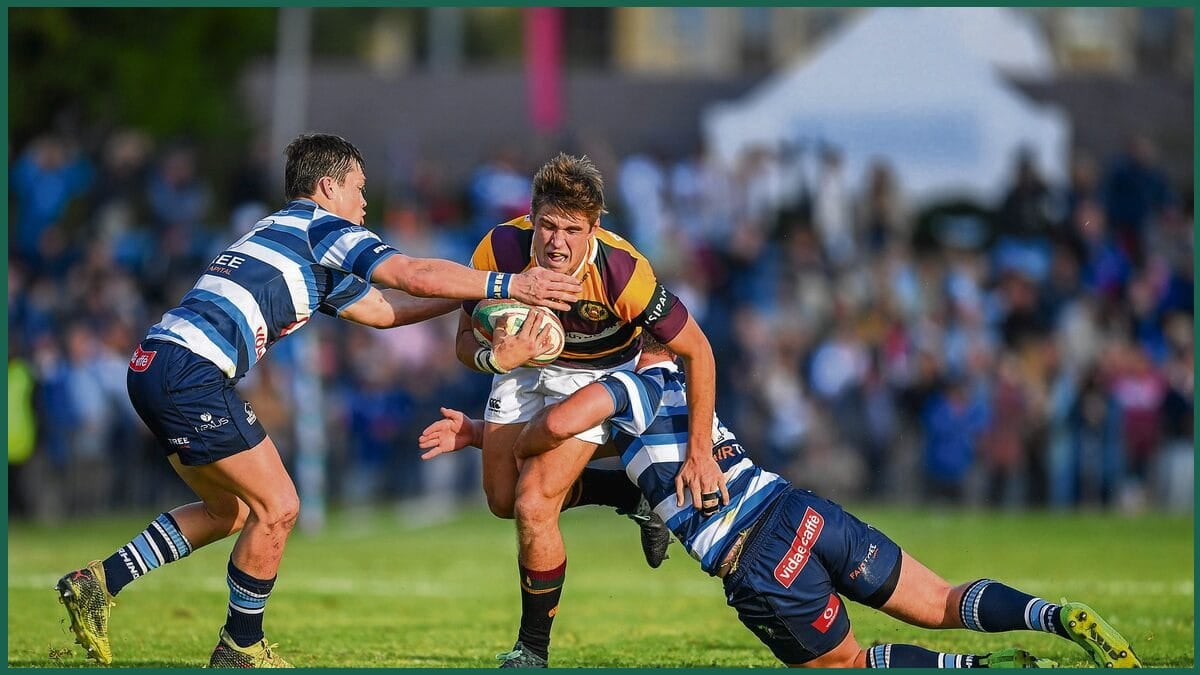
The best rugby schools in South Africa, measured by Springboks produced, are Paul Roos Gymnasium in Stellenbosch (56), Grey College in Bloemfontein (49), Bishops in Cape Town (43), and Paarl Gimnasium and SACS on 32 apiece. Six of the top 10 sit in the Western Cape, most of them within an hour of each other.
What separates them from the elite rugby schools of England, Ireland or New Zealand is not money or coaching. It is structure. A South African boy plays for his school and for nothing else, so one institution absorbs the sporting identity of an entire town — and the fixture that comes out of that fills a stadium of 25,000 people, runs live on television and carries a title sponsor.
On this page
The school derby the rest of the world never sees
On the first Saturday in August, the Cape Winelands town of Paarl shuts down for a rugby match between two state schools. Paarl Boys’ High, known as Boishaai, play Paarl Gimnasium at the Faure Street Stadium, and the town divides so completely that the two sets of supporters hold separate pre-parties and separate post-parties.
The first XV match kicks off at 4pm and pulls a crowd that Rugby365 and the school’s own records both put above 20,000. SuperSport Schools and SA Rugby magazine have estimated recent editions at 25,000. It is broadcast live, it sits inside a sponsored derby series, and it is not close to being the only thing happening that week.
Hockey, netball, golf, squash, chess and cross-country all run alongside it. There are old boys’ matches on the Wednesday, and on the Friday each school holds its Big Brag in the hall, where the first team is introduced and fathers cap their sons. The rivalry goes back to 1915; the schoolboys-only format has run since 1929.
In 2026 Gimnasium won 25-11, their 52nd victory in the fixture. The five before that tell you what kind of game it usually is.
| Year | Result |
|---|---|
| 2026 | Paarl Gimnasium 25-11 |
| 2025 | Paarl Boys’ High 35-33 |
| 2024 | Paarl Gimnasium 30-8 |
| 2023 | Paarl Gimnasium 20-17 |
| 2022 | Paarl Boys’ High 26-24 |
Watch one and the giveaway is the set piece. Schoolboy packs almost everywhere else are coached to keep the scrum up and get the ball away. In Paarl the front rows are coached to hunt penalties, because a game this tight is far more often decided by three points off a scrum offence than by anything the backs do — and because a schoolboy tighthead who can win a shove in front of 25,000 people has just auditioned for a professional contract.
The best rugby schools in South Africa, by Springboks produced
The cleanest way to rank rugby schools is the only measure that does not reset every season: how many of their old boys have played Test rugby for South Africa. The figures below were compiled by KickOff Rugby in June 2026.
| School | Where | Springboks produced |
|---|---|---|
| Paul Roos Gymnasium | Stellenbosch | 56 |
| Grey College | Bloemfontein | 49 |
| Bishops | Cape Town | 43 |
| Paarl Gimnasium | Paarl | 32 |
| SACS | Cape Town | 32 |
| Paarl Boys’ High | Paarl | 26 |
| Kimberley Boys’ High | Kimberley | 23 |
| Rondebosch Boys’ High | Cape Town | 21 |
| Grey High School | Gqeberha | 17 |
| Maritzburg College | Pietermaritzburg | 17 |
| Wynberg Boys’ High | Cape Town | 16 |
| Dale College | King William’s Town | 13 |
| St Andrew’s College | Makhanda | 12 |
If you go looking, you will find other versions of this list that disagree — Grey College at 45, 46 or 48, Paul Roos at 54, Paarl Gimnasium at 30. The gaps come from the counting rule rather than from sloppiness: some lists count all internationals rather than only capped Springboks, some include pre-1906 players from before the name existed, and some credit a post-matric school. Pick one rule and the order barely moves.
The names behind the numbers are familiar enough. Paul Roos produced Willie le Roux, Steven Kitshoff and Damian Willemse. Grey College produced Ruan Pienaar, Frans Steyn and both du Plessis brothers. Paarl Gimnasium has Handré Pollard, Schalk Burger and Jean de Villiers; Paarl Boys’ High has Frans Malherbe, Salmaan Moerat and Evan Roos. Grey High in Gqeberha has one that outranks all of them for significance: Siya Kolisi.
Why it feels professional, because most of it already is
Paarl Gimnasium’s head of rugby is Pieter Rossouw, who won 43 caps on the wing for the Springboks and sits seventh on their all-time try list. He describes the build-up to the derby in terms he borrowed from Test rugby: “For many of the boys, this is the biggest game of their rugby career,” he said before the 2025 edition, comparing the four-year wait from Grade 8 to a World Cup cycle.
Around that sits an entire broadcast industry. Craven Week is televised. First XV matches are streamed. There is a national ranking of school teams that changes weekly and is argued over exactly like a league table. Sponsors attach their names to derby series the way they attach them to competitions.
Springboks tighthead prop Thomas du Toit, who left Bath to rejoin the Sharks in 2026, captained Paarl Boys’ High into the derby in 2013 and thinks the description has caught up with the reality. Speaking on The Good, the Bad & the Rugby podcast, he said the exposure has changed what the thing is: “It’s become kind of like a semi-professional sport now in school.”
The detail that surprises visitors is that none of this is private. Paarl Boys’ High has about 950 boys and Paarl Gimnasium about 1,200 pupils, and both are ordinary state schools under the Western Cape Education Department. This is not an Eton-priced academy system. It is public education with a rugby programme bolted on and a town watching.
School, not club: the structure that does the work
Du Toit’s explanation of why South Africa keeps producing is the most useful thing anyone has said about schools rugby recently, and it is structural rather than sentimental. In England a boy plays for his school and also for a club, so his rugby identity is split across two badges and neither gets all of him.
In South Africa there is no club. The school is the only badge available, so everything concentrates. “It wasn’t two clubs that just had a dig at each other. It was like the two schools,” du Toit said of Boishaai against Gim — and he meant it literally, because the hockey, the cricket and the rugby all run at the same rival across the same calendar year.
That is the mechanism. A club rivalry is a rivalry between teams. A school rivalry is a rivalry between two versions of a childhood, and it comes with old boys, fathers, teachers and a town attached. Concentrate that into one afternoon every August and you get a level of pressure that no under-19 fixture in the northern hemisphere replicates — which is why South African forwards arrive in professional rugby having already played in front of a bigger crowd than most Premiership academy graduates ever see.
Craven Week: how a farm boy gets found
The pathway is unusually legible. A boy plays U13 Craven Week, then U16 Grant Khomo Week, then U18 Craven Week, and the best of that tournament are picked for South Africa Schools. Each stage is a national tournament between provincial sides, and the later ones are on television.
Du Toit is a clean example of what that does. He grew up on a farm outside Koringberg, a town with four tarred roads and no traffic lights, and went to Hoërskool Dirkie Uys in Moorreesburg because the school nearer home had closed for lack of pupils. He played U13 Craven Week for Boland in 2008, moved to Paarl Boys’ High at 15, made Grant Khomo for Western Province in 2011 and Craven Week in 2013, and was named captain of the South Africa Schools side that year.
He was a 122kg loosehead at the time, and the plan was to study agriculture at Elsenburg and go home to farm. Instead he took two years at the Sharks Academy, which his father agreed to on the grounds that he had wasted two years of his own life in the army. The line he gave Rugby365 the week of the 2013 derby has aged well: “When two lions meet one must die.”
Is the best rugby school in the world South African?
On output, it is hard to argue otherwise. The best rugby schools in South Africa are also the best in the world on this measure, and the honest debate is between two of them rather than between countries. Paul Roos leads the all-time count. Grey College leads the professional era, and the BBC went to Bloemfontein to film inside what it called the Springbok Factory, where the names of Test players are painted on the first XV changing-room wall and only selected players are allowed in.
A 2023 ranking of the world’s greatest rugby schools put Grey first and Paul Roos fifth, with Christchurch Boys’ High School, Blackrock College and St Joseph’s College filling the places between them. New Zealand’s closest structural equivalent is Auckland Grammar School, founded, as Grey was, by Sir George Grey.
The gap is not in facilities. Blackrock and St Joseph’s are far better resourced than a Free State state school. The gap is that Grey plays a full season of high-stakes fixtures against schools of similar standard, in front of crowds, on television, every year — and no Irish or Australian school has more than a handful of those.
The case against
The system has a cost and it is worth stating plainly. Big schools recruit boys out of small rural ones at 14 and 15, which strips the feeder schools of their best players and moves a child away from home for rugby reasons before he has any idea whether he is good enough. Du Toit is himself an example of the pattern.
Then there is the attrition. A first XV of 15 produces one professional in a good year, and the other 14 have spent five years training like professionals for a career that does not arrive. Critics call the whole arrangement a professional academy wearing a school blazer, and on the evidence of the coaching staff, the broadcast deals and the recruitment, that is not an unfair description.
The defence is the one du Toit makes without quite realising he is making it. A boy from a farm outside a town with four tarred roads got a Test career because a school 90km away came looking. In a country where most talent is never seen by anyone with a contract to offer, a system that goes looking has something going for it.
Frequently asked questions
Which South African school has produced the most Springboks?
Paul Roos Gymnasium in Stellenbosch, with 56 Springboks. Grey College in Bloemfontein is second with 49 and leads the count for the professional era since 1992.
What is Craven Week?
Craven Week is South Africa’s national schools rugby tournament, played between provincial representative sides. There are age-group versions at U13 and U18, with U16 Grant Khomo Week in between, and the South Africa Schools team is selected from the U18 tournament.
Is school rugby in South Africa professional?
Not formally. The players are schoolboys and are not paid, and the leading schools are state schools rather than private academies. But the coaching staff, the broadcast coverage, the national rankings and the recruitment all operate professionally, which is why players who came through it describe it as semi-professional.
Why do South African schoolboys not play club rugby?
Because the school system covers it. Schools field sides through every age group and play a full fixture list against other schools, so there is no need for a separate club structure at junior level — and the absence of one is a large part of why the school rivalries are as intense as they are.








Comments
No one has weighed in yet.
Be the first - what did you make of it?