PWR Salary Cap: The £265,000 Reality of Women’s Premiership Rugby vs the Men’s £8 Million
The PWR salary cap is £265,000. Not per player — per squad. For an entire Premiership Women’s Rugby team, for a whole season, clubs can spend less on wages than a single mid-tier player earns in the men’s game, where the cap sits around £8 million.
That figure comes straight from someone who signs the cheques: Sale Sharks co-owner Michelle Orange, speaking on the For the Love of Rugby podcast in August 2026. A year on from England’s home World Cup, her interview is the most honest public accounting yet of what women’s Premiership rugby players actually earn — and who still plays for free.
What Is the PWR Salary Cap?
Premiership Women’s Rugby operates a remuneration cap of £265,000 per club, per season — the total a club may spend on player payments, governed by the RFU’s PWR remuneration cap regulations.
Orange put the two numbers side by side herself: “We’re talking about the men’s salary cap being £8-ish million; the women’s is £265,000.” Then she added the line that should follow that statistic everywhere: “£265,000 doesn’t go very far.”
Spread across a squad of roughly 30, the cap averages out below £10,000 per player per season — before you account for the fact that the money isn’t spread evenly at all.
Red Roses Contracts vs Everyone Else
The reason a £265,000 cap can field an elite league is that the best players’ wages mostly don’t come from clubs.
England’s Red Roses are centrally contracted by the RFU — “pretty hefty contracts, not in comparison to the men, but not a bad sum of money,” in Orange’s words — with 32 players awarded full-time deals for 2026/27. The same applies to Sale’s Scottish, Welsh, Irish and American internationals, who carry central contracts from their own unions.
So a PWR squad is really three economies stacked on top of each other:
- Centrally contracted internationals — salaried by their unions, the club cap barely touched
- Club-paid professionals — sharing that £265,000
- Voluntary players — paid nothing at all
It’s the third group Orange dwelt on, and it’s the part of women’s Premiership rugby salaries nobody headlines.
The Players Still Working Full-Time Jobs
“We still rely on a number of girls who are on voluntary contracts who are still in full-time employment. They might be teachers, nutritionists, students, who don’t actually get paid any money to play for us.”
Sale cover their travel expenses to training at Carrington and to matches, plus medical care, kit and food. But these are elite-league athletes holding down teaching jobs, then training to face full-time Red Roses at the weekend. “Those are the girls with the passion for rugby,” Orange says — the definition of playing for the love of the game, at the exact moment the sport around them professionalises.
The direction of travel, though, is unmistakable — and Orange gave the numbers:
- Two seasons ago: ~10 full-time players at Sale
- Last season: 26
- 2026/27: around 29 full-time in the programme
From a third of a squad to nearly all of it in three seasons. That’s the professionalisation of women’s rugby happening in real time, at one club, in one quote.
Read Also “Why Sale’s owners fund all of this at an £8m annual loss”
How Sale Sharks Women Went From Zero to Red Roses
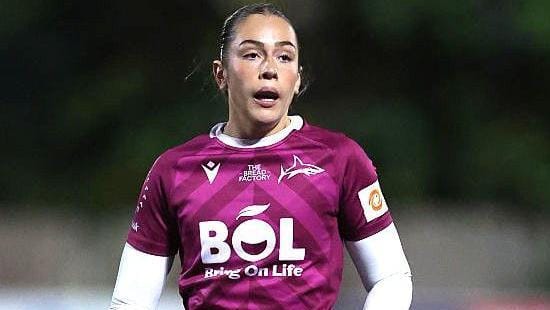
When the Orange/Mason ownership bought Sale in 2016, there was no women’s team at all. Offered a place in the league in 2020, Orange admits she “naively thought — dead easy, just recruit a load of great top women’s rugby players.”
They didn’t come. Northern-born Red Roses were settled at southern clubs, and with two World Cups on the horizon — the delayed New Zealand tournament and then the 2025 home World Cup — nobody wanted to risk selection by joining a developing team. As the only PWR club representing the North of England, Sale had geography as a selling point and nothing else.
The breakthrough came after the World Cup cycle: England internationals Amy Cokayne and Holly Aitchison joined as World Cup winners, with three more Red Roses arriving for this season. One of the new signings is due to give birth in September and — following the trail blazed by Abbie Ward — expects to be playing again by November or December. Orange’s response was pure Michelle: “I’ll be in the delivery room with a contract.”
And the Ilona Maher effect is on her mind too. Asked her dream signing, Orange named the American star alongside Antoine Dupont, citing what Maher’s short Bristol spell did for crowds: “If Ilona wants to come back and play 15s in England, she can come — there’ll be no salary cap left for anyone else, she’ll get the lot.” She’s only half joking: Maher is good friends with Sale’s captain Georgie Perris-Redding, and they’ve already had coffee at Orange’s house.
Who Actually Owns the PWR?
One structural detail from the interview that almost nobody knows: the leagues are owned completely differently.
- The men’s Premiership is owned by its ten clubs plus private equity firm CVC, which holds 27%
- The PWR counts the RFU itself as a 25% shareholder, alongside the clubs
That makes the governing body a part-owner of the women’s league — a structural bet on growth, and a reason the PWR’s development is tied to RFU strategy (and RFU budgets) in a way the men’s league never has been. Orange sits on the PWR board and describes a close working relationship with the RFU’s head of women’s game, Alex Teasdale.
Will the PWR Salary Cap Rise?
Nothing in the interview suggests an imminent jump — but every trend points up. Sale’s full-time numbers tripling in three seasons, post-World Cup attendance momentum, the Maher proof-of-concept for star power, and a governing body that owns a quarter of the league and needs its investment to appreciate.
The honest summary of women’s Premiership rugby pay in 2026: the top ~32 England players are properly professional, a growing middle class is full-time on modest club deals, and the league still quietly runs on teachers and students who play for expenses. The £265,000 cap is both the number that makes the league viable and the number that shows how far there is to go.
Read Also:“How the men’s England contracts work: EPS pay and RFU control explained”
FAQ
What is the PWR salary cap?
£265,000 per club per season — the total each Premiership Women’s Rugby club can spend on player payments. The men’s Premiership cap is around £8 million by comparison.
How much do PWR players earn?
It varies enormously. Red Roses hold full-time RFU central contracts, other internationals are paid by their home unions, club professionals share the £265,000 cap (averaging under £10,000 across a 30-player squad), and some squad players remain on voluntary contracts, receiving only travel expenses, kit, food and medical care.
Are all PWR players professional?
No. At Sale Sharks, around 29 of the squad will be full-time in 2026/27 — up from 10 two seasons ago — but the club still relies on voluntary players who work as teachers, nutritionists or students alongside elite rugby.
Who owns the PWR?
The clubs together with the RFU, which holds a 25% stake in Premiership Women’s Rugby. The men’s Premiership, by contrast, is owned by its ten clubs and private equity firm CVC (27%).
Do Red Roses get paid by their clubs?
Their primary income is an RFU central contract — 32 players hold full-time deals for 2026/27. Club payments on top are limited by the £265,000 cap.