


Taulupe Faletau is fit enough to run and not yet fit enough to be hit. Only the second of those decides whether he goes to a fourth World Cup, and one thing in Cardiff’s next two friendlies will answer it before Steve Tandy has to. It is not whether he plays.
Cardiff head coach Corniel van Zyl, a former Cheetahs and Benetton lock, gave the Taulupe Faletau injury update at the club’s pre-season media session on Friday 4 September, reported by WalesOnline. Faletau has not played since March, when he left the field in Durban with his arm in a sling, and signed a one-year extension in July anyway. He is 35 with 109 caps, and will be 36 when the World Cup starts in Australia next October.
The lines everyone will quote are the warm ones. “He’s a world-class athlete.” “His fitness levels are up there.” Both true. Neither is the sentence that matters.
The Taulupe Faletau injury update, in van Zyl’s own words
“Obviously with that shoulder injury, he can still run and move a lot,” van Zyl said. “Even though he can’t do contact, he can still run so fitness-wise he’s in a good space. It’s just integrating him into a bit more contact and then see when he’s ready to go for full matches.”
Asked whether Faletau would make the league opener, van Zyl did not say yes.
“He’s training so he’s here with the group. He’s not full-contact just yet. He’s in the progression phase. Hopefully next week, a little more and then progressing forward.”

Then the line to keep. “It’s the contact conditioning that he needs to top up now. In different years, he’s had different injuries. This is more shoulder, whereas last season it was calves.”
A coach protecting his player, and fair enough. Now put the calendar next to it. Worcester at Sixways on Saturday 5 September, then Exeter at the Arms Park a fortnight later. The URC opener at Parc y Scarlets follows on Saturday 26 September. A player who is “hopefully next week, a little more” into contact has three weekends to get from tackle bags to bodies. The original report walked straight past that.
Running fit is the easy half
Van Zyl’s distinction between fitness and contact conditioning describes two different physiological jobs, and a number eight needs the second one more than anyone on the pitch bar the props.
Running fitness is lungs and legs. A shoulder injury barely touches it, which is why Faletau could keep it ticking over all summer. Contact conditioning is the body’s tolerance for repeated collisions, and it is only built by taking them. The tissue around a rested shoulder has to be loaded gradually, in the tackle and in the clean-out, until it stops flinching. Skip a step and the joint goes on the first real one.
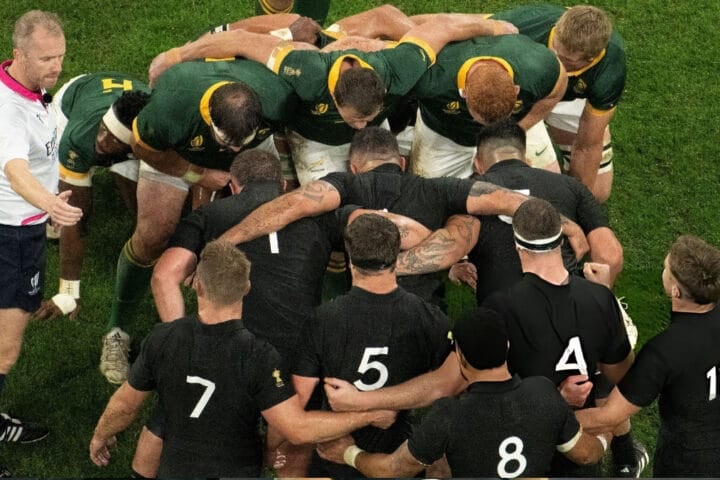
Now look at what a number eight does for a living. He carries off the back of the scrum into a defence that is set and waiting. He hits the ruck low and from the side to seal it. Both are shoulder-first collisions, several times a half.
Faletau knows the second one intimately. Two years ago, in the September after that Ulster game, he described the mechanism to Cardiff’s own website.
“The injury was nuts. One of the boys caught it when I was trying to seal the ruck,” he said. “I heard a movement, which I thought maybe was a dislocation, like it had popped out and in again. I knew it was a bad one and the amount of time I would be out for.”
That was a clean-out. The Durban injury in March, by BBC Sport’s account, came from landing awkwardly after a pass at the end of a strong carry. Two shoulder injuries in two years, from the two things his position exists to do. For Faletau, contact conditioning is the part of the job that keeps breaking.
Wales did not miss his quality last season. They missed him.
Van Zyl’s throwaway line about different years and different injuries deserves the count.
- Broken arm against Georgia at the 2023 World Cup. Tournament over.
- Fractured shoulder against Ulster, 30 minutes into his first game back. Six months out.
- Knee against Edinburgh last October. Released from the Wales autumn squad two days later.
- Calf against the Ospreys on New Year’s Day. Out of the entire Six Nations.
- Shoulder in Durban in March. Season over after seven appearances.
Five injuries in under three years, four different body parts. Thirty appearances for Cardiff in four seasons. His last Test start was the first Test against Japan in Kitakyushu fourteen months ago, and heat-stress cramping took him out of the second.
Faletau’s own reading, when he signed the new deal on Friday 3 July, was this: “The past couple of seasons have had some frustrating injuries but I’ve been pleased with my form when I’ve played.”
Nobody in Wales disputes the form. But “when I’ve played” is carrying that sentence. Aaron Wainwright started nine of Wales’ 12 Tests at number eight in 2025-26, per BBC Sport, and he is the undisputed first choice because Tandy has never once had a fit Faletau to pick ahead of him.
The tell: watch the clean-outs against Exeter, not the carries
If Faletau is named against Exeter on 19 September, ignore the carries. Everyone watches the carries. Watch him arrive at a ruck instead. A player who has done the contact work goes in low and stays in, shoulder through the defender’s hip. A player who has not goes in high and pulls out early, arms wrapping where the shoulder should be driving. That second version is protecting a joint, whether he knows it or not.
And a number eight who cannot seal a ruck in a friendly is not sealing one at Parc y Scarlets a week later. If the low version turns up on 19 September, the World Cup conversation is real. If the high version does, it is a year away at best.
The World Cup case is stronger than it looks
Take the other side properly, because it is a good one.
The calendar helps him. Wales play Japan on Saturday 7 November, New Zealand on the 14th and Australia on the 21st, then a Nations Championship finals game the weekend after. Tandy names that squad once the first block of URC rounds is done. If Faletau has a handful of games behind him by then he is in the conversation on form, because Cardiff’s other options at eight are Alun Lawrence and Taine Basham, and neither is a 109-cap Lion.
The age is not the problem either. Duane Vermeulen was 37 and retired when the Springboks called him back for the last World Cup. Faletau turns 37 the day before the 2027 final.
And when Wales named eight changes and a debutant for the Springboks Test last November, the back row still looked like a unit waiting for someone to run it. Van Zyl’s most honest line on Friday was about exactly that: “You all feel that sense that something special is going to happen when he’s around, either with him or the guy next to him.”
All fair. All of it sits on the same shoulder.
Cardiff can wait. Wales cannot.
Cardiff have every reason for patience. They are in the Champions Cup this season and they have every club in the United Rugby Championship to get through first. Nobody at the club needs him for round one.

Wales need him by November. The pool draw put England in Wales’ way in Sydney on 16 October next year, and the difference between Faletau in that back row and Faletau watching it comes down to whether a 35-year-old shoulder can be taught to take a hit again in three weeks, then take dozens more every game for a year.
On the record: Faletau does not start at Parc y Scarlets on 26 September. He plays his first game off the bench in October and has a run of games behind him when Tandy names his squad. Then the shoulder decides the rest.
Your turn
Two ways to read the next three weeks. Either the running fitness means the hard part is done and Cardiff are managing a fit man into a World Cup year, or the contact work is the hard part and a sixth injury in three years is waiting at the first ruck. One of those is a plan. Pick it below.\



Comments
No one has weighed in yet.
Be the first - what did you make of it?