
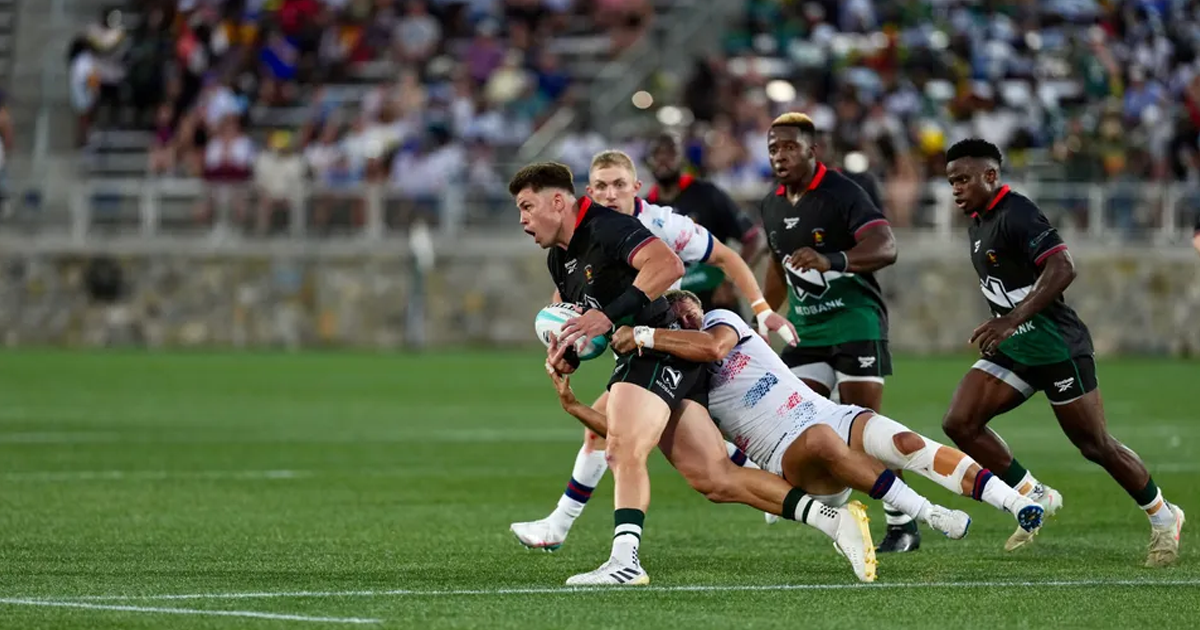
Rugby has written the hip-drop tackle into its foul-play law.
The catch is timing. World Rugby moved on two dangerous tackles on Wednesday 7 October, and they run on different clocks, so one is live before most fans have heard of it.
From 1 November 2026, a hip-drop tackle counts as dangerous play under an amended Law 9.13 and draws at least a penalty, while knee-drop tackles are covered by a law application guideline issued on 5 October that World Rugby says applies from this weekend.
It adds a line to a tackle rulebook former Springboks captain Jean de Villiers already finds baffling, as he argued over the always-illegal tackle framework.
The hip drop gets its own line in the law book
World Rugby’s Executive Board signed off the Law 9.13 amendment. The definition is narrow: a tackler who uses bodyweight to drag the carrier down, then drops onto that player’s legs from behind.
Brett Robinson, the World Rugby chair, said the evidence made the case. Hip drops are rare, he said, but they can do serious damage to a player’s legs.
READ ALSO: The Hanekom tackle Karl Dickson called simultaneous, and why Kirwan objected
The knee drop is already live
No new law was needed here. Making a tackle while on the ground is prohibited already, so the guideline exists to push referees towards the same call every time.
Robinson said knee drops were becoming more common, and that the action starts this weekend. That makes club rugby on 10 and 11 October the first test, three weeks before the hip-drop law arrives.
WalesOnline offers a recent example of the call. Wales flanker Tommy Reffell was sent to the bin in a 2024 Leicester Tigers game, it reports, after the referee ruled him off his feet with his right knee down.
Key facts
- Hip drop: added to dangerous play, Law 9.13; at least a penalty; from Sunday 1 November 2026
- Knee drop: law application guideline, issued 5 October; already illegal under tackle law
- Approved by: World Rugby Executive Board, announced 7 October 2026
- Origin: Shape of the Game meeting, February 2026
The coaches who drew it up
The work began at the Shape of the Game meeting in February, which created an expert tackle height working group. It took on the hip drop, then the knee drop, and commissioned research from Leeds Beckett University.
The same group reviewed the trial of a lower tackle height at the U20 World Championship, which we unpacked in our tackle height law explainer.
Its members cross every market. Felix Jones, a coach with the Springboks, sits alongside Toulon coach Richie Gray, URC match officials figure Tappe Henning, Rugby Australia’s head of rehabilitation and resilience Pat Williams, and scientist Ross Tucker.
Rob Kearney, the former Ireland full-back who represents the International Rugby Players Association on the Executive Board, backed the change. He accepted the adjustment may be awkward but said protecting players from serious injury made it the right call.
The warning from league
Rugby league shows what is at stake. According to WalesOnline, Penrith halfback Nathan Cleary broke and dislocated his ankle last month when Newcastle’s Phoenix Crossland hip-dropped him. Penrith missed the Grand Final, and Cleary misses the Rugby League World Cup.
A separate hip drop, Victor Radley’s on the Dolphins’ Herbie Farnworth, cost the Roosters lock a $3,000 fine, and he still played in their Grand Final win.
The counter-case
Both tackles are rare, so most matches will look no different. The risk sits with officials: every low tackle from behind now invites a TMO check.
What happens next
The hip-drop law starts on 1 November, in time for the November Tests. WalesOnline lists New Zealand, Japan and Australia on the Wales fixtures in that window.
When the first hip drop of the window lands in a Test, will a penalty be enough, or should World Rugby have gone straight to a card?