

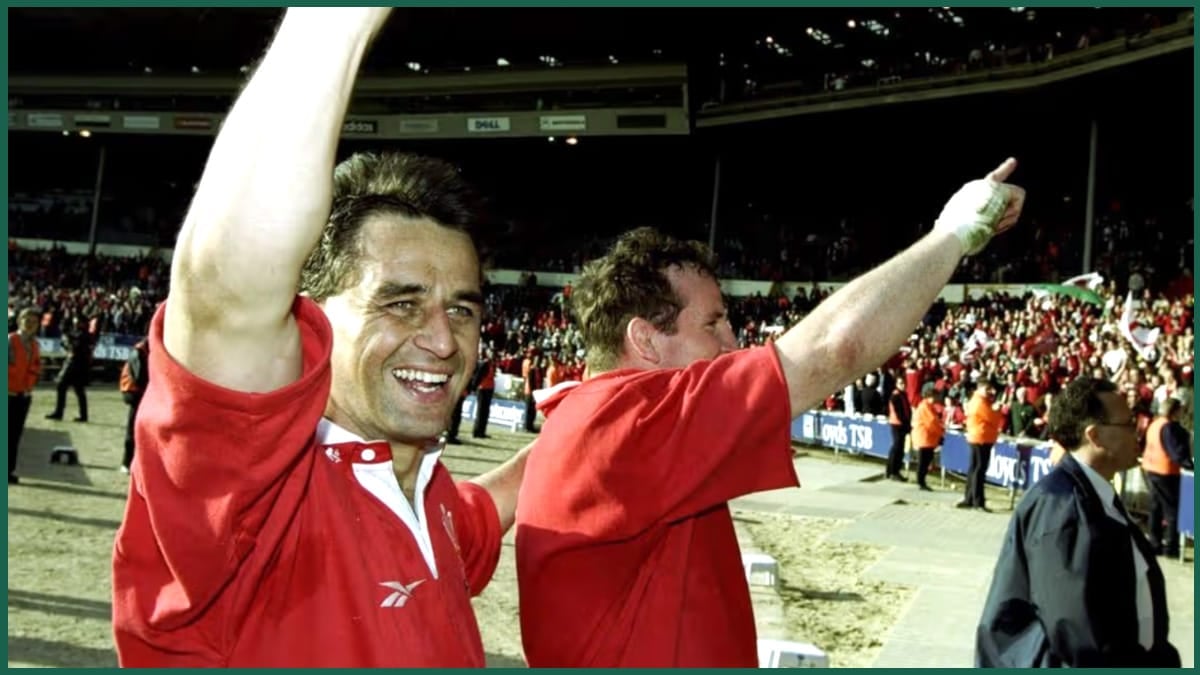
Shane Howarth is the only man Grannygate finished. Two others were caught in the same March 2000 eligibility scandal.
Both played for their countries again. Howarth never did — and the reason had nothing to do with his grandfather.
Howarth, a former All Black who won 19 caps at full-back for Wales between 1998 and 2000, lost his international career when he could not produce a birth certificate proving his grandfather was born in Cardiff. Brett Sinkinson and Dave Hilton could not prove their claims either. Both were back in a Test jersey inside three years.
TL;DR
- Howarth won 19 Wales caps and four for New Zealand. He played no Test rugby after March 2000.
- Sinkinson added six more caps after re-qualifying on residency. Hilton added one.
- Howarth stayed at Newport until 2003 and served the residency anyway. A rule change in 2001 made it worthless.
The Sunday paper that emptied two dressing rooms
A Sunday Telegraph investigation ran the numbers on three grandfathers in March 2000 and found every claim unprovable. Sinkinson’s grandfather turned out to have been born in Oldham. Hilton’s, supposedly an Edinburgh man, came from Bristol.
Howarth’s line traced back to a Thomas Williams he could not document. None of the three had ever been asked for paperwork. That was the whole problem.
The IRB’s judicial panel severely reprimanded the Welsh and Scottish unions and fined neither. Three further Wales players were investigated and exonerated, and Colin Charvis was cleared because his residency was already complete. Two internationals were left in the wreckage of a Six Nations campaign with no country.
Two of them got a second chance. Howarth got a rule change.
The route back was residency. Under IRB regulations of the day, three unbroken years in a country qualified you for it, ancestry or no ancestry.
Sinkinson took it. He stayed at Neath through the abuse, re-qualified and was recalled in 2001.
“I never set out to deceive anyone,” he said when the story broke, in comments carried by WalesOnline. He finished on 20 Wales caps.
Hilton took it too, cleared to play for Scotland again in 2002. One more cap. Forty-two in total.
Howarth won nothing.
| Player | Country | Caps when exposed | Caps after | Career total |
|---|---|---|---|---|
| Shane Howarth | Wales | 19 | 0 | 19 (plus 4 for New Zealand) |
| Brett Sinkinson | Wales | 14 | 6 | 20 |
| Dave Hilton | Scotland | 41 | 1 | 42 |
The four Tests in 1994 that locked the door
Howarth had already played for somebody else. Four Tests for New Zealand in 1994 — three against South Africa, one Bledisloe fixture against Australia.
Graham Henry talked him into a Wales shirt four years after that, at a point when the regulations still tolerated a player representing two nations.
Then the IRB closed it. The governing body barred dual representation in 2001 and reclassified Howarth as a New Zealand player, full stop. Residency could not undo four caps.
Sinkinson and Hilton had never been capped by anyone else, so nothing stood between either of them and a second qualification. Same scandal, same missing birth certificate. One of the three happened to have a Test career behind him, and that is the entire difference.
I guess because I was an All Black — I kind of got singled out.
Shane Howarth, speaking to WalesOnline
He served the residency anyway
The cruellest detail is that he stayed.
Howarth signed for Newport in 1999 and did not leave until 2003: 108 appearances, 1,035 points. Four years in Wales, one more than the regulations demanded of Sinkinson.
By the time his clock ran out, the rule that would have let him use it no longer existed.
What Shane Howarth says actually hurt
Ask him about the caps and he does not lead with the caps.
“But, in my heart, I truly believed, and I still believe now, that I had Welsh blood running through my veins,” he told WalesOnline. Then the part he keeps returning to: “The most disheartening thing for me, out of it all, was I let my mum and my grandmother down.”
The investigation went through his mother’s family to reach him. He drove up to see his nan and apologise.
There is a counter-case here, and it is worth stating plainly. Neither player forged a document. Neither was asked to produce one.
A national union selected two men on the strength of a verbal claim about a dead relative, played them 33 times between them, then watched those players absorb the reputational damage while the unions took a reprimand and no fine.
Could Grannygate happen in 2026?
Not like this. World Rugby’s Regulation 8 demands documentary proof now, and the residency route was stretched from three years to five with effect from 31 December 2020 — a change aimed squarely at protecting Pacific Island playing stocks. An August 2024 amendment softened the mechanics, dropping the requirement that those 60 months run unbroken up to a player’s first cap.
The capture rule loosened too. Since January 2022 a player may make one switch after a 36-month stand-down, provided they were born in the new country or have a parent or grandparent who was.
Run Howarth through that system today and the answer does not move. New Zealand would take him back. He still could not play for Wales, because the Cardiff grandfather he believed in has never appeared on a single piece of paper.
FAQ
What was Grannygate?
An eligibility scandal exposed in March 2000, when the Wales pair Shane Howarth and Brett Sinkinson, plus Scotland prop Dave Hilton, were found to have been selected on unprovable claims about a grandparent’s birthplace. All three were ruled ineligible. Their unions were reprimanded by the IRB but not fined.
How many caps did Shane Howarth win?
Twenty-three Test caps in total: four for New Zealand in 1994 and 19 for Wales between 1998 and 2000. His final international appearance came during the 2000 Six Nations, before the eligibility investigation removed him from the squad. He never played Test rugby again.
Why couldn’t Howarth re-qualify on residency like Sinkinson?
Because he had already been capped by New Zealand. When the IRB outlawed dual representation in 2001, Howarth was classified as a New Zealand player only. Sinkinson and Hilton had never represented another Test nation, which left the residency route open to both of them.
What does Shane Howarth do now?
He runs a supermarket in Auckland, having returned to New Zealand after his playing career and coached along the way — Auckland under Pat Lam, the Pacific Islanders, Wasps and Worcester. Sinkinson also went home, and owns Bay Landscapers, a landscaping business in Papamoa in the Bay of Plenty.
Read next
- Fifteen players who could legally switch nations before 2027 — the paperwork is already moving on several of them
- The 2027 World Cup pools in full — and the group Wales will be dreading
- Eben Etzebeth’s 12-match ban for an eye-contact incident — another Test career interrupted by a panel, not a referee
Sinkinson stuck it out at Neath, took the abuse and won six more caps. Howarth went home. Given the same three years and the same closed door, which of them made the right call?

Comments
No one has weighed in yet.
Be the first - what did you make of it?