


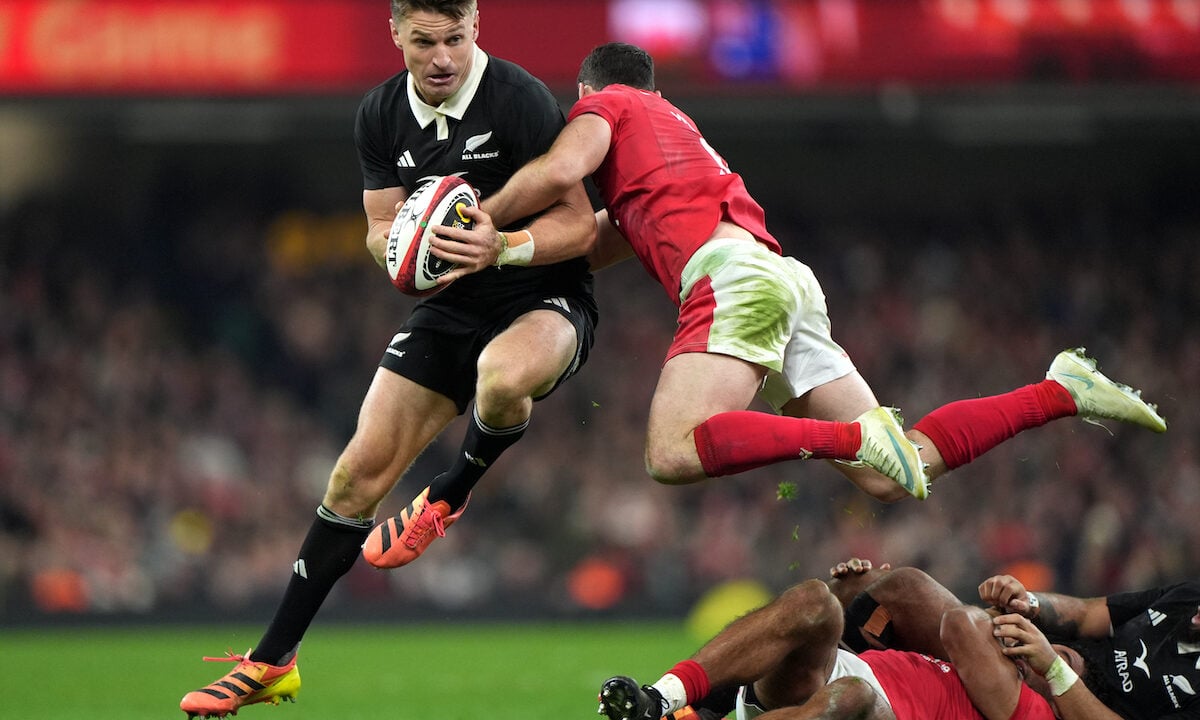
Dan Biggar says Wales’ goal-line stand against the All Blacks was coached, and he gives the credit to Dan Lydiate. New Zealand were held up over the line three times in Cardiff.
Each time, Biggar says, a Welsh defender did the same thing: “Use the momentum of the attacker to get your body in between the ball and the attacker.”
He calls it turtling. The defender lets the carrier come, rolls him over the try line onto his back and keeps the ball off the ground. “So, you’re not looking to win the collision.”
Coaching or pure courage: what kept the All Blacks out? Tell us in the comments.
Why would a defender pull an attacker over his own line?
The former Wales fly-half broke down the game on Biggar Thinking, his YouTube channel. Wales beat New Zealand 35-28 at the Principality Stadium on Saturday 14 November, their first win over the All Blacks since 1953.
It comes down to the laws. If an attacker carries the ball into in-goal and is held up, the defending side restarts with a drop-out from its own try line. World Rugby made that permanent in 2022. Before that, the attackers got a five-metre scrum and another go.
Biggar said: “you can’t get a scrum five and it has to be a goal line dropout.”
So the defender does not need to stop the carrier short. He only needs to keep the ball off the ground. “You want to almost use the momentum of the attackers to drag them over the line and kind of turtle them,” Biggar said.
Which Wales players held up the All Blacks?
Blindside James Botham did it first. Biggar told viewers to “look at where his body is”. Botham made 30 tackles, was ITV’s man of the match and put the defence down to trust.
Dan Edwards, the replacement fly-half who came on for Sam Costelow, did it to Leicester Fainga’anuku. “Gets his body in between the ball and his arms on the ball so he can’t turn and get it down,” Biggar said.

The third, on No 8 Wallace Sititi, was his favourite. “And probably the best example of the lot is Gareth Thomas here,” he said. Sititi “clearly wins the collision”, but the replacement prop turtles him over the line and gets his body between the ball and the try line. Thomas made 19 tackles in his 26 minutes.
Why does Dan Biggar give Dan Lydiate the credit?
Lydiate won 72 Wales caps as a blindside, was the 2012 Six Nations Player of the Championship and played in all three Lions Tests in Australia in 2013. He joined Steve Tandy’s staff on an interim basis in October 2025 and was later made a full-time specialist coach.
The WRU gave him “responsibility for defensive contact skills”: the tackle, the assistant tackle and what happens after contact. Pete Murchie is Wales’ defence coach.
Biggar said Lydiate “deserves huge credit” for that close-quarters work.
“I just thought it was, yes, courageous, yes, brave, but also took a huge amount of technical work,” he said.
Biggar has already covered the Wales attack and why he feared the dam would burst.
Do Wales’ defensive numbers really look like typos?
“These stats genuinely look like typos,” Biggar said. He gave Wales 348 tackles, 202 of them in their own 22, and called both Test records.
The official post-match report has Wales on 346 tackles to New Zealand’s 136. RugbyPass reported 346 as the highest total by a top-tier men’s Test side. Every Welsh number from that report is here.
Lock Dafydd Jenkins made 38 tackles. Biggar believes that draws him level with Thierry Dusautoir, whose 38 for France knocked the All Blacks out of the 2007 World Cup, also in Cardiff. RugbyPass has Jenkins level with that record.
Wales host Australia at the Principality Stadium on Saturday 21 November, kick-off 8.10pm GMT. The Wallabies will have seen the same three clips.
READ MORE: Wales v New Zealand: did Wales win it or the All Blacks lose it?

Video: Dan Biggar, Biggar Thinking, “How Wales BEAT the All Blacks”. The goal-line section starts at 7:45.







Comments
No one has weighed in yet.
Be the first - what did you make of it?