
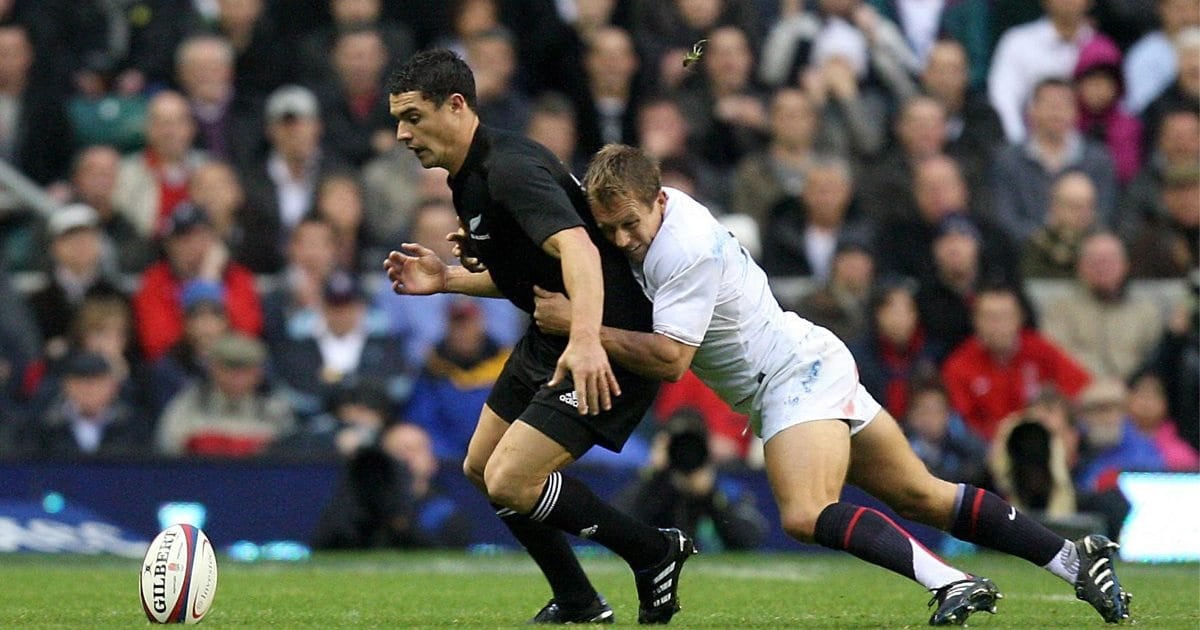
Dan Carter on Wilkinson is the part of this interview nobody expected. In 2003 he watched the England fly-half and decided to copy him on purpose. Eighteen years later, adrift six months into retirement, Carter rang him.
One hundred and twelve Tests. More points than anyone has scored for any country. Two World Cups, three World Player of the Year awards.
Here is the audit Dan Carter did when it stopped.
“I was always like, I can kick and pass really well, but how the hell is that going to help me in the next chapter of my life?”
Two skills. He was not being modest, he was being literal, and he still sounds faintly stunned by it.
To understand why that landed as hard as it did, go back to a 21-year-old who had played exactly one Test match, walked off, and instead of enjoying it did sums.
“That’s exactly what happened for me after that first test match where my dream became a reality. I walked off the field and I was like, man, this isn’t enough.”
Carter said it on Wednesday, talking to Steven Kitshoff on For The Love Of Rugby: South Africa, which Kitshoff has been fronting in Trevor Nyakane’s absence.
It is the same Carter who will happily pick over his own worst afternoons, including the missed touchline conversion at Soweto that he still puts in his five best memories against the Springboks.
So which is it — did Carter admire Jonny Wilkinson, or was he just picking the man to beat? The comments are open.
The list he made after one cap
Being an All Black was not the target. Being a great one was. So he made a list, and the first item on it was competitive, and slightly cold.
“One was work ethic. I need to work harder than all my opponents that I’m going to be coming up against. Also got to work harder than a lot of my teammates. You know, the guys are going to be fighting me for my position.”
Opponents first. Teammates second. A man who has been an international for eighty minutes, already counting the players who want his shirt.
That is the sentence Jonny Wilkinson walks into.
Dan Carter on Wilkinson: the man he picked to out-work
“At that time in 2003, I saw Jonny Wilkinson dominating world rugby and I’d learned from him and respected him so much and saw how hard he worked, and I wanted to take those habits into my career.”
Read it in sequence and it stops being a tribute. Carter has just said he needs to out-work every opponent he will face. Then he names the best fly-half in the world in 2003 and studies how hard that man works.
Wilkinson is not the hero of the story at this point. He is the benchmark.
The second item on the list
“Another one I knew was I needed to grow and evolve. So I knew that I needed to be better today than I was yesterday. So having a growth mindset and wanting to not only put in the work, but just look at the game differently. How can I be better each and every day?”
Fine as a sentiment. Useless without the third item, which is where it gets specific enough to steal.
Then he built the timetable
“So once I had that, I then needed the structure. So what do my weeks look like? What do my days look like? What is the extra work that I’m going to be doing? Because as a rugby player, you’d get right, we’re having a meeting at 9:00, we’re training from 10:30 to 12. We’re going to train in the gym again at 3:00. What am I doing in between those sessions to be an even better rugby player? So all of a sudden I was planning how many kicks I’m having, what yoga session was I doing, how much time am I spending with the physio, what food am I going to be eating, all those little things.”
The gaps. That was the whole method. Everybody does the 9am meeting and the 10:30 session and the 3pm gym, because everybody is told to. Carter went after the hours nobody was watching.
It worked, obviously. Gilbert Enoka named him and Richie McCaw as two of the three players who defined the era.
Five years after finishing, he is still building the perfect modern Test fly-half on air, better than almost anyone doing it.
But a timetable is a structure for a life, not just for a week. And a timetable stops.
Eighteen years later the phone went the other way
Carter finished in 2021. Then nothing much happened for half a year.
“I kind of moped around for about six months when I finished playing… I was like, actually, I need some help. I need to talk to people.”
The help he went looking for was not professional. It was a phone list. And on it was the man he had spent a career trying to out-work.
“Got on the phone to Jonny Wilkinson, and he achieved everything in the game. And he openly talked about the challenges that he went transitioning out of the game. Got on the phone to good mate Richie McCaw, one of the best players to ever play the game, and he openly talked about the challenges that he had.”
Sit with the shape of that for a second.
In 2003 a 21-year-old in Christchurch looked at Jonny Wilkinson and saw a man who had solved rugby. In 2021 he rang that same man to ask how to stop being a rugby player, and Wilkinson told him he had found it hard too.
The benchmark had the same problem as the man chasing it. Carter just did not know it for eighteen years.
What was left when the timetable stopped
“I had a bit of a loss of identity after rugby. I was like, jeez, who am I as Dan Carter the person, now that I don’t have rugby in my life? Dan Carter the rugby player, that’s all I was really known for.”
That is not self-pity. For twenty years Carter was a fixed point inside a system that told him where to be, what to eat, who to see and what he was for. He had built that system himself, out of Wilkinson’s habits and his own list.
And here is what the system had really been for. Not points. Nerves.
“When you work as hard as that and prepare as well as you possibly can, that’s when you can deal with the pressure. Because if you’re unorganized and you’re just relying solely on talent, you got all this external pressure of representing your country and the history of the Springboks and the All Blacks, then that pressure becomes too much. You start getting this nervous energy and it’s the wrong nerves. But if you get the nervous energy of performing at the highest level, but you’ve done the work, the preparation being the key, then they’re good nerves.”
Good nerves and wrong nerves. Same feeling in the chest, sorted by whether the week behind it was any good.
Which explains the six months. Retirement handed him every symptom of the bad kind and took away the only machine he had ever built for converting them.
The phone calls turned into an organisation
Those conversations did not stay private.
“We set up a global rugby players foundation a couple of years ago where we have 10 players or former players that run that foundation… We’re working with the players associations around the world to make sure that there is a support network for players, because there is a loss of connection, a loss of identity, physical and mental struggles that players go through.”
The number is exactly right. The Global Rugby Players Foundation launched in 2024 with ten founding players.
It is chaired by former Wallabies captain George Gregan, and runs alongside World Rugby and International Rugby Players.
Carter is one of the ten. So is Wilkinson. So is McCaw. The man he picked out in 2003 to measure himself against is now a co-founder of the organisation those phone calls became.
Read also: Conrad Smith is one of the ten as well, and he is still worth listening to on the rugby itself. He reckons the Springboks were the easiest side he ever had to prepare for.
Ten of the most decorated former players in the sport had to found a body to do this job. Every professional club on earth has dieticians, video analysts and full-time conditioning staff. Nobody had ever staffed the exit.
Which is a good thing and an indictment in the same breath. The players who stand to gain most never played 112 Tests. They never had a phone list with Wilkinson and McCaw on it. Nobody ever invited them onto a podcast to ask how they were doing.
Frequently asked
What did Dan Carter say about Jonny Wilkinson?
That in 2003 he saw Wilkinson dominating world rugby, respected how hard he worked and deliberately took his habits into his own career. He also named Wilkinson as one of the former players he phoned after retiring, to ask how they had handled leaving the game.
When did Dan Carter retire?
Carter finished playing in 2021, after 112 Test caps, 1,598 Test points and World Cup wins in 2011 and 2015. He says the six months that followed were spent moping before he asked for help.
What is the Global Rugby Players Foundation?
A body launched in 2024 by ten current and former internationals, chaired by George Gregan, working with World Rugby and International Rugby Players to support players leaving the professional game. Carter, Wilkinson, McCaw, Siya Kolisi and Conrad Smith are among the founders.
Your turn
Every club has one. The bloke who was the best player in the side at 28, stopped at 33, and has not been seen at the ground since. Rugby now has a foundation with ten famous names on it and a proper budget behind it.
Who is the one from your club that nobody ever rang?