

Dan Carter’s perfect No 10, measured against Ruben Love
Dan Carter spent an hour this week building the perfect No 10 out of six separate pieces: the pass, the tackle, the kicking game, the goal kicking, the composure, and the one nobody can be handed. Ruben Love is a live test of every one of them.
There is one thing Dan Carter used to do under pressure that nobody watching him kick from halfway would ever have guessed.
“That’s the state that I used to go into when I was under pressure. I’d freeze. I’d go quiet. Everyone’s looking at me. What’s the call? And I’m like, man, I’m still thinking about some mistakes that I made.”
That is 112 Tests and 1,598 points describing himself as the man who disappeared when the game got heavy. Fourteen players waiting on a call, and the best fly-half the sport has produced standing there replaying an error from two minutes earlier.
Carter was speaking on the For The Love Of Rugby: South Africa podcast, published on Tuesday 25 August, where a former Springboks-era front-rower asked him to build the perfect No 10 from scratch. What came back was not a personality sketch. It was a list of six separate, trainable skills, and the last one on it is the one Ruben Love cannot get hold of before Saturday.
“They’re yelling at the referee and they’re no value to the team”
Dan Carter split the fly-half under pressure into three states, which is the language of every sports psychologist who has ever walked into a changing room, except he had lived in all of them.
Fight is the hot-headed 10, arguing with the officials, looking to put shots in. Carter was blunt about what that player is worth: nothing. Flight is quieter and more common than anyone admits, the 10 who decides his hamstring is a bit tight and that the replacement should probably come on. Freeze was his own.
Every fly-half visits one of them in every match. The skill is not avoiding the state. It is noticing you are in it.
And what he does next is the part that runs against how most people imagine elite decision-making works.
“Sometimes if you just commit to something and get buy-in by everyone, whether it’s a right decision or not, it will turn into the right decision, because everyone believes and backs you and you go through with it 100%.”
A wrong call delivered with total conviction, executed by fifteen convinced players, beats a correct one nobody believes in. Test rugby rewards certainty more than it rewards accuracy, which is an uncomfortable thing to hear from the most accurate player of his generation.
Love spent the first 45 minutes at Ellis Park in exactly that environment. His pack was going backwards, South Africa were camped in New Zealand’s half, and the entire job of a first five in that half is to get the ball off the deck, get it long, and not be the man who forces it. He didn’t force it. He also went four from four off the tee in that wind, which is how a fly-half holds a Test together at altitude without ever appearing in the highlights package.
The pass that is ten centimetres wrong
Carter’s first technical requirement sounds basic until he explains what it costs when it goes.
Both hands. Short ball and long skip pass. Fine. The harder half is that the 10 has to look like a threat while he does it, because a fly-half who catches the ball, drifts sideways and then passes has already eaten the space his outside backs were going to use.
“That ability to look like a threat, catch early and distribute while you’re keeping your body shape square is a huge skill that a number 10 has.”
Then the number that gives the section its teeth. Carter described an All Blacks group so hard on each other that a pass arriving at a back shoulder, or a fraction too far in front, was treated as ruining the play outright.
“A poor pass that is just off by 10 centimetres.”
Ten centimetres. That is the margin between manipulating a defence and handing it back its shape.
He also took apart the drill every schoolboy in the world has done, the one where you catch, plant off the inside foot and pass. In a match, he said, the defence decides when the ball leaves your hands, not you. Sometimes it goes over the front foot. Sometimes off the inside foot. Sometimes you are static and under a rushing 12 and you just have to get rid of it cleanly.
And who receives it changes what a good pass even is. A back gets it in front, to run onto. A forward gets it in the chest.
“They’re basically catching at the same time as impact. So they can’t be lunging forward and reaching for that ball. You need to be hitting them in the chest, right where they’re targeted, so they can boom, tuck it and carry.”
Something to watch for on Saturday: ignore the ball and watch the 10’s feet at the moment of release. If Love has to plant and set every single time, the Springboks rush is dictating to him. If the ball leaves off whichever foot happens to be down, he is dictating to them.
Read also: the New Zealand scrum was not out-muscled at Ellis Park, it was rushing — which is the platform every one of these skills depends on.
Dan Carter: You cannot hide a 10 any more
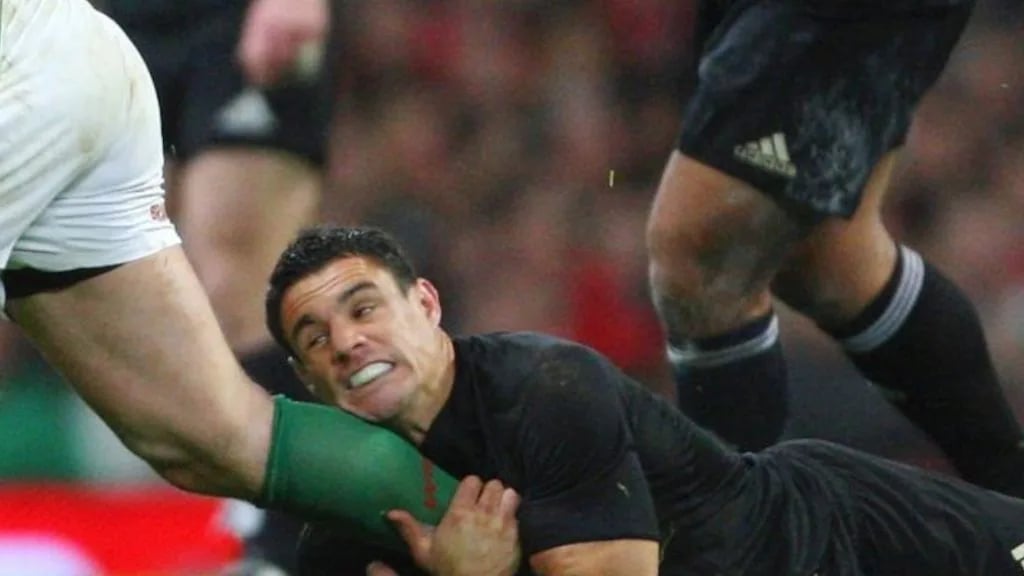
There was a time when a defensive system was built around keeping the fly-half out of contact. Carter remembers it, because he benefited from it.
“Richie McCaw, when he first started playing, used to just sprint off the scrum to try and protect the number 10. It was all about protecting the number 10.”
That is finished, and Carter explained why in one line: almost every attacking plan in the modern game targets the transition between backs and forwards, and that seam is precisely where the 10 is standing. So the traffic comes to him. Locks, midfielders, loose forwards, all of it down his channel.
His example was a Springbok. Read Also: I was trying to tackle this 120kg number eight that could run 100m in 11 seconds.”
Kicking is chess and the margin is two metres
Ask most fans what a good kicking game is and they will describe distance. Dan Carter described a conversation.
The 10 sees a winger who loves to rush up. So he puts a cross-kick in behind him. Now that winger has to think, and he talks to his full-back, and the full-back agrees to cover the space. Which is the exact moment the 10 stops cross-kicking and starts dropping the ball just in behind the defensive line, where the full-back no longer is.
“You’re constantly trying to outsmart and outthink the defensive systems through the variation of your kicking game.”
The margin on it is brutal. Two metres too long and a sweeping nine picks it up with a full field to counter into. A grubber that fails to get through hits a midfielder’s shins and the whole thing inverts, and now the 10 is the one defending. Carter named Andrew Mehrtens as the best he ever watched at it, which matters because he spent his first two professional seasons at 12 outside Mehrtens, following him around asking questions until the older man got sick of him. His other tutor that season was Carlos Spencer. Two players with almost nothing in common stylistically, which is how Carter ended up with the range he had.
A second thing to watch: when Love kicks, do not follow the ball. Watch the Springboks winger on that side. If he has already turned before the ball is struck, the kick was read. If he checks his feet for half a stride, it worked.
The part that takes ten years
Here is where Carter’s list stops being a list of skills and becomes a problem of time.
Game management was, by his own account, the last thing to arrive in his own game and the biggest area of growth by the end of his career. Early on he was instinct, pace and decisiveness. Then teams analysed him properly, and instinct stopped being enough.
But the detail that reframes the whole thing is what he said game management actually is, because it is not the 10 reading the game at all.
“I’m not doing a cross-kick because I think the cross-kick is the best option. I’m doing the cross-kick because the wingers have relayed that information where the space is to our midfielders, and the midfielders have relayed that to me. I’m just like a computer. I’m just digesting it all, processing it all.”
A fly-half cannot see the field. He is standing in the worst seat in the stadium, flat, in traffic, with his back three seventy metres behind him holding all the information he needs. Game management is a listening skill wearing a decision-making costume.
Which means it is not built in a player. It is built between players.
Carter had Ma’a Nonu and Conrad Smith outside him for dozens of Tests and Aaron Smith inside him, and described the work as coffees and small meetings where somebody says what if their nine does this and the answer gets agreed weeks before it happens on a field. The same conversations Carter says are happening around Love right now, with Beauden Barrett and Richie Mo’unga in the squad rather than in the 23.
That is the reason Carter would not hand out the title of best 10 in the world this week, and why he would not call Sacha Feinberg-Mngomezulu world class yet despite rating him a rare talent. Two or three good seasons is not the unit of measurement. Longevity is.
Love has four Tests with this group. Four.
Dan Carter’s perfect No 10, measured against Ruben Love
| Carter’s requirement | Love after four Tests under Rennie |
|---|---|
| Pass off both feet, square, fixing defenders | Yes. The Super Rugby final was 25 points and a Hurricanes title built on exactly this |
| Tackle without hiding | Unproven at Test level. Carter’s whole point is that Cape Town is where a 10 finds out |
| Kicking game as manipulation, not distance | Close. His exits were clean at altitude, the chess element is still ahead of him |
| Goal kicking under pressure | Yes. Four from four at Ellis Park, including a sideline conversion in that wind |
| Composure and decisive communication | Yes, with the caveat that he has not yet been behind on a scoreboard in this jersey with 10 minutes left |
| Game management | No. And no amount of talent shortens it |
Assessment: WeTalkRugby, on Love’s four Tests under Dave Rennie and the 2026 Super Rugby final.
Three of the six he can already be trusted with. One is close. One gets answered on Saturday. And the sixth is the only item on the list that cannot be coached in a fortnight. That is not a criticism of Love. It is a description of what a 25-year-old with five caps before July looks like, measured against a standard set by a man who needed a decade to reach it himself.
It also happens to be an argument for keeping him in the jersey rather than for taking him out of it. Game management is accumulated, and it is accumulated in Tests, and there are three of them left in this series.
Read next: the case for Love keeping the 10 shirt in Cape Town, and why Mo’unga’s return does not change it.
On the record, then: Love starts at 10 in Cape Town on Saturday, in Johannesburg on 5 September, and Mo’unga does not get that jersey before Baltimore on 12 September. Screenshot it. Every fixture and kick-off time in Rugby’s Greatest Rivalry is here, and if Rennie names someone else this week, the comments are open.
Carter was speaking on the For The Love Of Rugby: South Africa podcast, published Tuesday 25 August 2026.