

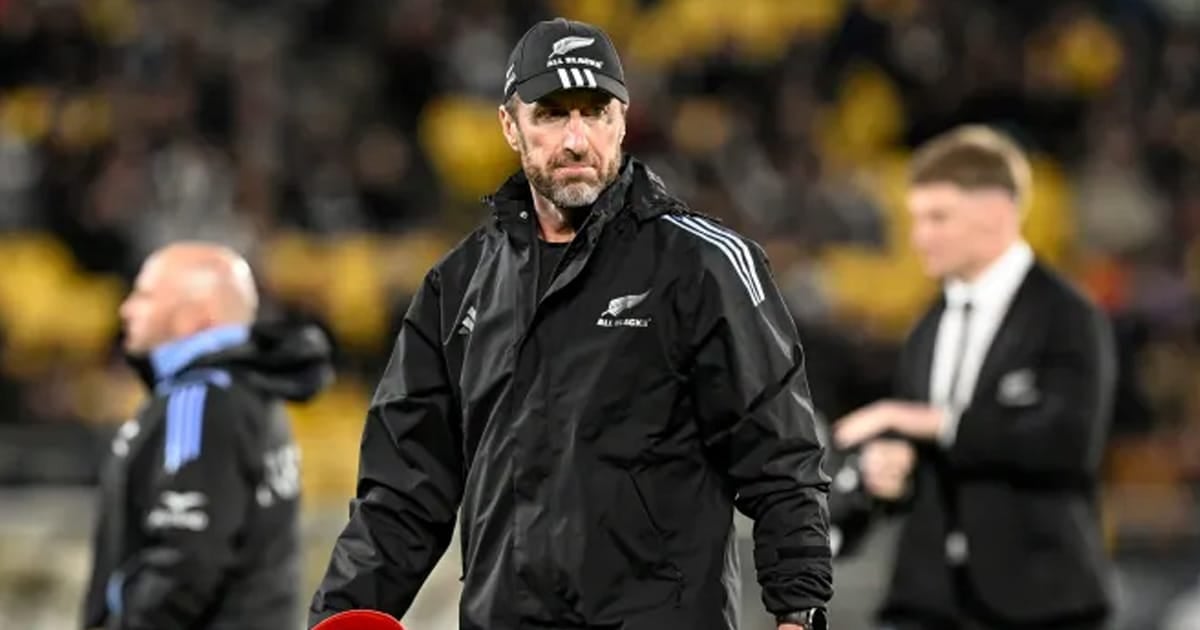
Nic Gill spent 18 years making All Blacks fitter. He won two World Cups doing it. Six months into an NFL job, he has counted the hours both sports actually work.
“They actually put rugby players to shame in terms of how hard they work.”
The head of performance New Zealand Rugby just lost, on New Zealand Rugby’s own podcast. Three days before the All Blacks play the fourth Test at the Ravens’ own stadium.
Gill is not a tourist in this argument. He took over All Blacks strength and conditioning in 2008 and stayed eighteen years, across two World Cup wins.
In March the Ravens built him a job that had never existed: vice president of health and performance. He said this to Brad Weber on Inside The Black Jersey, and then killed the obvious reading of it in his next breath.
“I don’t mean physically how hard they work, but … our normal day, we’ll do four days in a row. So Wednesday, Thursday, Friday, Saturday.”
So not effort. Not the gym, not the contact, not the conditioning he spent two decades measuring.
Something narrower, and worse.
So is he right that rugby has a ceiling nobody has ever tried to lift? Or has he confused two sports that need completely different things?
What Nic Gill actually counted
Ninety minutes in a meeting room before anyone has moved. Thirty to fifty minutes walking it through indoors. An hour to get ready. Two hours on the field. Another ninety minutes afterwards, pulling apart what just happened.
One working day at the Baltimore Ravens. They do four of them in a row.
“Every day there’s an hour and a half meeting in the morning. Then there’s a walk through. So an indoor practice for 30 to 50 minutes. Then there’s an hour to get ready for practice. Then it’s a two-hour practice on the field. And then it’s another one and a half hour meeting at the end of it.”
Roughly six and a half hours of organised work. Three of them sitting down.
And then again on Thursday. And Friday. And Saturday.
No Test squad works a day like that. And that is Gill’s normal week, not his hard one.
An hour of meeting, and rugby calls that long
“So then that’s every day … compared to a rugby team that’s probably meeting for an hour tops. Back in the day when you were there we’d be like, you meet for an hour and that’s too long. You know, it’s too long.”
“When you were there” is aimed at Weber, who played under Gill.
So this is not an outsider guessing at a culture. It is the man who ran it, putting sixty minutes at the point where a rugby room stops taking anything in.
Two hundred plays, and the loop that runs every day
The reason the Ravens can hold players in a room that long is that they have something to put in it.
“There’s like 200 odd plays, right, that you have to know … there’s a whole lot of study, a whole lot of preview, review every single day. So preview before practice, then walk through it, then do it at speed and intensity, and then review it, and then you rinse and repeat. So it’s actually pretty full on.”
Preview, walk through, full speed, review. Every day.
Rugby has the pieces. An analysis meeting, a captain’s run the day before a Test, a video session on Sunday that half the squad watches on a phone.
What it does not have is that loop closing on the same detail before the players leave the building.
Take a lineout. A Test side carries a stack of calls into Saturday. How many get previewed, walked, run at full speed and reviewed inside one day?
For most international teams, once. On a Thursday. And the review happens on a laptop in a hotel after the match.

A former All Black agreed with him on air
The claim was already being compressed before the episode finished.

Within two minutes of the interview ending, the studio had recapped it as Gill thinking the Ravens work harder than any All Blacks team he was part of. Which is exactly what he had ruled out. Weber corrected it.
“I guess he wasn’t saying that rugby players don’t work hard. And I think he kind of made a point of that, but he was just saying that like the time in classroom — like an hour and a half every morning.”
And then Weber went further than Gill had.
“He actually made a little bit of a gag that rugby players would complain at anything over an hour, which is so true. We sort of start losing concentration, right?”
That is a former All Black, on New Zealand Rugby’s own platform, agreeing that his sport’s players cannot sit still for ninety minutes. It went unchallenged.
The defence rugby has, and where it runs out
An NFL team plays seventeen regular-season games and knows the date of all of them before pre-season starts.
New Zealand are into a fourth Test on a fourth straight Saturday, across two hemispheres, squad cut to 36, with Ardie Savea, Quinn Tupaea and Luke Jacobson already ruled out.
There is no Wednesday-to-Saturday classroom block when Saturday is a Test and Tuesday was a flight.
Rugby is unscripted, too. Two hundred memorised plays reward classroom hours in a way a game of continuous decisions does not.
All of that is true. None of it touches what Gill said.
His complaint was never the schedule. It was the hour.
A squad that treats sixty minutes as the limit of its attention has capped the detail it can carry. That cap does not lift because it is a World Cup year.
Nobody measured their way to sixty minutes. It is just how long players will sit there.
Which is why the timing bites.
Gill is saying it from inside the organisation whose stadium hosts Saturday’s Test. About a team that has just lost a series lead. In a week where Weber has already been asked how New Zealand closes a 958-to-606 gap in caps against the world champions.
Experience is one way of describing what South Africa have. Detail is another.
Frequently asked
Who is Nic Gill?
Dr Nic Gill led All Blacks strength and conditioning from 2008 until 2026, through two Rugby World Cup wins. The Baltimore Ravens made him vice president of health and performance in March 2026.
Did Nic Gill say rugby players are lazy?
No, and he ruled it out in his next breath. His words were “I don’t mean physically how hard they work.”
His comparison was about meeting time and daily repetition of detail. Not conditioning, and not effort.
How long is an NFL training day compared with a rugby one?
By Gill’s account of a Ravens week, roughly six and a half hours of organised work a day, four days running.
That includes three hours of meetings either side of a two-hour field session. He puts a rugby team at about an hour of meeting, and says even that is treated internally as too long.
Your turn
Two ways to read what Gill has done here.
Either he has come back from one American pre-season with the most useful thing anyone has told New Zealand Rugby this year. That its ceiling is an attention span, not a fitness level.
Or he has confused two sports with different demands, because 200 memorised plays need a classroom and a game of continuous decisions needs a field.
Which one is it? Settle it below.




1 comment
An NFL match is 60 minutes but the ball is moving 11min on average, deciding the outcome of the game. This makes the play results of each individual down worth so much more than a phase of rugby. The NFL gets paid for it too as there are 16 mandatory advertising breaks per game at a minimum. With so little action, American football has been designed for tv, to make money, and can inso demand the long work hours because the players and staff are all getting paid. There is no doubt in my mind that if the pro rugby player paycheck tripled, the demand to put in more training hours would also be met, to include longer off field meetings.