


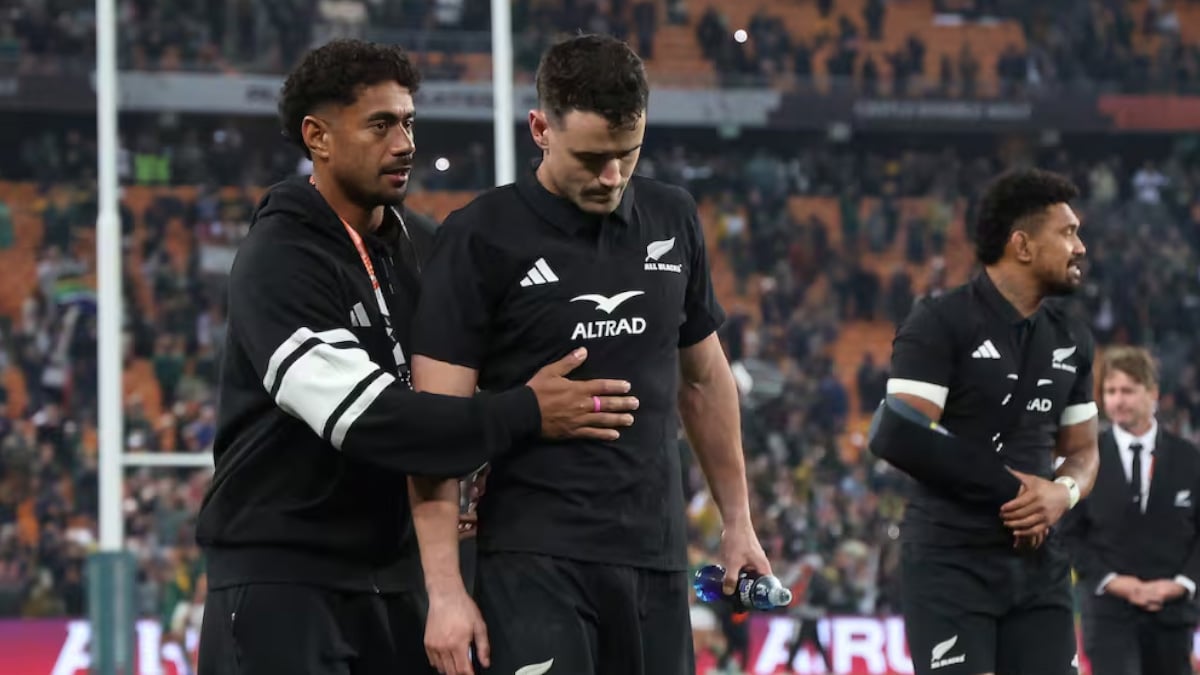
The two coaches who picked the same All Blacks pack for Baltimore on Rugby Unity also agreed on what was missing at FNB Stadium. Almost none of it was the attack.
Thirteen tries in three Tests is not what a side that is missing something usually scores.
Ewen McKenzie, 51 Tests at tighthead prop for the Wallabies and their head coach in 2013 and 2014, said as much about the third Test of Rugby’s Greatest Rivalry. “I saw some of the best, most skilful attacking rugby by New Zealand. There’s a couple of patches there that was just sublime.” Then the rest of the sentence. “The skill execution was brilliant, but not good enough to win the game, unfortunately.”
Steve Hansen, All Blacks head coach from 2012 to 2019 and a World Cup winner in 2015, sat beside him on Rugby Unity on Monday and went through what was not there. Between them the All Blacks weaknesses came to six. Five are things Dave Rennie can change before Saturday. The sixth is the one Hansen says takes years, and it is at the bottom.
If you think the answer is the scrum and nothing else, the comments are at the bottom too. Read the sixth first.
First, what was not missing
McKenzie’s list of what New Zealand did well was longer than his list of what they did not. It goes first.
The lineout plan: “I could clearly see that New Zealand had done a lot of work on their lineout, the strategy, particularly in the first half. The options they used, some subtle stuff, the shorter lineouts, worked quite well.” The restarts: “They kicked down the middle. South Africa never got their shape from the kick-off reception. Even if they caught the ball, it was disjointed.” The scrum-half: “Roigard did a good job. He’s a very key player. When he went off, the other guy came on and he was serviceable, but I never felt like he was going to break the game.” Bryn Hall would lose Jordie Barrett before he lost Cam Roigard, and McKenzie has just explained why.
None of it lost the Test.
1. All Blacks weaknesses begin with par at scrum time
Hansen’s first sentence on how to beat South Africa was the one New Zealand have not managed in three Tests.
“You’re not going to beat the Boks until you can get par at scrum time and you can get decent ball in the lineout. A lot of the times we were having to go to the front and it was messy or ugly, and you’re letting them get a free shot at you from the back with their defensive system the way it is. So you’ve really got to try and win ball at the back.”
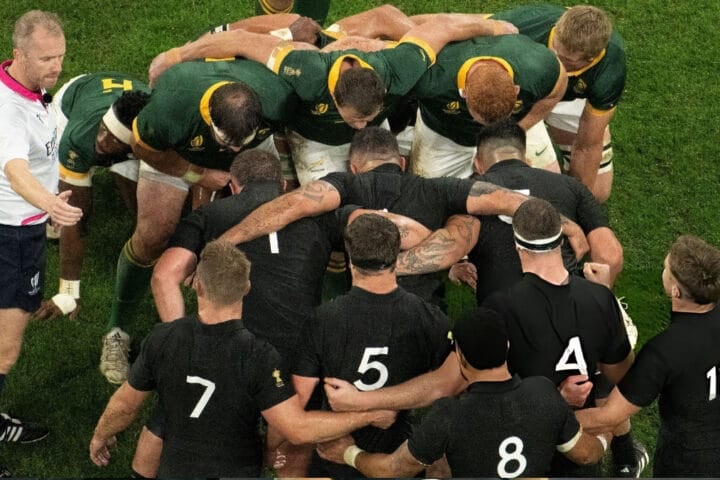
Soweto: New Zealand fed 11 scrums, and a penalty try and four penalties came out of them. McKenzie: “I thought there was pretty good parity in the scrum, but when the scrums mattered, the Springboks dominated. They got that try, they got the points.”
Both men would fix it with a lock. McKenzie: “The All Blacks are scrumming Tupou Vaa’i on the right-hand side, which I wonder about. Maybe they might look at a different second row. Darry and Holland would be a good second-row pairing for me. But I’m talking set piece.” Hansen, in five words: “I’d move Holland straight to tighthead lock.”
Hansen’s reason is a number. McKenzie’s is a habit. Hansen: “65% of your power comes from the back five. So your front-rowers get hung out to dry when the scrum goes no good, but it’s an eight-man thing.” McKenzie: “My experience is that there’s plenty of locks, right, they love playing on the left, because they don’t have to work as hard. I remember playing, in my era, I had Rod McCall and John Eales. Well, Rod McCall, he just loved being on the left. But the better athlete was John Eales, but he was on my side.”
A scrum does not push straight. The loosehead angles in on the opposing tighthead, the hooker’s weight sits on the tighthead’s side, and the drive from behind has to go through that corner to keep the scrum square. The lock on the right pushes into the load; the lock on the left pushes into space. Hansen knows why Holland has been on the left, and thinks it is time to stop. “I think there’s a combination that he has with de Groot on the left-hand side, and they probably thought, well, let’s stay with that. But I think it’s time to roll the dice and say, no, big fella, pop on the other side and get excited and be the best tighthead lock in the world.” McKenzie: “When he can wheel that guy backwards, I thought that’s pretty special. So he’s got the physical attributes you need to be on that right-hand side.”
Read also: Kyle Sinckler says no tighthead alive holds out that scrum, and Kieran Read says the Springboks scrum is legal, which is the bad news for New Zealand.
2. Lineout ball at the back
Hansen’s second clause is the one nobody wrote about. New Zealand’s lineout went 11 from 12 in Soweto, and Hansen says the number hides the problem: too much of it went to the front, where the Springboks’ back three can stay in the defensive line and rush.
McKenzie saw the same thing and was kinder about it. “Yes, they took the cheap option at the front a couple of times, but the options they used, some subtle stuff, the shorter lineouts, worked quite well. But all of that stuff that you work on at training will get you so far in the game.” The one throw that went missing cost a try inside a minute, a week after Rennie dropped Codie Taylor for the lineout, not the scrum.
Front ball is safe ball. Against South Africa it is also ball with 15 defenders already set, because the winger and fullback never had to drop back for a throw to the tail. Hansen’s phrase was “a free shot at you from the back”. A lineout that wins 11 from 12 and lets the opposition keep 15 men in the line has not won as much as the number says.

3. Points off the tee
McKenzie found the series in one line of numbers. “Eight tries to 13. Six conversions to nine. But eight penalties to zero. So New Zealand haven’t opted to take shots at goal, or haven’t kicked them, whatever. But there was a point. That’s the point.”
He had named the pattern on Friday’s preview show, before Soweto confirmed it. “New Zealand have been scoring tries out wide and not converting them. They’re difficult kicks, obviously. So they’re getting the five points, but they’re not getting the seven.” Hansen, on the other side of the ledger: “Their goal-kicking has been exceptional in this series.”
New Zealand have not kicked a penalty goal in three Tests, and have taken one shot: Ruben Love’s from the left of the posts on 53 minutes, which missed. They have outscored the Springboks 13 tries to 8 and are a draw from losing the series, and the gap on the tee, 36 points to 18, is bigger than the aggregate margin three times over.
4. Ten minutes of composure
McKenzie’s word for the finish was “un-All Black-like”. “The composure we’ve seen all through sort of dropped off in the last ten minutes. There was some penalties, Barrett missed touch, there was a bunch of things that happened in the last ten minutes. They had the yellow card early on and then gave away three penalties in a row. Three penalties in a row piggyback South Africa up to the end of the field.”
Hansen’s explanation is a coach’s, and it is about the head.
“You can’t go scoreboard-focused, because it creates an outcome pressure that you don’t need. You’ve just got to say, what do I need to do right now, right here? Be where my feet are and execute what I need to do. And probably wasted five of those ten minutes worrying about the scoreboard… Wanting to win is not a bad thing, but you’ve just got to be controlled. Process will give you the outcome.”
Asked whether Ardie Savea staying on would have changed it, he refused the easy answer. “As good a leader as Ardie is, you’ll reassure people, but there’s enough leaders out there to be able to do that. They’ve allowed themselves to slip into that: it’s a series, here we go, we’ve got to score twice. That sort of thinking, you become distracted. So it can be an individual thing that even your skipper can’t control. But the experience will be one that they’ll be able to bank.” The site’s own rewatch found five mistakes, and the last twenty minutes nobody’s name is on. Hansen has just put a name on it.
5. A bench that knows the job
Fabian Holland‘s penalty on 70, entering a ruck from the side in front of his own posts, is where this one starts.
Hansen was affectionate. “There’s an art to coming off the bench. And when you’re a big physical bloke like he is, he wants to make a difference, and sometimes they charge around like a big bull in a china shop and cause a bit of havoc.”
McKenzie was not. “You need guys that can come on and, what I say, improve the performance. Their job is to go out there and improve the performance, not go out there and emotionally give away three penalties… So you’ve got to improve them. Otherwise don’t have them on the bench. They’re no good to you.”
He went through Saturday’s. “Lienert-Brown, he comes on all the time off the bench, right? He just fits in. He’s like a glove. Moorby came on, dropped the first ball that came to him. Sititi came on, replaced a big job, for more than half a game, and he did a good job too. Holland came on, was probably a bit too excited. So Steve’s 100% right. The guys that know how to play off the bench do a really good job. Whereas New Zealand’s actually got a bunch of new guys. New guys to the team, let alone new guys to the bench.”
What is missing is a meeting, and Hansen described the one he used to hold, using his best player as the example. “Let’s say, for some reason, Aaron Smith’s on the bench. Now, Aaron Smith would have come off the bench probably two or three times his whole career. And he’s got no idea how to do it. And he’s a competitor. So you’ve got to get him to understand: I don’t need you to come off and win the game. I need you to come off and just control your emotions and, as Link said, deliver the tasks that need to be delivered at a really high standard… Narrow down your focus. What’s happening in my area?”
The ratings had Carter’s 5 after two tries made and two conceded and Holland’s 5.5. McKenzie’s reading of Leroy Carter’s two missed tackles was that one-on-one “is like watching golf”, and that Carter “will be feeling bad about that”. The bench is the one he would change.
6. Time
The sixth is not a selection. Hansen: “There’s nothing in this Test series. It’s small margins. And the thing that gives me a lot of excitement and hope for the All Blacks is, this group’s only been together for about six weeks. The South African team has been together now for quite some time.”
What he thinks the six weeks are missing is the thing he says Rassie Erasmus has built in South Africa, and the thing his own side had.
“When the All Blacks were really coming, it always felt like we were the nation’s team. We weren’t the All Blacks, we were actually a team of five million, because everybody was in behind the team, and everyone was for the team and the team was for the nation. It wasn’t just for themselves. You can’t do that just with a flick of ‘I want us to be the team’. You’ve got to earn the respect of the people who are your fans, and you earn that by what you do on the park, obviously, but you also earn it by the stuff you do off it and how you conduct yourself.”
Then the line New Zealand will want on the wall this week. “This All Black team is starting to grow into that area too. So I think New Zealanders will be pretty proud of them at the moment. They’ll be disappointed we didn’t win, but we know we’re not far away.” And the horizon he is working to: “We’ve got until next year in the World Cup to get those things right, and I think we will. And once we do that, then we’re right on the hunt.”
The pack both men wrote down
Ardie Savea will not travel to Baltimore, nor will Luke Jacobson or Quinn Tupaea, and Rennie names his side this week from a squad of 36 with nobody flown in. McKenzie went first, reading the injury list. “That would suggest that Lakai might play seven, and Sititi’ll be at eight, and they might put Tupou Vaa’i back to six, and Holland and one of the other three locks in at lock.”
Hansen held up his notes. “I wrote it down. That’s exactly how I wrote it down on the piece of paper while you were talking. That’s how I’d pick it. And then that gives you some good options coming off the bench.” Anton Lienert-Brown “will slot in, I assume, at midfield”. The other three locks are Sam Darry, Josh Lord and Patrick Tuipulotu, with Ethan de Groot and Lord back in the 36 after the head knocks that took them out at Ellis Park.
Rennie can fix five of the six by Saturday. Nobody fixes the sixth by Saturday.
Frequently asked
What are the All Blacks’ weaknesses against the Springboks?
As Steve Hansen and Ewen McKenzie named them on Rugby Unity on 7 September: no parity at scrum time, lineout ball thrown to the front instead of the back, no points off the tee (no penalty goals in three Tests), composure that went in the last ten minutes in Soweto, a bench that is new to being a bench, and only six weeks together as a group against a settled Springboks side.

Who replaces Ardie Savea for the All Blacks in Baltimore?
Both coaches expect Wallace Sititi at 8, Peter Lakai at 7 and Tupou Vaa’i back to 6, with Fabian Holland and one of Sam Darry, Josh Lord or Patrick Tuipulotu at lock. Ethan Blackadder and Semisi Ta’eiloa are the other loose forwards in the 36, and the back row is the one All Blacks weaknesses list item the injuries settled for Rennie.
Why would Fabian Holland move to tighthead lock?
Hansen says Holland has packed on the left because of his combination with Ethan de Groot, and that it is “time to roll the dice” and let him “be the best tighthead lock in the world”. McKenzie says locks prefer the left because it is easier, and that Holland has the physical attributes for the right side, where the weight of a scrum comes through.

Your turn
On the record: Lakai 7, Sititi 8, Vaa’i 6, and Holland on the right-hand side of the scrum. Six things missing, five of them fixable by Saturday. Say which one Rennie fixes first, and which one he does not fix at all.






Comments
No one has weighed in yet.
Be the first - what did you make of it?