


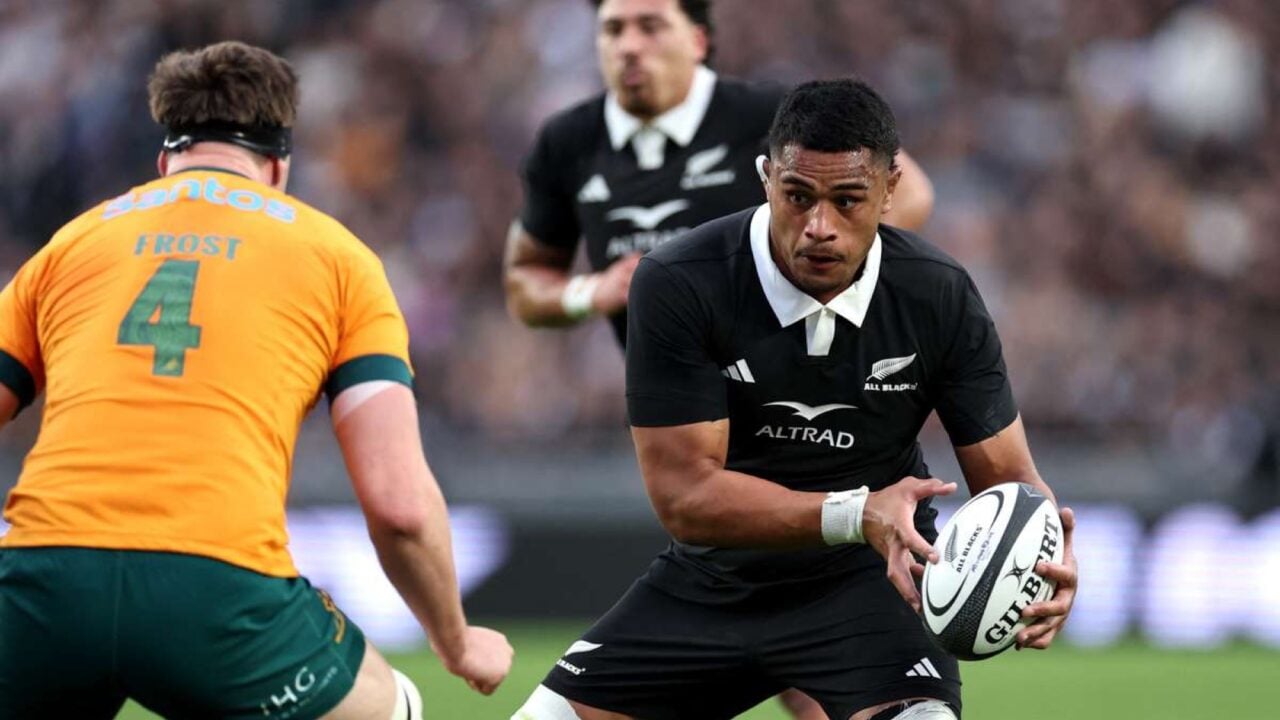
Did the officials miss the head knock that forced Tupou Vaa’i off in England’s 37–12 win over the All Blacks? Nigel Owens says no.
The former Test referee was asked on World Rugby’s Whistle Watch why the knock was not looked at. Vaa’i went off for a head injury assessment after England’s Maro Itoje came in to clear him out of a ruck.
England and New Zealand meet again in today’s third-place play-off. Do you trust that the TMO checks everything, or should every head knock be shown on the big screen? Tell us in the comments.

READ MORE: England v New Zealand: team news, stats and the kicking duel
‘They would have been checking this in the background’
Owens said the television match official reviews every head contact, whether the crowd sees a replay or not.
“When you have incidents of head contact, or foul play, or somebody leaving the field, particularly around head contact, the television match official will be clearing all,” he said. “He’ll be looking at everything to see if there’s anything there illegal that he needs to bring to the attention of the referees.”
His message to anyone who thought the incident had been missed was blunt. “Rest assured, anybody who’s wondering, ‘oh, they didn’t look at it, they missed it’. No, they would have been checking this in the background.”
Why Tupou Vaa’i’s head clash was not a penalty
Owens called it an accident with no foul play from anyone. Two players came in to clear out at the same moment, and their heads met.
“This is an example of where you just have head on head, which is a complete rugby incident,” he said.
“Unfortunately there is head contact and the player does go off for an HIA, but there was no foul play committed, so hence they play on.”
READ MORE: All Blacks player ratings v England
When does a clear-out become foul play?
Owens gave the test the officials apply. It turns on whether the player coming in could see the danger and had time to change course.
“If he ran in seeing that guy there, knowing ‘if I carry on here I’m risking hitting his head’, and does carry on where he had time to readjust, then you would reach that foul play threshold,” he said.
That was not the case with Vaa’i, Owens said. Both players were simply going in to clear out.
The same test sent Mayco Vivas off
The contrast came later in the show. Argentina’s Mayco Vivas had his yellow card upgraded to a 20-minute red against France for direct head contact at a ruck.
“He has time to readjust,” Owens said. “This is a straightforward reckless action: direct contact of the head, high degree of danger.” Today’s rematch will test the same line at every ruck. On the same show, Owens explained why Jack van Poortvliet’s dive over the ruck stood at Twickenham.




Comments
No one has weighed in yet.
Be the first - what did you make of it?