


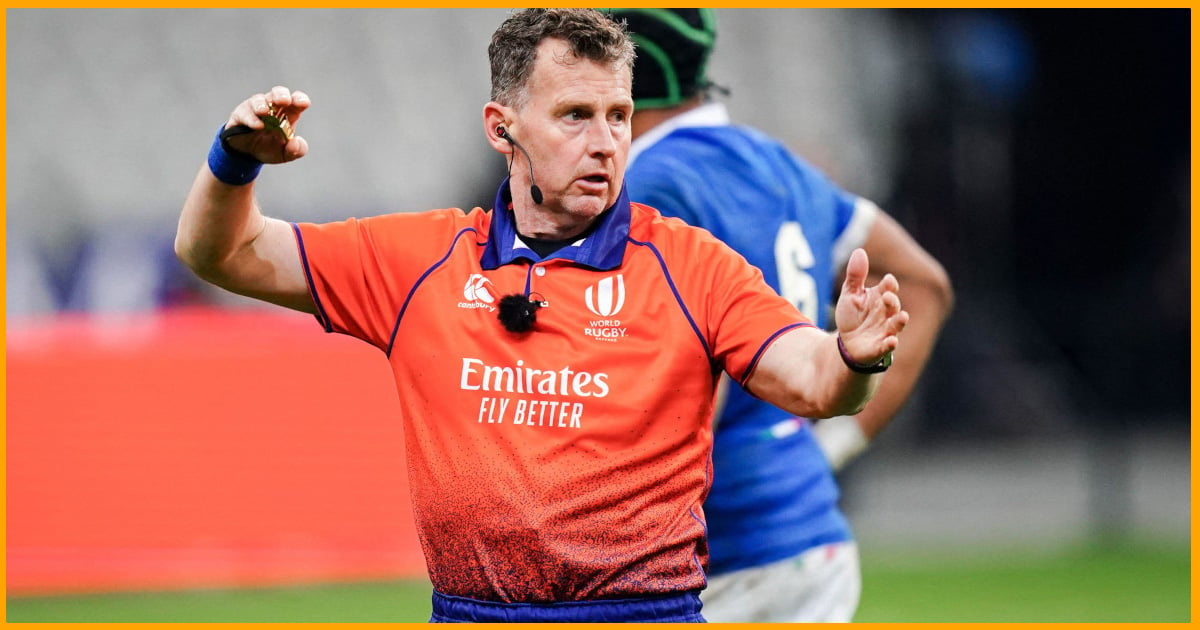
A fan asked World Rugby’s own law show why the rugby advantage law lets a team wave one away and take the scrum instead. Nigel Owens answered, and named the old cheating that keeps referees out of it.
You have watched this a hundred times without knowing what you were looking at.
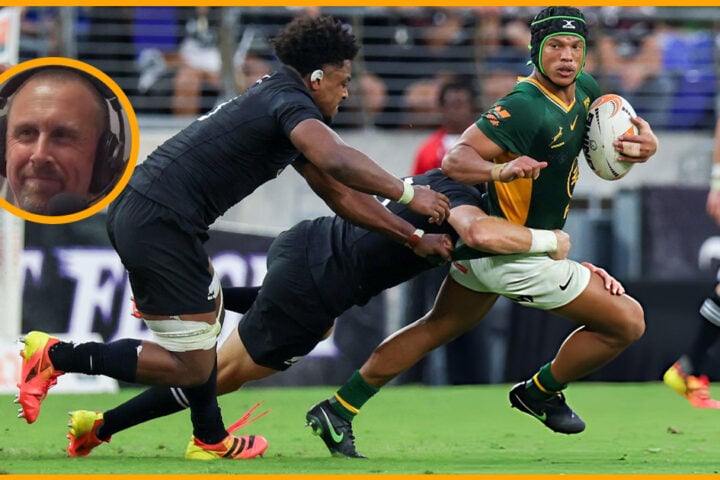
South Africa have the ball inside their own 22 and they are under pressure. An All Blacks wing knocks on. The referee’s arm goes out for advantage, and the Springboks scrum-half looks up and asks for the scrum instead.
He is allowed to do that. The referee is not really allowed to argue.
That is the rugby advantage law as referees apply it, and almost none of it is written down the way you would assume.
Owens refereed 100 Tests and the 2015 World Cup final. Asked about it on Whistle Watch, his answer came with a piece of old cheating attached.
“I remember a couple of scrum-halves knock it on. Knock it on deliberately. Well, that’s against the spirit of the game.”
The law is thinner on that than you would expect. So who should actually get to make that call, the captain or the nine?
Why a team under pressure wants the scrum
Start with what advantage is for. It belongs to the team that did not infringe, and Owens keeps returning to that word.
“You’re there to play advantage for that team. So what you are doing, that team needs to gain advantage from it. If that team feels that their best advantage is not to try and play out of their own 22, because they’re under pressure…”
A side pinned on its own line does not want quick ball. It wants to stop.
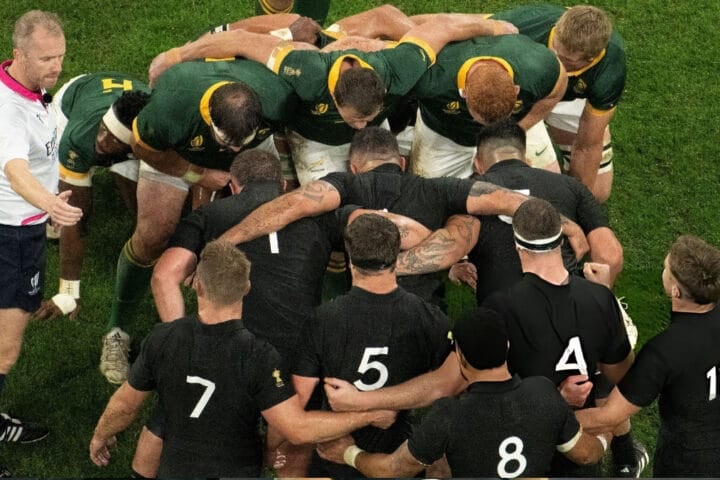
A scrum is a rest. It is eight men with their hands on each other for forty seconds, a chance to get the wingers back, and for some packs it is the most reliable weapon they own.
“We don’t want this. And particularly if you’ve got a strong dominant scrum, our advantage here is the scrum. We want the scrum. Because we’re confident we can push him back. We have a platform.”
That is the whole calculation, and it is why South Africa guard that set piece so jealously.
A pack that wins its own put-in turns a knock-on into three points or a lineout in the opposition half. Playing on with tired forwards turns it into nothing.
The cheating that keeps referees out of it
Here the question gets interesting. If a referee thinks the advantage is worth more than the penalty, why not overrule the scrum-half and play on?
Owens has an answer, and it is not about fairness. It is about what players would do next.
“So that team decides, I don’t want this advantage, I want the penalty. Then as a referee it’s your duty then to do that. You can’t say, no no, I’m playing advantage.”
Then the reason.
“I remember a couple of scrum-halves knock it on. Knock it on deliberately.”
Think that through. A referee who insists on playing advantage against a team that does not want it is a referee who can be beaten by a deliberate knock-on. The nine drops the ball, shrugs, and gets the scrum anyway.
Owens spells out where that ends.
“Players will just ‘oops, sorry’, accidentally, and lost the ball on.”
So the practice exists to protect the laws from a loophole. Refuse to let a team decline an advantage and you invent a reason for them to cheat.
What the rugby advantage law actually says, and what it leaves out
This is where the neat version falls apart.
World Rugby’s Law 7, which is the whole of the rugby advantage law, contains no clause letting a team refuse one. What it contains is a referee making judgments.

Advantage ends, the law says, when “the referee deems that the non-offending team has gained an advantage”, or when “the referee deems that the non-offending team is unlikely to gain an advantage”.
Both of those verbs belong to the official, not the captain.
The law also sets a bar most fans have never heard. Advantage “must be clear and real. A mere opportunity to gain an advantage is not sufficient.”
There is exactly one clause where a player gets to choose, and it is narrower than the thing Owens is describing.
Law 7.2(d) covers a second offence: “The referee stops play and allows the captain of the non-offending team to choose the most advantageous sanction.”
Captain. Not scrum-half. And only after the offending side has infringed twice.
So what Owens describes is practice rather than statute. A referee who deems a team unlikely to gain an advantage is doing exactly what the law tells him to, and a nine shouting that he does not want it is the fastest evidence available.
Nobody has decided who gets to ask
Owens raises the gap himself, and does not close it.
“The argument here is, who decides that? Is it the captain? Is it any player? Is it the scrum-half, that’s the only sort of, maybe, as a referee you would tell the scrum-half, who’s always there, isn’t he… ‘Listen, if you don’t want the advantage lads, you tell me.'”
His own position is blunt.
“If they don’t want the advantage, you can’t force them to take it.”
In practice it is whoever is nearest and loudest, which is almost always the nine. Law 7 has nothing to say about him.
You do not referee the scoreboard
The same principle runs through a question Owens was asked earlier in the show, and his answer is one of the cleaner explanations of why officials seem stubborn.
Imagine a side two points down, late, with an advantage running. All they want is the three points. Should the referee just give it to them?
“If you’re playing advantage and the team you’re playing advantage to is only two points behind… all they want is the penalty. But it’s not for me to decide… Well, they could miss. And they could turn around and tell me, well, we would have scored.”
A referee who starts doing a team’s thinking for them owns every outcome that follows. Missed kick, wrong call. Held-up try, wrong call.
He applies the same rule to the clock and to intent.
“You wouldn’t tend to factor in the time as a referee. Same as foul play, you don’t tend to factor in the intention, because as a referee I can’t prove that you were intending to do something.”
Jamie Roberts, the former Wales and Lions centre who puts the questions on the show, got to the human objection first: “You’re not going to concede deliberately.”
Which is true, and beside the point. The law is not written for what players would like to do. It is written for what they could be tempted to do.
The tell to watch for on Saturday
Watch the scrum-half’s head, not the referee’s arm.
The instant a knock-on happens near his own line, a nine who wants the set piece will look straight at the official rather than at the ball.
That glance is the whole negotiation. Most broadcasts never cut to it, and it decides whether the next forty seconds are a rest or a retreat.
South Africa beat New Zealand 29-24 at FNB Stadium with a pack that spent the second half asking for exactly that. Owens went through the calls that shaped the earlier Tests in the series too.
Frequently asked
Can a team refuse an advantage in rugby?
In practice, yes. Nigel Owens said on Whistle Watch on Friday 11 September that if a team does not want the advantage, “you can’t force them to take it”, and that it is the referee’s duty to bring play back for the penalty. The written law does not phrase it that way.
What does Law 7 say about advantage?
Law 7 says advantage may be tactical or territorial and “must be clear and real. A mere opportunity to gain an advantage is not sufficient.” It ends when the referee deems the non-offending team has gained an advantage, or deems them unlikely to gain one.
Who decides to turn down an advantage, the captain or the scrum-half?
The law names the captain only in Law 7.2(d), where a second offence lets the captain of the non-offending team “choose the most advantageous sanction”. For an ordinary advantage the law gives no player the choice at all. Owens says referees tend to tell the scrum-half to speak up, because he is always there.
Why would a team want a scrum instead of playing on?
Because a scrum stops the clock on a defensive passage, lets the forwards reset, and gives a dominant pack a platform to win a penalty or clear territory. Owens describes a side pinned in its own 22 deciding its best advantage is the set piece.

Your turn
Two ways to see the gap.
Either it is fine as it is, because referees and nines have understood each other for a century and writing it down would only create arguments about who is entitled to speak.
Or a decision worth three points should not rest on which player shouts first, and Law 7 should say plainly who is allowed to turn an advantage down.
Captain, scrum-half, or nobody at all. Who should it be?






Comments
No one has weighed in yet.
Be the first - what did you make of it?