Nigel Yalden used the word on DSPN’s Monday review, and Dave Rennie had used a different one the night before. The six tries settle it.
“There were some very tired plays. A couple of them I think you could have classed as lazy.”
Nigel Yalden, rugby editor at Newstalk ZB and Radio Sport, said it about the All Blacks defence in Baltimore on DSPN’s Monday review.
Nobody in the All Blacks camp will use that word. Rennie’s version, to reporters after the match, was that they “defended pretty well throughout the series but got beaten by some of their flash boys tonight”.
Six Springboks tries. One word each. Lazy, tired, or beaten by a better team?
Sam Darry on his haunches
Yalden’s evidence starts with one picture from the 22nd minute.
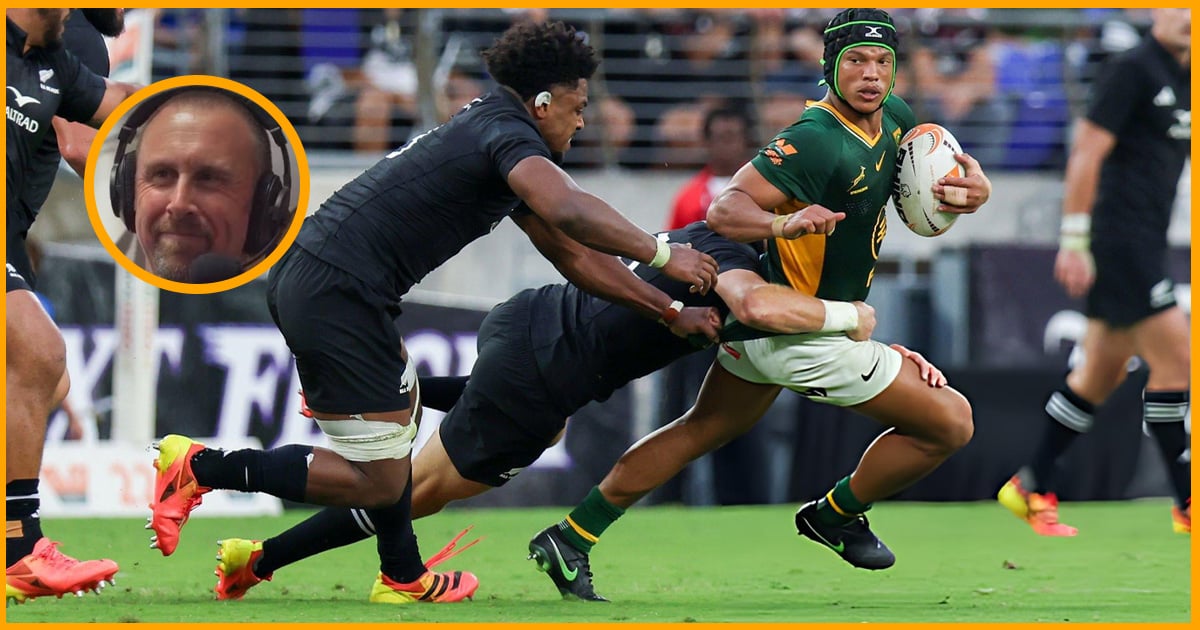
“I thought that the defence from the All Blacks was actually quite poor. There were some very tired plays. A couple of them I think you could have classed as lazy … there were just some moments where, you know, the [van den Berg] try, you could see Sam Darry straight away, he was heading out there. He didn’t cover the man and [van den Berg] just went underneath, and you could see Sam Darry on his haunches just looking like, yep, messed that one up. And that to me was just an error caused by the physicality that South Africa brought.”
The sequence is on the site’s ratings. Peter Lakai’s side entry at a maul gave South Africa the five-metre lineout. Van den Berg came off the back of it and dummied two men. Darry was one of them.
Darry made fifteen tackles that night and came off on 57. One decision, and it is the one everyone remembers.
Yalden’s last sentence is the interesting one. He does not call it lazy. He calls it an error caused by physicality, and the six tries are the way to test which one he actually means.
Six tries against the All Blacks defence, one word each
| Min | Try | What happened | Word |
|---|---|---|---|
| 15 | Damian de Allende | 16 phases, de Allende over from close range | Beaten |
| 22 | Morné van den Berg | Lakai penalty, 5m lineout, maul, dummy, Darry beaten | Yalden’s word |
| 49 | Malcolm Marx | Uncontested lineout, maul over on the second shove | Structure |
| 53 | Pieter-Steph du Toit | Short side from a scrum, Esterhuizen, du Toit over | Beaten |
| 72 | Kurt-Lee Arendse | Loose ball, two men stepped, nobody home | Tired |
| 78 | Cameron Hanekom | Jordan swamped, pick and go under the posts | Tired |
Source: the site’s Baltimore ratings for both sides, with minutes from the Guardian’s live blog.
Read the right-hand column. Two of the six are the kind Yalden means, and both came after the 70th minute, when South Africa won the series 3-1 in Baltimore with 14 points in six minutes.
Two more, the first and the fourth, were a side being carried through by bigger men, which is what Yalden calls physicality. One was a lineout New Zealand decided not to contest, which is a coaching call before it is a defensive one.
That leaves the 22nd minute, and one lock heading the wrong way. So “a couple” is about right, and “lazy” is Yalden’s word for one of them. The site’s word is the one he used next: an error, and a decision rather than a character.
Tired is not an excuse, and the changes count backs him
The tiredness defence was coming, and Yalden got there first.
“We could talk about maybe elements of, oh, they’re tired. Well, guess what? They’ve also played four Test matches, the Springboks, and they didn’t make a whole lot of changes. Whereas the All Blacks were sort of chopping and changing a fair bit throughout the course. So I don’t think there’s any excuses there. I just think there was some very poor defence, not reading and reacting the way we know they can be … particularly at that fourth Test that they did concede six tries, and a couple of them just a little bit meekly.”
Count it. For the decider South Africa changed two starters from Soweto: Damian Willemse for the injured Cheslin Kolbe, and van den Berg for Cobus Reinach. New Zealand changed eight. Across the series, from the site’s four ratings pages per side, South Africa made 12 personnel changes to its starting XV and New Zealand made 14.
The series totals are less kind to Yalden than the Baltimore number. Six of South Africa’s 12 were one decision, the front-row swap before Cape Town and its reversal a week later. And five of New Zealand’s 14 were forced. Ethan de Groot and Josh Lord went out after the Ellis Park head clash, then Ardie Savea, Quinn Tupaea and Luke Jacobson after Soweto.
Nine All Blacks went home injured before the decider, and the panel’s scrum fix had already gone home with them.
The side that scored six tries had played the same four Tests, in the same three weeks, with fewer changes of its own choosing. If fatigue explains the 72nd and 78th minutes in black, it should have explained them in green too.
Rennie’s answer: pretty well, until the flash boys
Rennie’s line after the match was not a denial.
“I thought we defended pretty well throughout the series but got beaten by some of their flash boys tonight,” he told reporters, and then: “We scored 17 tries in the four Tests.” Both are true.
Rennie said the Baltimore numbers were even and asked about the comms, and the clock disagreed with him from 72 minutes on.
The tackle counts are on his side for 65 minutes. Ethan Blackadder made 26, the most on the field. Jordie Barrett made 19, the most of any back. Darry’s 15 are in there too.
New Zealand were 29-21 down on 65, and had gone through 32 phases for Will Jordan’s try before half-time. That is not a side that had stopped working.
Read also: John Kirwan says Blackadder at seven is the answer because Tupou Vaa’i is the reason, and the 26 tackles are his evidence.
Tony Johnson’s reading, on the same show, was that South Africa “expanded the parameters” in Baltimore and “that’s when you saw for the first time in the series sort of holes starting to open in the All Black defence”.
The tell: watch the third man, not the tackler
Two of the six tries came from the same shape, and Yalden’s phrase for it was “not reading and reacting”. A ball goes loose in New Zealand’s half. Two All Blacks arrive at it. The Springboks’ next man, Arendse on 72 and Hanekom on 78, is already running before the second tackler has looked up.
The third New Zealander, the one whose job is to cover the space the first two just vacated, is a step behind.
That step is the whole argument. Rennie’s “pretty well” is the first two men. Yalden’s “lazy” is the third. The site’s Springboks ratings gave Arendse four line breaks and 169 metres from seven carries. He got most of them running at a third man who had not arrived.
Johnson’s summary from the same review is the fairest one available. “Maybe by the end of it, the All Blacks were just looking a bit frayed around the edges.” Frayed is not lazy. But at Eden Park on 10 October, the third man is the one to watch.
Read next: Steve Hansen and Ewen McKenzie named six Springboks strengths, and two of them cannot be coached. The flash boys Rennie mentioned are on that list.
Your turn: Yalden or Rennie?
Two ways to read the half-dozen. Either Yalden is right and two of them, at least, were a defence that stopped reading the game before it stopped running.
Or Rennie is right and a side that made 26 tackles through one man and 19 through another was beaten by better players in the last ten minutes. Settle it below.
Frequently asked
What did Nigel Yalden say about the All Blacks defence in Baltimore?
On DSPN’s Monday review he called it “quite poor”, said some plays were tired and “a couple” could be classed as lazy, and said tiredness was no excuse because the Springboks had played the same four Tests with fewer changes.
How many changes did each side make for the fourth Test?
South Africa changed two starters from Soweto, Willemse for the injured Kolbe and van den Berg for Reinach. New Zealand changed eight.
What did Dave Rennie say about the defence?
That the All Blacks “defended pretty well throughout the series but got beaten by some of their flash boys tonight”, and that they scored 17 tries across the four Tests.