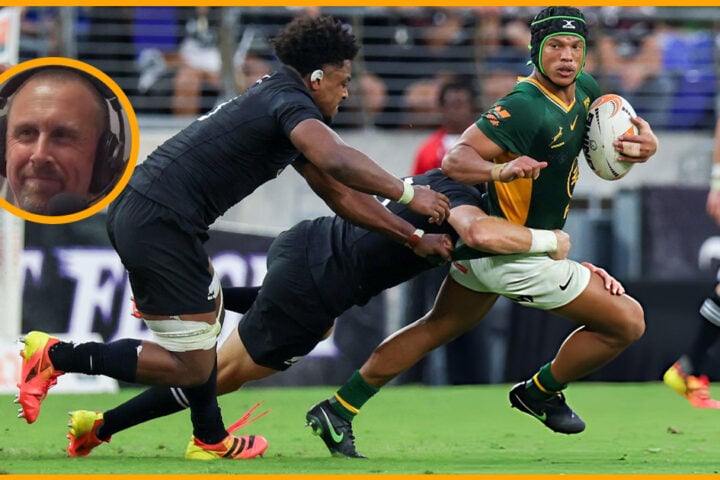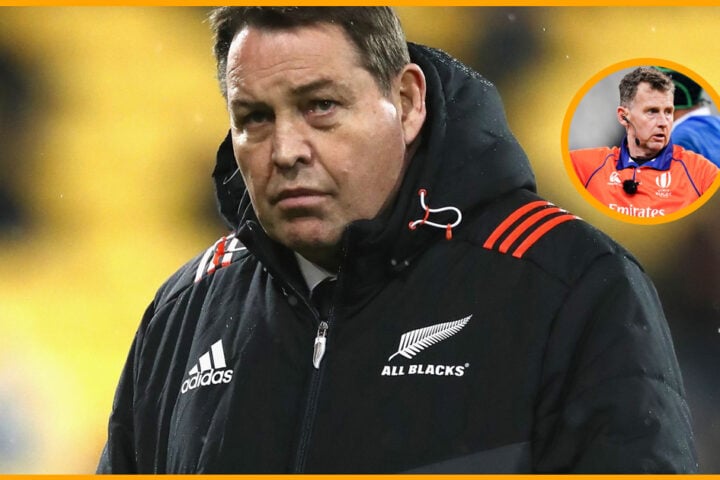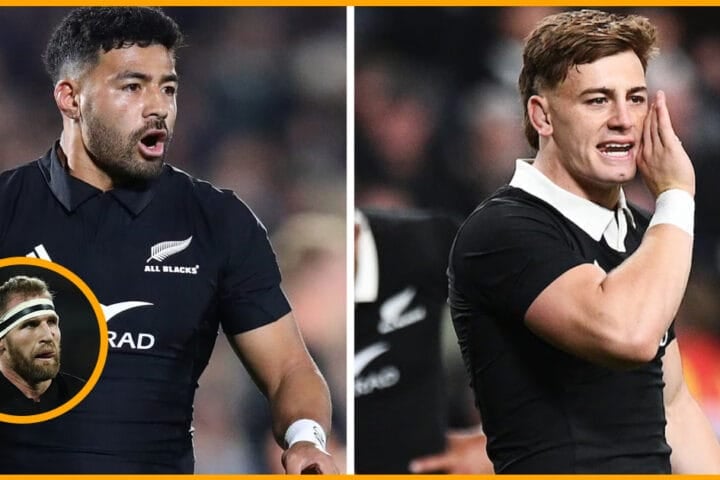
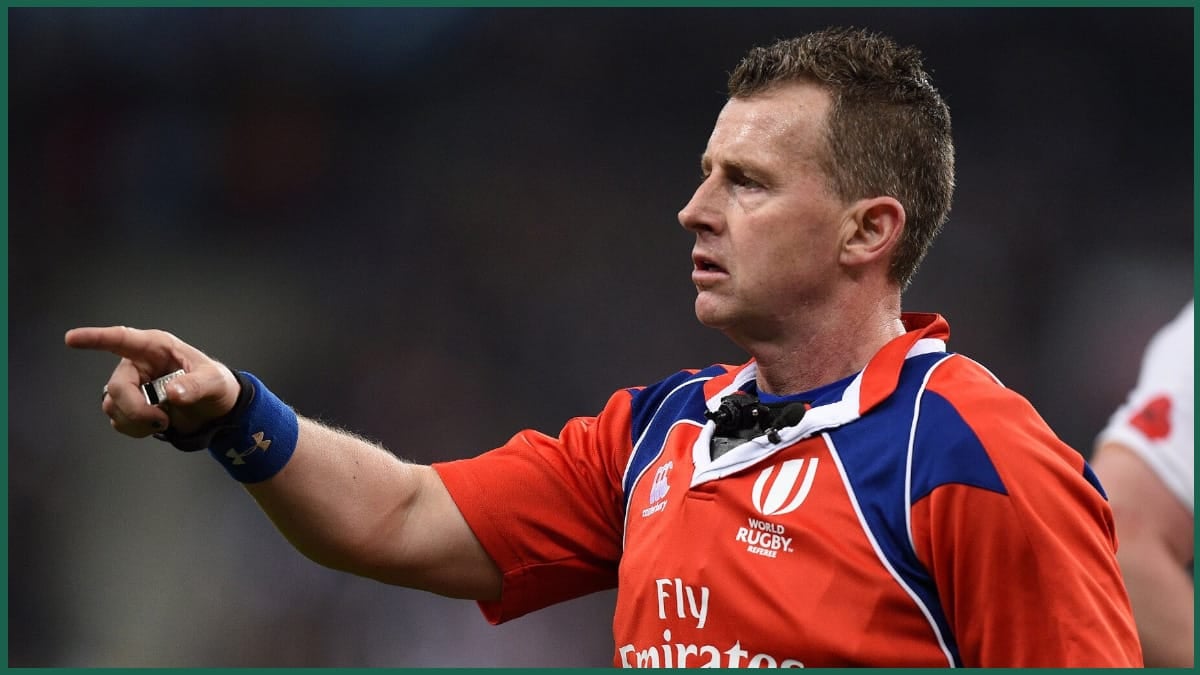
Nigel Owens explains the tour’s contentious calls on Whistle Watch, from Codie Taylor’s dummy tap at Loftus Versfeld to a referee who overruled his own TMO. One of them has no law behind it at all. REVIEW: Thursday 27 August.
Codie Taylor stands over the ball five metres out and moves like a man about to tap it.
Three Bulls defenders come up. He does not tap it. He steps off his right foot into the space where they used to be and scores under the posts.
Amashukeli, on the mic, to the Bulls: “He can do that, I promise you.”
He was right. The dummy tap is legal, and that is the easy part of this.
What nobody has worked out is what happens the next time somebody tries it and the defence gets back.
VOTE WHO WINS IN CAPE TOWN
Add a winning margin for points
Nigel Owens took the dummy tap apart on Whistle Watch, the World Rugby show he presents with Jamie Roberts, the Wales and Lions centre who won 94 caps and spent two seasons at Bath. Owens refereed 100 Tests, more than any referee before or since, and the 2015 World Cup final at Twickenham. He does not reach for “unfair play” casually.
He went looking for it here and came back with almost nothing.
The try came in a 50-19 win at Loftus Versfeld on Saturday 15 August, a warm-up on a South African tour that has already produced a week of arguments about officiating.
Nobody could penalise the dummy tap, and the law is the reason
Nigel Owens started where a referee starts, at the base of the scrum.
“You’ve got in law that you cannot dummy off the base of the scrum… You can’t do that, because what you’re doing basically, you’re enticing the opposition to give a penalty away.”
Do it there and it is a free kick against you. Scrum-halves still try it every weekend, and Owens’ point was that most referees deal with it by having a word.
A dummy tap at a penalty mark is a different animal entirely.
“There’s nothing in law that says that you cannot dummy… It’s not in law. It doesn’t say that. The only thing that this would come under in law is if you felt it was unfair play.”
That is the whole legal position, and it turns on taste rather than text. Is a dummy tap unfair play? Or is it a dummy pass with a different piece of grass under it?
Owens did not call it unfair. Neither did Amashukeli, who saw it live, said so out loud and gave the try. Planet Rugby’s law discussion two days later landed in the same place, noting that the only clause that comes close is Law 9.27, which asks players to comply with the spirit of good sportsmanship. That is the kind of sentence that settles nothing at 5.30 on a Saturday.
The sentence a referee is allowed to use instead
Here is where Owens goes somewhere the law book does not.
“The referee would have been well within his right to say, ‘Look, hang on now. I’m not going to allow this now, close to the goal line. New Zealand, don’t dummy, go again.'”
No law required. No card and no reversal. Five words and a reset, and the scoreboard never gets involved.
He was equally clear that Amashukeli was within his rights to let the dummy tap stand and do nothing. Play on, try given.
Both correct. Which is the problem in a single line: the same incident, two referees, opposite outcomes, and neither of them wrong.
The version Nigel Owens explains later in the show is the one that has not happened yet.
Read also: this tour has already produced a referee who overruled his own TMO and a Springbok camp that spent a week counting the calls. Every decision that turned the first Test at Ellis Park is here.
The metre of white paint most fans have wrong
The best thing on the show was not the dummy tap at all. It was a metre of white paint.
Josh Moorby, in the tour opener against the Stormers in Cape Town, made a try-saving tackle on Warrick Gelant, detached, then went back in and held Gelant off the ball. Penalty try and a yellow card, and a lot of confused faces at home.
“If that player was in goal, he would have been okay to try and prevent that ball being grounded, even though he’s on the ground. But he is in the field of play here. So he’s not allowed to interfere then with that player with the ball and preventing him placing the ball.”
Same player. Same action. One metre apart, and one of them is legal.
Nigel Owens had sympathy, and it was the sympathy of a referee who has stood over that exact pile. A tackler lying on his stomach with a body across his chest does not know whether he is short of the line or over it. He knows only that if he does nothing, they score.
Watch for it the next time a tackle is completed in the corner. Where the referee places that ball is not only a scoring question. It decides, after the fact, what the tackler was ever allowed to do with his hands.
Ninety seconds, and a referee who told his TMO no
Two television match official moments, and Owens came down on the same side of both.
At Loftus, Amashukeli awarded Ruan Vermaak’s try for the Bulls. His TMO, France’s Eric Gauzins, tried to talk him out of it. Amashukeli did not move.
“The referee has the final say, and that’s how it should be.”
His condition is the one the protocol already states and the game keeps stretching.
“You want the TMO to come in with something that is clearly obvious and people are going, ‘How the hell have they missed that?’… If it’s a 50/50, it’s a tight one, then the TMO should leave it to the referee.”
Then Buenos Aires, and the version where it goes wrong. A player in touch in the 55th minute, missed by the assistant. The TMO did not have the pictures in time to call it on the run. Ninety seconds later a try went up on the board and came back off it.
Nigel Owens accepted the outcome and not the process. His objection was the clock.
“Ninety seconds of ball-in-play time is a lot in a game of rugby, when you look at ball-in-play time is sort of 32, 38, sometimes 40 minutes.”
World Rugby has not answered whether that time gets added back. Owens thinks the conversation is coming.
Now run it again, and let the defence get there
Back to Loftus, and the version of the dummy tap that has not happened yet.
Every one that works ends the way Taylor’s did. This is the one that does not.
Taylor scored. That is the only reason this ended quietly.
“If they hadn’t have scored, the players who made the tackle, because they came up because of that dummy, from the try line would have not been back the five metres to the try line. You can’t penalise them then.”
Read it twice, because it is the whole thing.
Defence is stood on its own line. The attacker dummies. Two or three defenders bite and come up a couple of metres. The attacker then taps for real, goes, and gets stopped short.
Now the referee has a ruck two metres out with three defenders in front of where they should be. Offside, in law, in the most punishable spot on the field. And they are only there because they were deceived by something that is not illegal.
Owens’ position on that is flat.
“You’re basically saying, ‘Well, look, I’m now in front of the goal line. Basically, I’ve got to let you score. I can’t tackle you.'”
So the referee gets three options and no good one. Punish the defence for something the attack caused. Punish the attack under a law that does not exist. Or wave it through and hope nobody noticed, which holds up fine until it happens in a World Cup quarter-final.
Owens could see where it ends.
“We’re going to see that happen again. We are.”
Where Nigel Owens keeps planting his flag
He has now spent a year making the same argument in different clothes.
He warned that depowering the scrum would destroy rugby. He called the governance around Eben Etzebeth’s ban a total mess. In Cardiff he went through the yellow card he would have given frame by frame. One complaint underneath all of them: the game keeps reaching for a rewrite or a replay when what it needed was a referee trusted to referee.
On the dummy tap he is right about the law and, on this site’s reading, too gentle about the fix.
Refereeing your way past a hole in the law book works right up until two officials handle it differently in the same tournament. Amashukeli let it stand at Loftus. Owens says the next man can refuse it. Both are defensible, which means a five-metre penalty in a knockout Test now turns on who is holding the whistle. Jean de Villiers made the same complaint about a different clause when he pointed out that nobody knows what always illegal actually means.
World Rugby wrote the anti-dummy clause into the scrum and the ruck for a reason. There is no dummy tap clause at a penalty mark because until Saturday 15 August nobody had thought to try one five metres out with three defenders on their heels.
Somebody has now.
Frequently asked
Can you dummy a tap penalty in rugby?
Yes. Nigel Owens confirmed on Whistle Watch that there is no law preventing a player from feigning a tap penalty. The only clause it could fall under is unfair play, and neither Owens nor referee Nika Amashukeli judged Codie Taylor’s dummy tap to meet that bar.
Was Codie Taylor’s try against the Bulls legal?
Yes. Amashukeli awarded it and told the Bulls on the referee’s microphone, “He can do that, I promise you.” Taylor scored twice on his captaincy debut in a 50-19 All Blacks win at Loftus Versfeld on Saturday 15 August.
Can you dummy off the base of a scrum or ruck?
No. Law already covers both, and the sanction is a free kick. Owens explained that the reasoning is that a dummy at the base entices the opposition into conceding a penalty, and that most referees manage it with a warning rather than a whistle.
What does Nigel Owens think referees should do about the dummy tap?
Stop it before it happens. Owens said a referee close to the goal line would be well within his rights to tell the attacking side not to dummy and to take the tap again, because if the move fails, the defenders who came up cannot fairly be penalised for being in front of their goal line.
Who presents Whistle Watch?
Nigel Owens, who refereed a record 100 Tests and the 2015 World Cup final, alongside Jamie Roberts, the 94-cap Wales and British and Irish Lions centre. It is produced by World Rugby Studios in partnership with Emirates.
Read next
- The two late yellow cards that finished South Africa off — ten minutes with 13 men, and how a Test got away from a side still in it
- Who actually played well in a 17-point defeat — a nine in a loss, and two marks in the fours
- The lower tackle-height law World Rugby is trialling — what changes, and why it is easier to police than the current line
Your turn
Two readings of the dummy tap, and they cannot both be right.
Either it is a dummy pass with a penalty mark under it, no different from selling a defender in midfield, and the Bulls should have stayed on their line. Or it is a move that only works because the defenders are legally obliged to react to it, one that leaves a referee with nothing fair to give when it fails, and World Rugby should write the same clause it already applies at the scrum.
Pick one. Then say which way it should go the first time somebody tries it and gets held up short of the line.
Nigel Owens’ comments were made on Whistle Watch, produced by World Rugby Studios, in an episode recorded in Bath during the week of Monday 24 August. Law analysis of the Taylor try via Planet Rugby. Match detail from the RNZ report.