

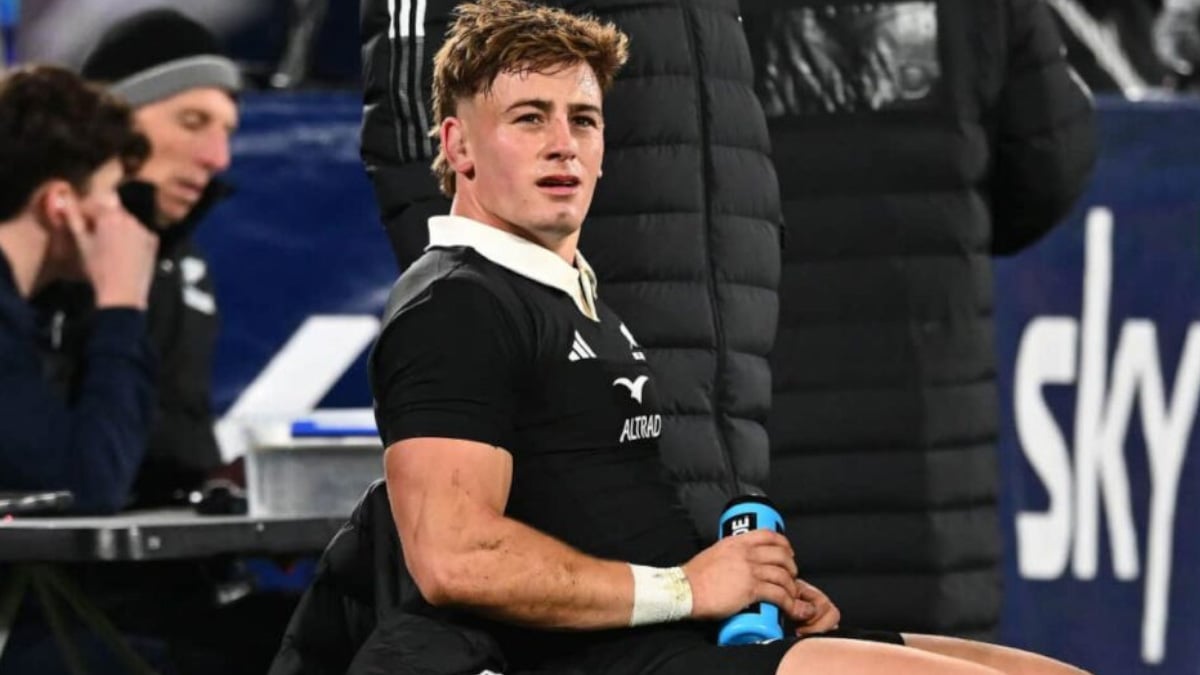
James Marshall coaches the Crusaders backs and watched the 36th minute at FNB Stadium back several times as a neutral. On his What A Lad Podcast on Monday he called the Ruben Love yellow card the harshest in Test history, and Bryn Hall said the other card that night should have been seven points.
“That’s not even a penalty.”
James Marshall said it about the Ruben Love yellow card with the care of a man who knew how it would land, and then he said the rest. Potentially the harshest yellow card in international rugby history.
Dave Rennie’s version on Saturday night was “hard to take”. 1News called it a line call at best. This site’s own account of the night has Love going in to slow the ball a metre from his own line. One of those readings has to give, and only the replay can decide which. South Africans who think all three of them are wrong get their turn at the bottom.
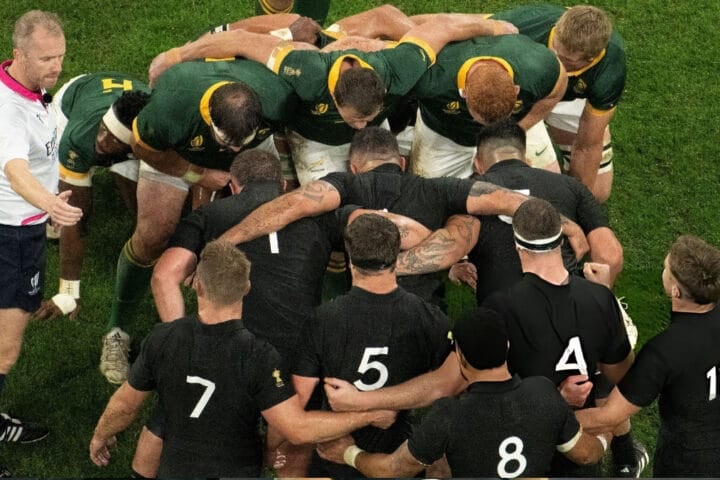
Thirty-sixth minute. All Blacks 12-5 up, Ardie Savea already gone. Cobus Reinach rips the ball from Asafo Aumua on halfway, Jasper Wiese goes through a wall, Ox Nché takes a pass at his laces, and Manie Libbok steps three times before he is stopped a metre short.
Ruan Nortjé carries. Nché carries. Nika Amashukeli’s hand goes to his pocket, South Africa turn down the three points for a five-metre scrum on the All Blacks’ feed, Nché goes through Tyrel Lomax, and it is a penalty try. 12-12 at the break.
Was the Ruben Love yellow card even a penalty?
“I’ve watched that replay a few times and I always try and look at these decisions as a neutral, like take the players, the teams out of it… But genuinely looking at that footage, that’s not even a penalty. He’s got behind the line, ball’s been picked up and he looks good to go for me. But I guess if it was deemed as a penalty, then it’s a yellow card just ’cause how cynical it was and the likelihood of them scoring.”
A claim about timing, then, and timing can be checked. The offside line at a ruck is the hindmost foot, and a defender in front of it when the halfback plays the ball is offside. A metre from his own line, with a try on, the referee is entitled to call that cynical and reach for the card. Marshall’s claim is narrower than the outrage around it: Love had got back behind the last foot before Reinach lifted the ball. If a frame shows that, there was no offence.
The reporting on the Ruben Love yellow card does not settle it. The Guardian logged “slowing the ball”, RugbyPass “cynically offside”, Planet Rugby “going offside to slow the ball down”, and the All Blacks’ own match report “a cynical action in defence”. Everyone saw a cynical offence at the ruck. Nobody has described the frame Marshall is describing.
Marshall conceded the rest himself.
“I thought the All Blacks can feel hard done by on that decision. Don’t think it was as costly as it potentially could have been. That next try they scored was a pushover try which they would have got if Ruben Love was on the field anyway… But I do think it was an incredibly harsh decision.”
What 80,000 people do to a referee
Hall went after the room instead.
“I think sometimes when you actually probably are away from home and probably 80,000 people being able to scream gives a little bit of pressure, psychological pressure to the referee and AR and even the TMO sitting there… when you don’t have that momentum to that point, it’s very easy to be able to get that yellow card. And to your point, I believe it probably wasn’t.”
He is not accusing Nika Amashukeli of anything, and neither is this site. Amashukeli, 31, has refereed in the Six Nations since 2022 and took three matches at the last World Cup, and Ruck graded his Saturday a B+. What Hall said is that 85,976 people and a Springboks pack a metre out make a line call feel like a certainty, and that a neutral watching it back on Monday sees the line call.
The other card, and the seven points that never came
Twenty-six minutes earlier, Amashukeli had made the same kind of judgment in the other direction, and Hall thinks he got that one wrong as well.

Savea offloaded close to the South African line, Sacha Feinberg-Mngomezulu stuck out a hand, and the TMO review ended with the Springboks fly-half in the bin on ten minutes. The law then asked a second question: would a try probably have been scored had the ball gone to hand? Amashukeli decided not, “much to the surprise of many” in Planet Rugby’s words.
“I think more so maybe Sacha’s one. I think possibly a penalty try. I don’t think there was actually anybody outside him, and I think the covering tackle I don’t believe probably would have made it. So I think the yellow card was fair for Sacha, but by the law technically a penalty try could have been given in that time.”
Then the law itself.
“The one hand motion, I believe in international rugby, it’s still pretty fair and deemed like if you just have one hand, that’s classed as a foul act… I feel actually in Super Rugby and NPC this year it’s actually been a little bit more linear now, even with the one hand. So I just feel that in international rugby… if you’re going to get one hand, be ready for a send-off or a penalty.”
The gap is real. In Mendoza on the same afternoon, two Pumas were binned inside a minute for deliberate knock-downs against Australia. At Test level a hand up with no attempt to catch is a card, every time. Feinberg-Mngomezulu, who Nigel Owens said should have been carded for a no-wrap tackle in Dublin in November, got the card and was spared the seven points. This site gave him a 4.5 in the Springboks ratings, and New Zealand scored while he was off.
Two probable-try calls, and both went the same way
Both cards turned on one question. How likely was a try?
On ten minutes Amashukeli decided a try was not probable, so Feinberg-Mngomezulu was binned and New Zealand got a penalty instead of seven points. On 36 he decided a try was probable, so Love was binned rather than penalised. Both judgments went South Africa’s way, and that is the whole of the New Zealand grievance.
On the scoreboard it is nothing. New Zealand kicked the tenth-minute penalty to the corner and Savea scored before the sin-bin clock had run two minutes. Seven points. South Africa took the scrum on 36 and the referee ran under the posts inside the same two minutes. Seven points. Each decision the aggrieved side would overturn produced exactly the score they say it cost them, and Marshall said as much about the second one himself.
So, where the site lands. On the Ruben Love yellow card, the copy stays as written until a frame proves otherwise. A defender at the ruck a metre from his own line, with the halfback reaching for the ball, is a penalty, and a card at that range is the referee’s judgment to make. Harsh is a fair word for it. Harshest in history is a coach’s Monday.
On the knock-down, the site is with Hall. Nobody outside the ball and the cover not arriving: the penalty-try law was written for that picture, the hand went out with no attempt to catch, and Amashukeli’s answer to the second question was the lenient one.
One decision each. Which is how a 29-24 Test gets refereed, and why the card everyone is shouting about is not the one that would have changed the score. The fourth Test of Rugby’s Greatest Rivalry is on Saturday, and both 10s will have read the same law twice by then.


Frequently asked
What was the Ruben Love yellow card for?
A cynical offence at a ruck a metre from the All Blacks line in the 36th minute on Saturday 5 September, described by the Guardian as slowing the ball and by RugbyPass as being cynically offside. South Africa took a five-metre scrum instead of the three points and were awarded a penalty try from it, for 12-12.
Was the Ruben Love yellow card harsh?
James Marshall, the Crusaders backs coach, said on the What A Lad Podcast on Monday 7 September that the replay shows Love back behind the line when the ball was picked up, and that it was “not even a penalty”. Dave Rennie called it “hard to take”. WeTalkRugby’s position is that the penalty stands on the reporting and the card was the referee’s judgment to make a metre from the line.
Why was Sacha Feinberg-Mngomezulu not given a penalty try for his deliberate knock-on?
Amashukeli ruled the knock-down deliberate but decided a try would not probably have been scored had the ball gone to hand, so no penalty try was awarded. Bryn Hall and Planet Rugby both questioned that judgment. New Zealand kicked the penalty to the corner and Ardie Savea scored within two minutes.
Your turn
Two decisions, one referee, and the site would overturn one of them. Either the Ruben Love yellow card was the harshest in Test history and the knock-down was handled correctly, or the card was a fair judgment a metre out and the penalty try was the call Amashukeli missed. Pick one. If you would overturn both, say which one cost more, because the scoreboard says neither did. And if you are South African and think both calls were right, say that too. It is the third option, and it will probably win the comments.




Comments
No one has weighed in yet.
Be the first - what did you make of it?