



Ewen McKenzie thinks the Wallabies have found a method. Argentina will tell him if it’s real.
The former Wallabies head coach sees a repeatable method for the first time in years. He also knows exactly which opponent will find out whether it holds.
Ahead of Wallabies vs Argentina in the two-Test Puma Trophy series, former Wallabies head coach Ewen McKenzie has set out the clearest case yet for why this Australian side is different: a defined way of scoring inside 10 metres, a fly-half steering rather than surviving, a second row being rebuilt rather than rotated, and a lineout tactic that pressures a hooker before he throws. Speaking on the Rugby Unity podcast, his caveat was Argentina — a side he rates well above their world ranking, and one that will not be pushed around the way Japan were in Townsville.
“It’s almost telegraphed” — and it keeps working
McKenzie’s central observation from the 15 August Test in Townsville is not that Australia played well. It is that they played a method, and one they can run again.
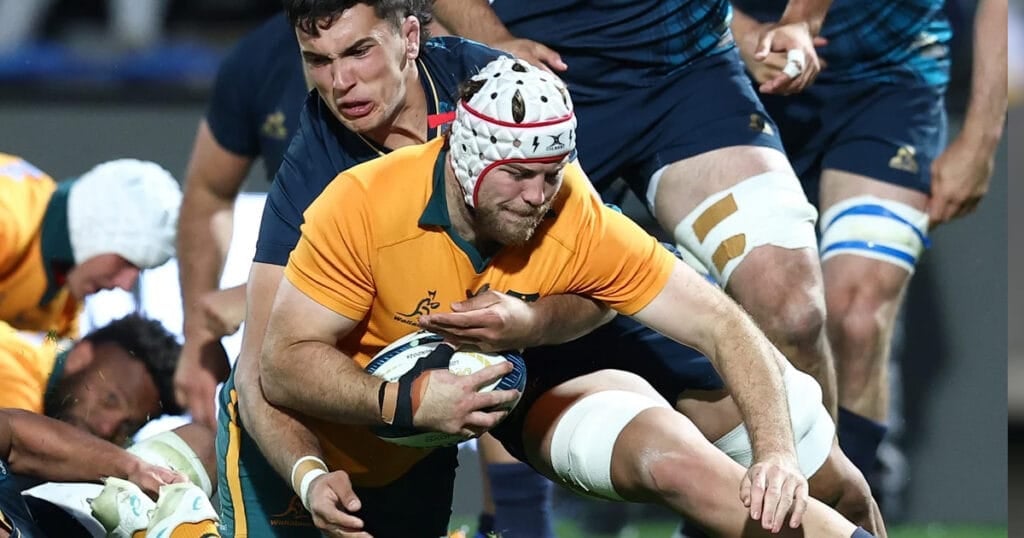
What they’re proving to be is, if they’re 10 metres out from the goal line, they’re proving to be a very effective side at getting across the goal line. It’s almost telegraphed. The nine stands back — so in other words, forwards, it’s all yours. And they go to work. And that showed up on the scoreboard, all the front rowers getting tries.
Telegraphed is not a criticism. A red-zone play the opposition can see coming and still cannot stop is among the most valuable things a Test side can own, because it converts territory into points without requiring anything creative to happen first.
McKenzie pinpointed the turn: “From that moment — the 51st minute, I think it was — is when Australia started to turn over the ball at the breakdown. It was a succession of penalties where Japan couldn’t sustain the support at the breakdown.”
He put Australia’s post-contact metres at around 500, which he described as the highest figure he had seen from any side all season, and their tackle completion at roughly 90 per cent. Both were his own numbers, offered from his notes rather than an official stat sheet.
He was careful not to oversell the scoreline. “To be fair to Japan, at the 71-minute mark it was 36-17, and then Australia got three tries in the last sort of… but that’s how it is. The game’s 80 minutes and you’ve got to be there.”
McKenzie:”He’s our best prospect” — the Carter Gordon question
McKenzie is unambiguous about who made the difference.
For me the difference was Carter Gordon. It just looked like he was managing the game, and players look confident around him. And I’m not just talking about attack — he was good in defence too. He made some good tackles, he was in there over the ball. He’s a complete player.
The reason he gives for the change is not technical. It is psychological, and he says it plainly.
We’ve always known he’s got plenty of talent — that’s never been the problem. But I think he’s had some mental demons. The imposter syndrome you sometimes get when you’re first selected: am I good enough to be here? Should I be here? He’s moved that to the side and he’s now saying, well, I am here and I’m going to do the business.
Then comes the part that reads as an indictment of Australian rugby rather than a compliment to the player.
I was really surprised that rugby didn’t try harder to keep him. He just one day was gone, off to the Titans, rugby league. I’m thinking, he’s our best guy — he’s our best prospect. It’s like there was no interest in fighting for him. I couldn’t believe it.
His accounting of the cost is brisk: “So we lost a good 12 months, 18 months in all of that process.”
McKenzie also rates the decision to hand Gordon the goal kicking, and not for the points. It gives him ownership in the team, he argues — an immediate responsibility he has taken on, after years of the job going to everyone but him. The immediate worry is what sits behind him: Australia need two more in the same mould, so the game plan does not have to change when he leaves the field.
“You can almost single-lift him” — the lineout tactic
The most detailed coaching passage McKenzie gives is on how Australia are using a light, quick jumper in the middle of the lineout.
If you can get someone up in that contest position easily, you can almost single-lift him. It puts enormous pressure on the thrower, because the thrower just doesn’t get to dart the ball in. He’s got to throw with an arc. The ball spends more time in the air. It allows other guys in the lineout time to be able to move in defence.
The chain runs like this. A light jumper reaches the contest position before the pod has finished forming. With a body already in the air, the flat, fast dart becomes a bad risk, so the hooker has to loop it instead. And a looped throw hangs.

Which is where the real value sits. One jumper does not just contest his own pod — he buys time for every other defender in the line to read the target and shift. That is why the tactic will always look better on tape than on a stat sheet, and why steal counts undersell it.
McKenzie adds the officiating angle: “It keeps the hookers honest. And automatically you’ve got to throw straight, because there’s someone defending in the air.”
The second row behind it is changing too. Where Australia spent years rotating the same locks in and out, McKenzie sees a younger, fresher group now — and a position whose job description has shifted. The modern second row’s contribution, he argues, is a far more athletic one than it was a decade ago.
“A different kettle of fish”: why Argentina is the real test
Everything above is measured against Japan. McKenzie is clear the tour is a different proposition entirely.
What’s good now is we’ve had a really good look across two different teams. We’ve had a good look at a bunch of players. Now we’re going to play Argentina — that’s a different kettle of fish. Argentina are further up the ladder in terms of world rankings, and they can mix it with anyone. They’ve got a diverse playing style. So now we’re going to get a good look at the players in that context.
That last clause is the one that matters. Two Tests against Japan told Australia what a group of players can do against a side they physically outmatch. Argentina will tell them what those same players are worth against a side that can meet them.
He thinks the rankings undersell the opposition: “I really rate Argentina. I was looking at the rankings and I think they’re seventh — just in front of Australia. I sort of couldn’t believe that. They were up to four at one point.”
His read on their form is that the experimenting has cost them little. A lot of uncapped players have featured recently, and they were still competitive against a Springboks side, even one missing its front-liners. He rates their attack, and Santiago Carreras in particular, as among the best fly-halves going around.
The specific worry is that Argentina are comfortable in exactly the arena Australia have just learned to win. They do not mind the physical stuff, McKenzie points out — they have won in New Zealand and they enjoy going to South Africa and getting stuck in. Which sets up the line that frames the whole tour.
What Australia is doing well at the moment, they might be licking their lips about — saying, well, let’s see how you go against us. And they’re not bad at that caper either. They’re pretty good 10 metres out, getting across the goal line.
Two sides with the same strength, one of whom has been doing it longer. The recent history is close too: “It was a close series the last time out. Last year was close, both Test matches.”
Wallabies vs Argentina 2026: fixtures
| Test | Date | Venue |
|---|---|---|
| First Test | Saturday 29 August 2026 | Estadio 23 de Agosto, San Salvador de Jujuy |
| Second Test | Saturday 5 September 2026 | Estadio Malvinas Argentinas, Mendoza |
The two Tests form the 2026 Puma Trophy series, both away from home. Kick-off times are still to be confirmed. Australia return from Argentina to face South Africa on 27 September before a Bledisloe Cup series against New Zealand in October.
Two away Tests inside eight days is a demanding schedule, and the first significant workload question of Les Kiss’s tenure as head coach.
Where McKenzie thinks Australia are
His own summary came before any of the detail above, and it is about as warm as McKenzie gets.
From where we sit right now, we’re heading in the right direction. Certainly a couple of positions have been problematic for us over the last few years.
A method at the goal line, a settled 10, a lineout that creates problems rather than just surviving them. None of it has been tested by a side that can match Australia physically. Wallabies vs Argentina, over two Tests in eight days, is where that changes.
Frequently asked questions
When is Wallabies vs Argentina in 2026?
The first Test is on Saturday 29 August at Estadio 23 de Agosto in San Salvador de Jujuy, and the second on Saturday 5 September at Estadio Malvinas Argentinas in Mendoza. Both are away fixtures in the Puma Trophy series.
What did Ewen McKenzie say about the Wallabies?
That they have developed a repeatable method for scoring inside 10 metres, that Carter Gordon is the right man at fly-half, and that the second row is being rebuilt with younger, more athletic players. His caveat is that Argentina will test all of it properly.
Why does McKenzie rate Argentina so highly?
He believes their ranking undersells them, points to their competitiveness against South Africa while fielding uncapped players, and notes they are comfortable in a physical Test — the exact area where Australia have just found form.
What did McKenzie say about Carter Gordon leaving for rugby league?
That he was surprised rugby did not fight harder to keep him, calling Gordon Australia’s best prospect and saying the episode cost the game 12 to 18 months of his development.





Comments
No one has weighed in yet.
Be the first - what did you make of it?