


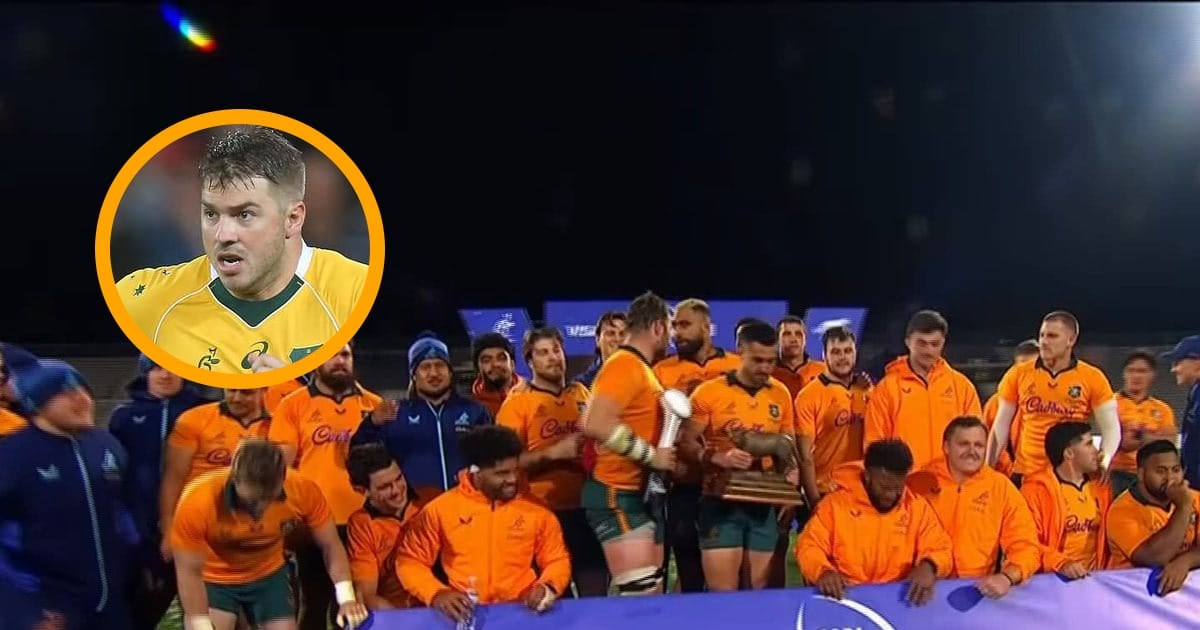
The 2026 Wallabies Argentina series was the first Australia have ever won there, in four attempts across 47 years. On Monday’s Kick Offs and Kick Ons, Drew Mitchell was handed the achievement by name and refused the word attached to it.
Drew Mitchell was handed a piece of Wallabies history on Monday, and told the room it did not count.
“I don’t think a series can be two games,” he said, still finishing a lolly.
He was talking about Argentina. Australia had gone there, come home unbeaten, and Mitchell, 71 Tests and four years at Toulon, wanted nothing to do with the word everyone was using.
So: pedant, or the only man in the room reading the format properly? Pick a side in the comments before you scroll, then check it against the table further down. It moved a 121-cap Wallaby on air, and it may move you.
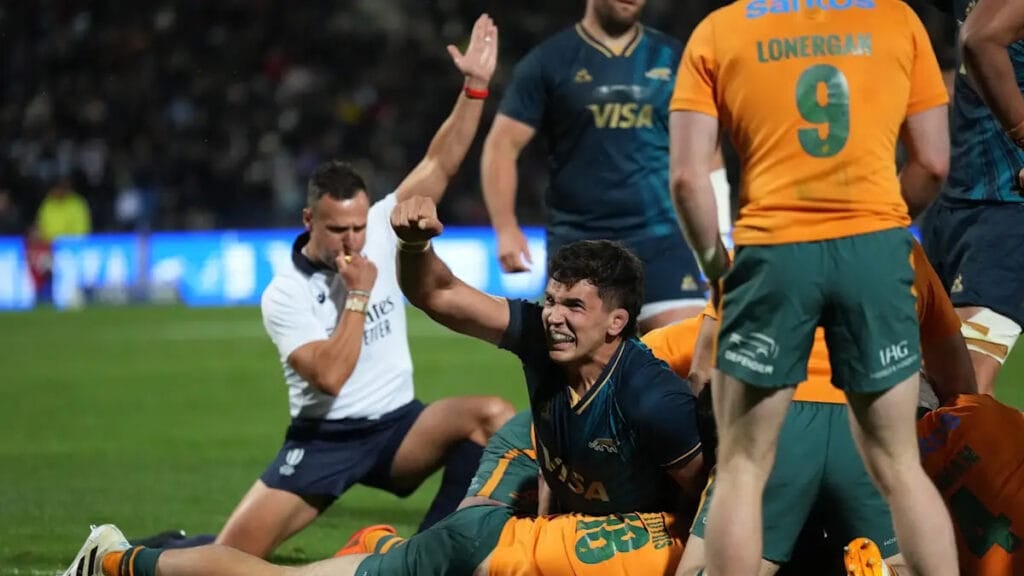
Australia beat Argentina 27-21 in Jujuy on Saturday 29 August, then drew 28-28 in Mendoza after two yellow cards inside a minute on Saturday 5 September, taking the tour and the Puma Trophy without defeat. It is the first time an Australian side has won a Test series in Argentina. Previous tours in 1979 and 1997 finished 1-1, and Argentina won the 1987 series.
Nobody on the show mentioned that last part. It is the reason Mitchell’s objection is worth arguing with rather than waving away.
“You need an outcome, don’t you?”
He built it properly, which is what separates it from bar-room quibbling.
“I don’t think you can say it’s a drawn series when you’ve won one and a half,” Mitchell said on Kick Offs and Kick Ons, published on Monday 8 September. “Like I think you need to win two games to win a series. You need an outcome, don’t you?”
Then he offered a scoring system, unprompted.
“I just think you get one point for a win, half a point for a draw. We’re one and a half there… if there was a third in Argentina when it’s one and a half all… I just think series should be over three not two. I think it’s an Argentina tour. It’s not a series.”
Test it on its own terms and it holds. A two-match set can only finish level or 2-0. Australia’s finished neither way, which is why the record books will file a win and a draw under the same heading as a clean sweep. Under Mitchell’s model it reads 1.5 to 0.5. And 1.5 is not two.
He also refused the easy escape. Told the same logic would bite the All Blacks in Baltimore, he did not flinch, and then went further than he needed to: “I don’t think there should be a four game series either. Like that doesn’t work anyway.”
Which is the part that should stop anyone accusing him of parochialism. The argument costs him the thing his own team just won.
The number the show got wrong, in Australia’s favour
“For the first time in forever” was how the achievement was introduced on air. That phrasing implies a long gap since the last one. There was no last one.
| Tour | Venue | Result |
|---|---|---|
| 1979 | Ferro Carril Oeste, Buenos Aires | Argentina 24-13, then Australia 17-12. Drawn 1-1 |
| 1987 | Vélez Sarsfield, Buenos Aires | 19-19, then Argentina 27-19. Argentina won |
| 1997 | Ferro Carril Oeste, Buenos Aires | Australia 23-15, then Argentina 18-16. Drawn 1-1 |
| 2026 | Jujuy and Mendoza | Australia 27-21, then 28-28. Australia unbeaten |
Sources: match records for the 1979, 1987 and 1997 Australian tours of Argentina, plus the 2026 tour results.
Four tours. Forty-seven years. Two draws, one defeat, and now this.
The trip was also Australia’s first tour of Argentina since 1997 and their first sole tour since 1987. The Wallabies finally got it done, and the format they did it in cannot quite hold the weight of it.

Adam Ashley-Cooper walked in disagreeing and left agreeing
Seventy seconds after Mitchell finished, something happened that panel shows almost never allow.
Adam Ashley-Cooper, 121 Tests, was asked whether he agreed. He opened with a joke, “yeah, I always agree with Drew. Otherwise, I’ll hear about it after the podcast”, and then admitted on air that he had walked into the studio thinking the opposite.
“He swung me. I’ll tell you, he swung my vote. I tend to agree. How can you have a series that’s only two games? It’s more like a tour… Series for me is always over three.”
Two men with 192 caps between them, both of whom toured for a living, landing in the same place. The word is wrong. Not the result.
That distinction matters, because the result was earned. Harry Wilson’s side scored four tries in Mendoza including a penalty try, held 15 against 13 through the closing quarter, and did not lose in a country where Australian sides have been losing since 1979. The ratings out of Mendoza do not read like a team that stole anything.
What the Wallabies Argentina series cost Les Kiss
Vocabulary is the small half of this.
A three-Test series is a coaching instrument. A head coach learns in the first Test and corrects in the second. The third is where he finds out whether the correction held, against the same opponent, in the same conditions, with nowhere to hide. It is why the Lions play three. It is why South Africa and New Zealand are playing four right now.
Two Tests hand a coach the first two steps and take away the third.
Les Kiss leaves Argentina having learned something in Jujuy and adjusted for Mendoza. He never found out whether the adjustment works. He lost Carter Gordon to a fractured fibula on the way, confirmed by the Wallabies with no official recovery timeline attached. He rotated a squad across two matches and drew one of them.
What he does not have is the third data point. The one that tells a coach whether he is building something or guessing.
The panel felt it without naming it. “It’s now time we start to pick and stick a bit more,” one of them said. “You’ve had your look.”
Give a coach two Tests and rotation becomes an experiment he never gets to finish.
The calendar handed out four, two, and none
The objection was never really about Australia.
The 2026 southern-hemisphere season did not stage the Rugby Championship. It was skipped for a year, not dissolved, and it returns next season. The space it left got filled unevenly. South Africa and New Zealand were given four Tests against each other, a genuine series with a decider still to come in Baltimore on Saturday. Australia were given two Tests in Argentina. And Argentina, who outplayed Australia for long stretches in Mendoza, were given no All Blacks fixture at all this year.
There is the argument underneath Mitchell’s semantics, and it is why this site takes his side.
Two Tests is not a series. It is a tour, and it should be recorded as a tour. Australia’s most significant away result in half a century arrived inside a format too small to describe it, and that is a scheduling failure rather than a linguistic one. The Wallabies should be asking for three. So should Argentina, who have now gone a full calendar year without playing New Zealand while New Zealand played the same opponent four times.
The show’s host arrived at the same place from the opposite direction. He admitted he had opposed the four-Test South Africa series precisely because it cost Argentina their All Blacks fixtures, then said it plainly: “I have to say, and I say this hat in hand… It has worked.”
It has. Four Tests produced the best rugby of the season, and two produced a historic result nobody can name properly. Meanwhile a former Wallabies coach wants World Rugby to lock an All Blacks fixture into the 2027 opener, which tells you the appetite for proper scheduling exists and keeps losing to the calendar.
It bites Australia again on Saturday 10 October
The Bledisloe Cup this year is a standalone two-Test series, precisely because the Rugby Championship is not being played. Eden Park on Saturday 10 October, Sydney on Saturday 17 October.
Two Tests. One trophy. And if they split it, New Zealand keep the Cup they already hold and Australia go home with a 1-1 that settles nothing, which is Mitchell’s entire argument arriving five weeks later, wearing gold.
Australia have already been reminded this season how thin the margins get when there is no third match to fix anything. Tom Hooper was released for one Test and lost again before the Bledisloe, the kind of squad churn a three-Test tour absorbs and a two-Test one cannot.
Frequently asked
Have Australia ever won a Test series in Argentina before 2026?
No. The 2026 tour is the first Australian series win on Argentine soil. Previous tours in 1979 and 1997 finished 1-1, and the 1987 tour was won by Argentina.
What was the result of the 2026 Australia tour of Argentina?
Australia won the first Test 27-21 in Jujuy on Saturday 29 August and drew the second 28-28 in Mendoza on Saturday 5 September, taking the tour and the Puma Trophy without defeat.
Why was there no Rugby Championship in 2026?
Under the SANZAAR 2026-2030 calendar the tournament is skipped in Nations Championship years. It was not staged in 2026 and returns in 2027.
When do Australia play South Africa and New Zealand next?
Australia meet South Africa at Optus Stadium in Perth on Sunday 27 September for the Mandela Challenge Plate, then New Zealand at Eden Park on Saturday 10 October and in Sydney on Saturday 17 October. The full list sits in the Wallabies 2026 Test schedule.
Read next: Perth is three weeks away and the Springboks arrive off a four-Test series, which is exactly the format Australia did not get. Who Les Kiss picks at 10 with Carter Gordon gone is the question that decides whether the Mendoza draw was a floor or a ceiling.
Your turn
Two ways to see it, and both have a fair case. Either a win and a draw across two Tests is a series win, and Australia should be allowed to enjoy the first one they have ever had in Argentina. Or Drew Mitchell is right, a series needs a decider, and what happened in Jujuy and Mendoza was a tour that finished unbeaten and nothing more.
Pick one. And if you go with Mitchell, answer the follow-up: does the Bledisloe Cup stop being a series on Saturday 10 October too?





Comments
No one has weighed in yet.
Be the first - what did you make of it?