



“Are you saying that Wales beat a New Zealand B team?” James Haskell asked it straight out on The Good, The Bad & The Rugby. Host Alex Payne had just listed the stars New Zealand left out in Cardiff. Haskell’s own answer: rotate against Japan or Fiji, not against a top side. Mike Tindall went the other way. He says the All Blacks B team row comes from a New Zealand culture of expecting never to lose, and the critics need to “get over” it.
Was Cardiff a lesson about rotation, or did Wales simply play better? Tell us in the comments.
Was it really an All Blacks B team in Cardiff?
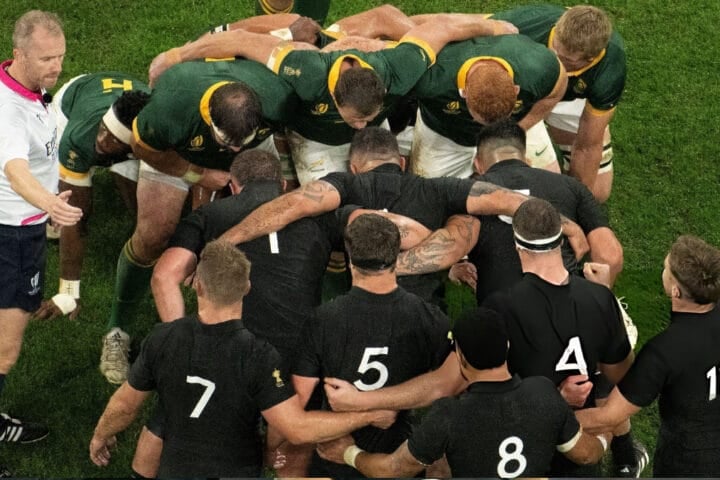
Wales won 35-28 at the Principality Stadium on Saturday 14 November, their first win over New Zealand since 1953. Dave Rennie made 10 changes to the match-day 23 that beat Scotland, eight of them in the starting XV. Beauden Barrett captained the side for the first time.
Not every absence was a choice. Will Jordan was out with a hamstring injury, and Jordie Barrett had failed a head injury assessment against Scotland. Cam Roigard, Damian McKenzie and Codie Taylor were not in the 23.
Rennie called it “a strong side with 783 caps” when he named it. After the loss he said he had no regret over the side he picked.
Why does Haskell say you can’t rotate against a top side?
Payne ran through the names and linked Cardiff to South Africa’s changed side losing in Perth. That was when Haskell cut in with the B-team question.
“I’m not saying that,” Payne replied. He was asking how New Zealand saw it. So Haskell answered his own question.
“I think South Africa proved that you can put different sides out and still get victories,” he said. It depends who you play. “I think you can do it against the Japan. I think you can do it against… Fiji.”
His line stopped at the top eight. “I don’t think you can do it… against a top side,” Haskell said, “because again the margins are so small.”

In New Zealand, Kevin Putt made the same point on Sky Sport NZ: the depth is not there for 10 changes at once.
Is New Zealand’s ‘never lose’ culture the real problem?
Tindall, a World Cup winner with England in 2003, put much of the noise down to “old traditionalists who expect a win every single game”. International rugby, he said, “isn’t like that” any more.
“I think you have coaches now who are quite happy to take a loss every now and again to try and find out who’s ready for the next step,” he said. A World Cup needs a full squad, so the squad has to be built.
Then came the line that will sting in New Zealand. “With Dave Rennie in particular, there is a culture in New Zealand that they expect that they won’t lose.”
Tindall had heard a New Zealand radio host call Cardiff the worst defeat in the country’s history. His reply: “I think you just need to get over and understand it was a second team.” He corrected himself at once: “Not second team, but it was a… rotated team.”
Did rotation lose it, or did Wales win it?
Tindall did not take the win away from Wales. “You just have to sometimes tip your cap to Wales for the passion,” he said.
Haskell thinks Wales were the wrong team to rotate against. Tindall thinks one loss is the price of building a squad. Neither says Wales were lucky. Dan Biggar’s tape shows how they cut the All Blacks open, including where Richie Mo’unga was caught out.
Who comes back for England at Twickenham?
New Zealand play England at Twickenham on Saturday 21 November, kick-off 2.10pm GMT (3.10am Sunday in New Zealand). The team has not been named yet, but Roigard, McKenzie and Jordie Barrett are expected back, says Justin Marshall. Wales host Australia in Cardiff the same day, at 8.10pm GMT (7.10am Sunday in Sydney).
Lose at Twickenham with the big names back, and nobody in New Zealand can blame rotation.
READ MORE: The KOKO panel on the All Blacks changes: “There’s no week off”

Video: The Good, The Bad & The Rugby, “Rassie Erasmus Banned After ‘Match Fixing’ Comments”. The All Blacks debate starts at 36:58.





Comments
No one has weighed in yet.
Be the first - what did you make of it?