



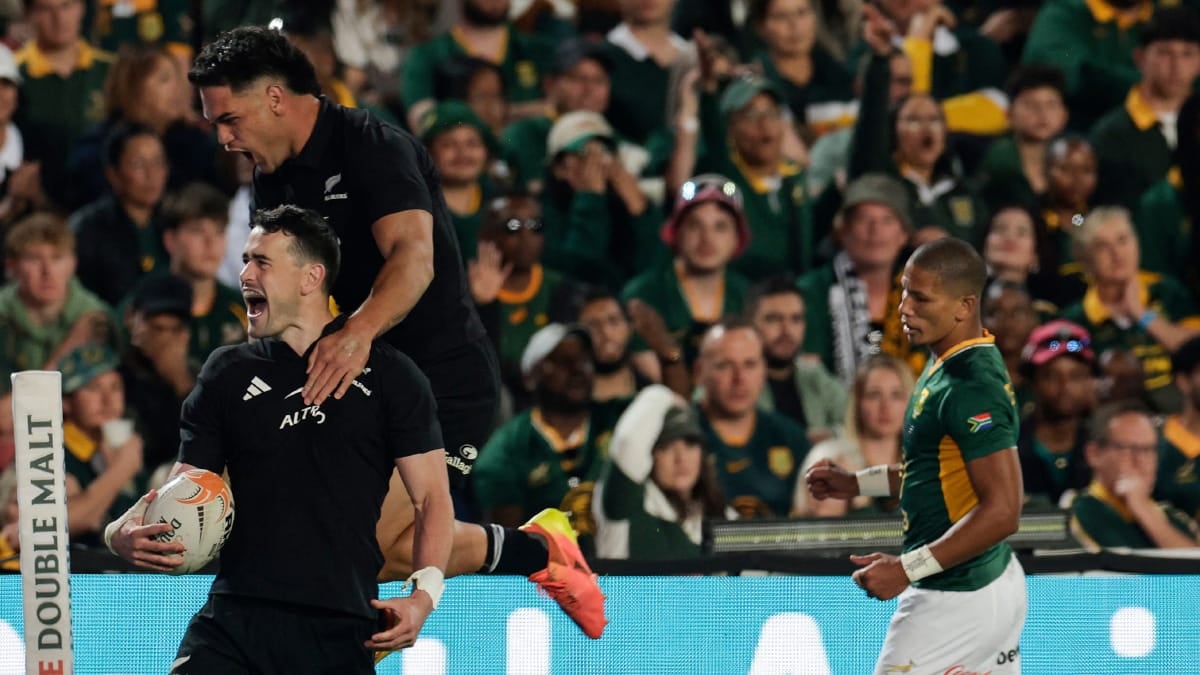
New Zealand beat South Africa 33-16 in the first Test of Rugby’s Greatest Rivalry at Ellis Park on Saturday, scoring five tries to one to lead the four-match series 1-0. The Springboks won the scrum, won the collisions and won most of the aerial contest, and still lost by 17 points — a defeat that ends a run of 12 consecutive Test victories.
Two numbers explain the whole night. South Africa entered the New Zealand 22 eleven times and came away averaging 0.9 points a visit. New Zealand went there nine times and averaged 3.6.
Everything else is detail.
Twenty minutes of nerves
The opening quarter was not a Springboks stranglehold. Both sides were tight and both sides made the kind of errors that come from wanting a Test too much: dropped lineouts, offside penalties, kicks put straight back down the throat of the chaser.
Cheslin Kolbe opened the scoring from the tee inside the first five minutes. Will Jordan answered in the ninth with his 52nd Test try, finishing a skip pass on the right after Cam Roigard had sniped from the base. Andre Esterhuizen — on early for Kurt-Lee Arendse, who failed a head injury assessment — put South Africa back in front on 14 with a straight-line carry through two tacklers.

Then Tupou Vaa’i, the best forward on the field for an hour, waded through contact in the left tram and offloaded infield for Josh Moorby to score on 24. Half-time: South Africa 13-12 New Zealand.
Then the Springboks took over
From roughly the 20th minute to the hour, this was one-way traffic in the tight.
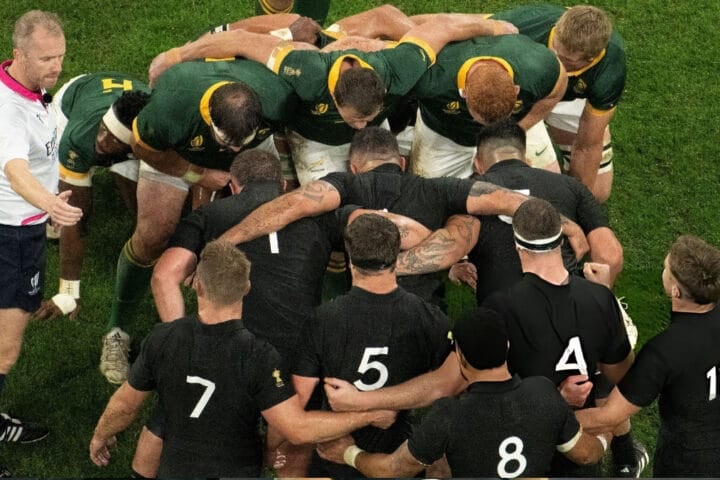
Ox Nche put Tyrel Lomax through the floor on 32 to win a scrum penalty that had the stadium chanting for more of the same. Jasper Wiese was the best player on the field — a No 8 hitting the gainline every time he touched it, plus a turnover and a defensive shift that never dropped off. The half-time numbers showed South Africa carrying 42 times to New Zealand’s 58 and still making 133 post-contact metres to 103. Fewer carries, more damage.
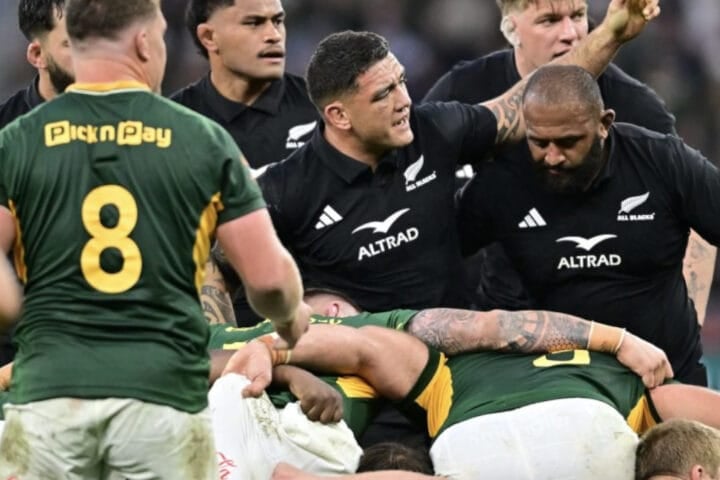
New Zealand were also being physically dismantled at the set piece. They conceded scrum penalties in both halves and lost Ethan de Groot and Josh Lord to a clash of heads just before the break, forcing George Bower and Simon Parker on early.
The problem was what South Africa did with all of it. Malcolm Marx spilled the ball over the line from a maul on 35. Sacha Feinberg-Mngomezulu overran passes three separate times. Grant Williams was slow enough at the base for Fabian Holland to charge down his box kick on 48 and stride in — a try that came completely against the run of play and put New Zealand 19-16 up.
The substitution that changed the Test
By the 55th minute the Springboks had won three second-half scrum penalties in a row and kept waving away the posts to scrum again, hunting a yellow card for the New Zealand front row. It was the right call. It was working.

Asafo Aumua replaced Codie Taylor on 54. Two minutes later, camped on their own line under the exact pressure that had been breaking them all evening, New Zealand won a scrum penalty.
That was the match.
It is not that Aumua single-handedly fixed a scrum — Bower and Fletcher Newell were part of the same front-row refresh. But the moment the hooker arrived is the moment the platform stopped collapsing, and the psychological swing was immediate. New Zealand had spent an hour being told by the scoreboard and the crowd that they could not live in that contest. One penalty told them they could.
South Africa never won another scrum penalty of consequence.
Once the scrum stopped paying, everything went
Within two minutes of losing their weapon, the Springboks were defending a break they had no business conceding. Jordan beat five tacklers from a retreating catch and released Damian McKenzie, who was inside the 22 before Damian Willemse got a hand to the offload and saved a certain try. It bought 60 seconds. From the resulting scrum, Ardie Savea picked and went, dragged in two defenders, and Luke Jacobson fell over on the short side. 16-26.
Quinn Tupaea’s 50-22 on 68 pinned South Africa in their own half. Marco van Staden was sinbinned on 70 for taking out the scrum-half on the line, Cobus Reinach followed on 71 for a deliberate knock-on, and against 13 men Savea’s bridge pass sent Jordan over untouched on 75 for his second.
Fans started leaving Ellis Park with five minutes on the clock.
The table that tells it
Key match numbers. Possession, carries and post-contact metres are first-half figures; 22 entries and tries are for the full 80.
| Metric | South Africa | New Zealand |
|---|---|---|
| Tries | 1 | 5 |
| Entries into opposition 22 | 11 | 9 |
| Average points per 22 entry | 0.9 | 3.6 |
| First-half possession | 44% | 56% |
| First-half carries | 42 | 58 |
| First-half post-contact metres | 133 | 103 |
| First-half line breaks | 2 | 4 |
What South Africa have to fix
Nothing about the pack. Nche, Wiese, Eben Etzebeth and Pieter-Steph du Toit — captaining in Siya Kolisi’s absence — all delivered. Paul de Villiers, three caps in, made 12 tackles by half-time, more than anyone on the field.
The failure was behind the scrum and between the ears. Eleven entries into the 22 for one try is not bad luck; it is a side that arrives in the red zone with no plan beyond another collision. Feinberg-Mngomezulu and Williams were not on the same page all evening. And when the one thing that had been generating points stopped generating them, there was no second idea.
Dave Rennie‘s All Blacks did not out-muscle anybody. They survived 60 minutes of being out-muscled, kept their heads, and took four of the five chances they created. On this evidence they will take that trade three more times.
The second Test is next in the series. South Africa need a backline, not a bigger pack.





2 comments
The only comment you got right is that the second test is next in the series.
Why?