



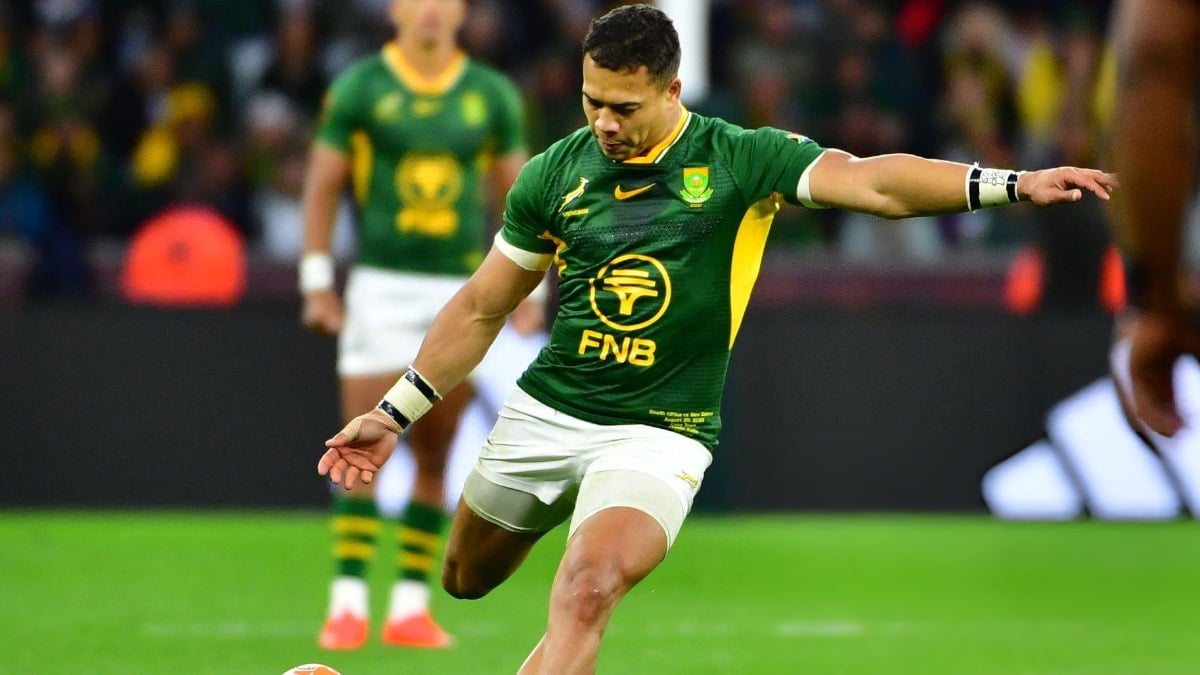
Second Test, DHL Stadium, Cape Town, Saturday 29 August 2026. South Africa 33, New Zealand 26. Series level at 1-1.
South Africa visited the New Zealand 22m four times and scored three tries.
New Zealand went there nine times and scored four.
That gap is the whole second Test, and it is the exact reverse of what happened seven days earlier at altitude. These are the five key moments that levelled Rugby’s Greatest Rivalry, in the order they happened. The one that actually ended the New Zealand comeback landed on 71 minutes, and it was won by a hooker who had spent Friday named in the starting XV.
1. Two minutes gone, and the Springboks had already told them everything
South Africa won the opening lineout, mauled off it, and Cobus Reinach sent Jesse Kriel through a line that had not finished organising itself. Cheslin Kolbe converted before the clock reached two minutes.
Seven-nil, inside 120 seconds, against a side that had won the opener 33-16 at Ellis Park and arrived expecting to dictate.
A start like that hands the home crowd a reason to make noise and hands the visitors a job. Play catch-up rugby, for as long as it takes, against the best defensive side in the world.
Dave Rennie was asked afterwards about another slow start and gave the only laugh of a bruised evening.
“We might get him to win a toss so we can kick off.”Dave Rennie, All Blacks head coach, post-match press conference, Cape Town, 29 August 2026
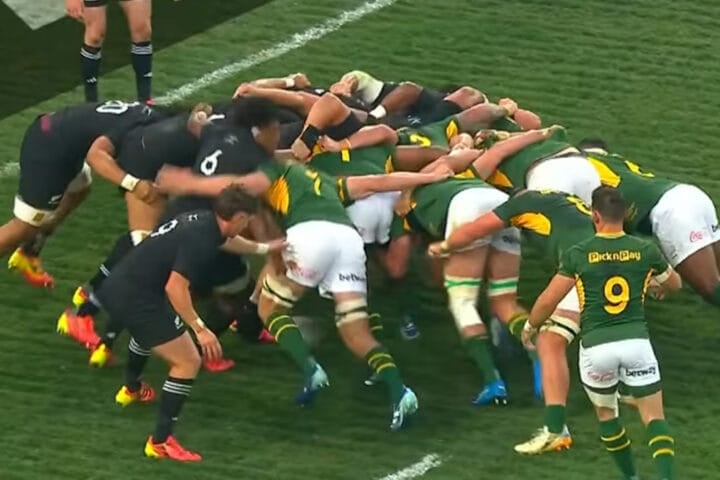
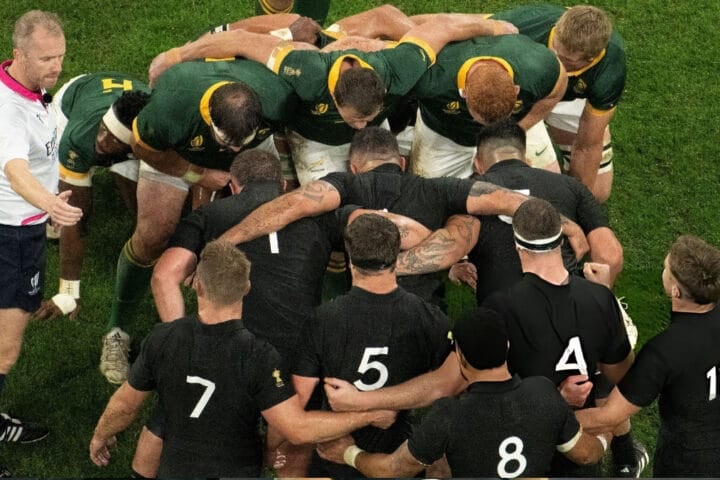
The set piece underneath it mattered more than the try. South Africa were 100 per cent on their own lineout throw all night, with a 39-year-old hooker starting the game and a bench hooker finishing it. New Zealand were not. Eben Etzebeth spoiled three attacking All Blacks throws, and the first of them came during a first-half siege on South Africa’s own five-metre line, when a New Zealand attacking lineout inside the shadow of the posts became a Springbok scrum instead.
He did it again on 64 minutes, after a fourteen-phase All Blacks attack and a penalty had taken them to within a metre of the line. Same lock, same result. Ball cleared, siege over.
Two of the biggest chances New Zealand created all night died on their own throw-in. Not in a tackle, not at a scrum, not to a turnover. On the one bit of the game they were meant to control completely.
2. Roigard levelled it, and South Africa took six minutes to answer
New Zealand did get to 7-7. Jordie Barrett and Ruben Love shifted it wide, Leroy Carter released Will Jordan early, and Jordan looked inside for Cam Roigard to score under the posts on 15 minutes. Love converted. Level game, quarter of an hour played, and the Test everybody had come for was finally under way.
It lasted six minutes.
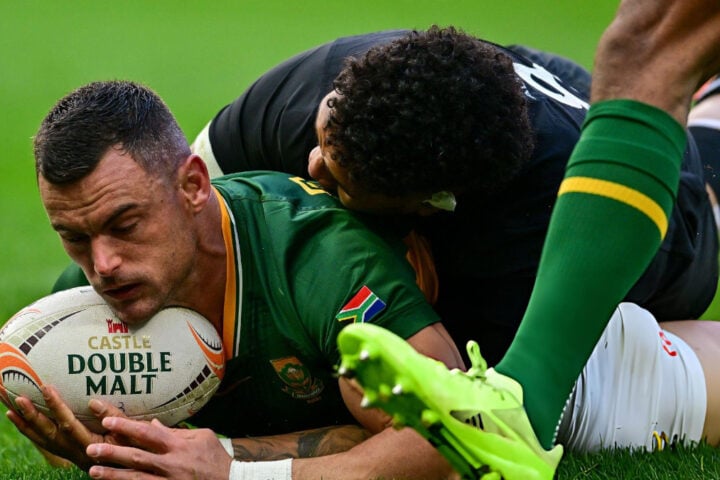
Kolbe kicked a penalty on 18 to make it 10-7. Three minutes after that the maul went again, and Damian de Allende came off the back of it and shrugged two defenders off to score. Kolbe converted. 17-7.

This is the pattern that decided the Test and it repeats four times: New Zealand score, South Africa answer inside six minutes, the deficit resets. Momentum in rugby is not a mood. It is a period of time in which one side is allowed to feel comfortable, and South Africa never granted one longer than a few minutes all evening.
3. Kolisi scored the try they could not score at Ellis Park
Thirty-seven minutes, and the captain went over from close range. Kolbe converted for 24-14 at the break.
On its own, a routine forward’s try. Set against last week, the most significant score of the night.
Seven days earlier there were eleven visits to the New Zealand 22 and one try to show for them. Malcolm Marx was held up over the line. Three first-half entries produced nothing. South Africa dominated a Test for an hour and lost it by 17, because dominance without points is a highlights reel.
In Cape Town they entered four times and scored three tries. Same pack, same coach, same opposition, one week apart. The difference was entirely in the finishing.

Going in ten clear at half-time also changes what a coaching group can say in the sheds. A three-point lead invites a warning. A ten-point lead invites instructions.
4. Two penalties, six points, and the arithmetic changed shape
The first ten minutes after the restart settled it, and South Africa did not have to build a single attack to do it.
New Zealand were pinged for an obstruction on 48. Kolbe kicked it from 35 metres. New Zealand were caught holding on two minutes later, closer in. Kolbe kicked that too. 30-14.
Sixteen points, half an hour left.
Look at what that does to a chasing side. At ten down, two converted tries win the Test. At sixteen down, two converted tries still lose it. New Zealand needed three scores now, and they had just emptied their front row to chase the smaller number.
Kolbe finished seven from seven off the tee. Three conversions and four penalties, 18 of South Africa’s 33 points. Twelve of those points arrived without the Springboks getting inside the 22 at all. With his range, any New Zealand infringement inside their own half was worth three.
5. Carter scored, the ground got nervous, and Marx ended it on 71
This is where the Test could have turned.
On 65 minutes Fabian Holland got the ball moving, Quinn Tupaea threw a pass to Leroy Carter on the left, and Carter beat the cover to the corner. 30-19. Love’s conversion from the touchline drifted left, which mattered, because a successful kick makes it a two-score game with fifteen minutes to play and a stadium that has started to remember Ellis Park.
Everything about the shape of it looked like the first Test, where New Zealand lost an hour and won the match anyway.
Then Malcolm Marx got over the ball in midfield.
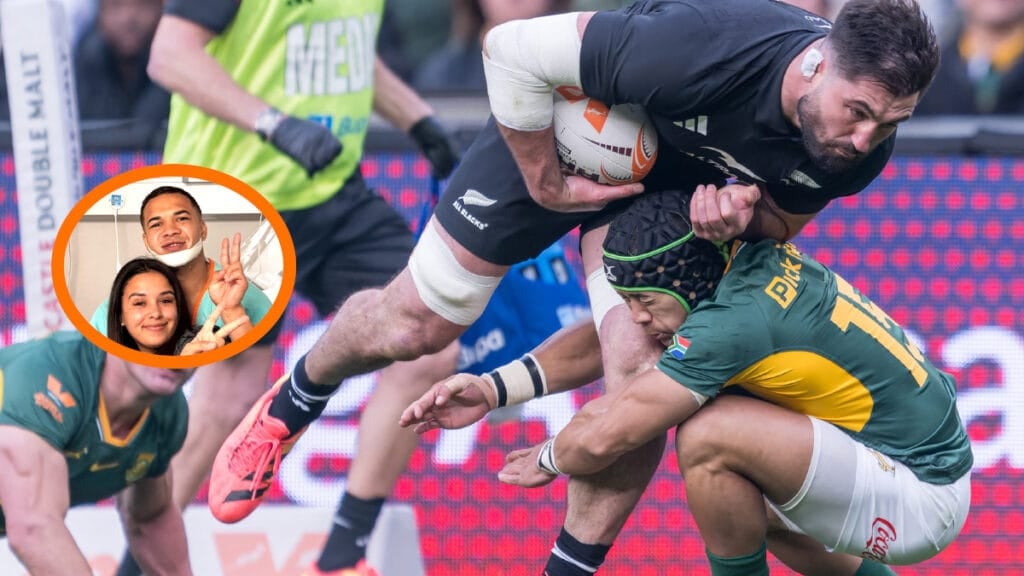
Marx had come on at 35 minutes, in the front-row switch Rassie Erasmus made five minutes before kick-off, and he won three breakdown turnover penalties in his 45 minutes on the field. The one on 71 was the one that counted. It stopped a New Zealand attack dead in the middle of the pitch at the exact moment the comeback needed continuity, and it handed Kolbe a shot from 40 metres, straight in front.
33-19. Fourteen points with nine minutes left, and the crowd sat back down.
New Zealand still had a route. Kyle Preston broke the line, Ardie Savea crashed over on 76 and Love converted, and when Lood de Jager was sin-binned on 79 for head-on-head contact on Carter, the All Blacks had the final play a man up, from halfway.
They got nowhere. André Esterhuizen, on since the 42nd minute, and Cameron Hanekom clamped over the ball at a tackle on Will Jordan, and the last act of the Test was a South African turnover.
Twice in nine minutes, a South African got his hands on a ball that belonged to somebody else. The seven-point margin is those two moments and nothing else.
What Johannesburg has to answer
The lineout is New Zealand’s most fixable problem and their most urgent one. Three spoiled attacking throws, two of them inside the South African 22, is not a matter of effort or of the pack being beaten up. It is a calling and timing problem against a lock who is reading the caller, and it is fixable in a week.
South Africa’s question is narrower and less comfortable. Between the 50th minute and full time they scored three points, and New Zealand held 95 per cent of the possession in the final ten. The finishing that had been so good for fifty minutes disappeared, and it nearly cost them the Test.
There is also the scrum row New Zealand took to World Rugby before this Test, which 80 minutes of evidence did not settle in either direction. That one goes to Johannesburg as well.
Springboks vs All Blacks second Test key moments: the takeaway
Rennie named it himself, without being shown a stat sheet.
“We left two or three out there, which in the end is the difference.”Dave Rennie, post-match press conference, Cape Town
Two or three tries left on the field, in a Test lost by seven, by a side that scored four tries to three and led for none of the 80 minutes.
Efficiency is a skill, not luck. South Africa have built a decade of results on doing less with the ball and more with the moments, and Cape Town was the purest version of it. New Zealand were the better side for long stretches and go to Johannesburg carrying the feeling South Africa carried out of Ellis Park.
The third Test is at FNB Stadium on Saturday 5 September, the fourth is in Baltimore on 12 September, and whoever wins in Soweto needs only a draw in the United States.
Read next
- Springboks player ratings: Marx got a 7.5 off the bench, and there is a case he was the most influential player on the field
- All Blacks player ratings: the lowest-rated starting back kicked three from four, and the reasoning is arithmetic
- The full match report: four tries, no lead, and the front row that was picked off a weather forecast
- Every fixture and kick-off time in Rugby’s Greatest Rivalry: the series is level with two to play
Two ways to read the same 80 minutes. Either South Africa won it at the set piece and the breakdown, taking every point on offer, or New Zealand lost it by leaving tries in the opposition 22 and losing their own lineout twice in the danger zone. One of those is a team being beaten. The other is a team beating itself. Pick one in the comments, with a minute number attached.




Comments
No one has weighed in yet.
Be the first - what did you make of it?