



Trevor Nyakane and Steven Kitshoff spent Monday’s episode of For The Love Of Rugby trying to explain the man they know to the one who played hooker in Soweto. They could not do it, and the reason New Zealand cannot either is in what happens at every ruck Malcolm Marx gets near.
Steven Kitshoff brews a beer with Malcolm Marx. Trevor Nyakane shares a bus seat with him. Between them they have 151 Springboks caps and two World Cups each, and on Monday morning they gave up trying to explain him.
“This can’t be the same Malcolm that I chill with on the bus,” Nyakane said. He was not joking.
There is one thing from Saturday that explains the gap, and Kitshoff counted it from the SuperSport box while the match was still going. Not the steal on 61 minutes, not the try. It comes later, because it only makes sense once the rest of the series is on the table.
The two of them host For The Love Of Rugby: South Africa, and Monday’s episode was 72 minutes on the 29-24 in Soweto that put South Africa 2-1 up in Rugby’s Greatest Rivalry. Kitshoff, 83 caps at loosehead, retired last year with a neck injury and was on SuperSport commentary on Saturday. Nyakane, 68 caps and still playing for the Sharks at 37, shared a Springboks dressing room with Marx through two World Cups and explained Siya Kolisi’s captaincy on the same show a fortnight ago.
Their subject was the reigning World Rugby Player of the Year, a hooker with more Test tries than any Springboks forward in history, 89 caps before this series started, and a RugbyPass headline by Sunday morning that called him rugby’s greatest bully.
Malcolm Marx, 32, is the Springboks’ first-choice hooker and plays his club rugby for Kubota Spears in Japan. Across the three Tests against New Zealand he has started twice and come off the bench once, won the breakdown penalty and scored the maul try that decided the Soweto Test, and thrown 11 from 11 at the lineout. If you think the vote that gave Ethan Hooker the award on Saturday got it right, hold that thought until the last section.
Kitshoff’s business partner does not play like this
Off the field the description is boring, and both men insist on it. Kitshoff’s version: one of the nicest people in the squad, always keen for a coffee or a beer with his mates. The beer is literal. Kitshoff and Marx co-founded Bomb Squad Beer, brewed at Saggy Stone in Robertson, which makes the loosehead a business partner as well as a former front-row neighbour.
Then Kitshoff asked the question the episode was built on. What flips?
“There’s a flicker somewhere in his brain, or somehow, somewhere, and he just goes onto the field and you’re like, this can’t be the same Malcolm that I chill with on the bus, that I talk to. He just becomes a beast on the field. And you can’t say this is luck anymore. He does it consistently, week in, week out. Everybody knows, if Moose is on the field, chances are, if you’re a second too late, ball is gone. If you don’t tackle at the right height, you’re going to get bounced.”
Nyakane, on For The Love Of Rugby: South Africa, Monday 7 September.
“A second too late” is the technical part of that. A jackal wins the ball in the gap between the tackle landing and the first cleaner arriving, and most hookers are not in that gap because they are still getting to the ruck. Marx is set before the carrier hits the floor, feet wide, weight already over the ball, so the cleaner is not moving him off it but trying to move him back through it. Sir Steve Hansen, who coached the All Blacks to the 2015 World Cup, saw the same thing from the other side. On Rugby Unity before the third Test he said New Zealand had been going to ground too early in the first two Tests, and that “Malcolm Marx, he’s wonderful at it.” The first half of that sentence is the part New Zealand can still fix.
One steal, one try, and a stadium on its feet
The Soweto ledger is short and it decided the match.
On 36 minutes South Africa chose a scrum five metres out with Ruben Love in the bin, Ox Nché went through Tyrel Lomax, and the referee walked under the posts for a penalty try. Marx was the man in the middle of that scrum, which, as Nyakane explained on the same episode, is where the Springboks send every ounce of pressure. On 61, with New Zealand building inside the South African half at 19-17, Pieter-Steph du Toit made the tackle and Marx got over the ball. Penalty. It turned the last quarter. Four minutes later du Toit brought down a throw at the back of the lineout, the ball came to Marx at the back of the maul, and it went 20 metres and sideways towards the posts until it splintered and he fell over the line.
He thumped the turf. Planet Rugby gave him a 9 and noted the standing ovation when he went off on 70. He got an 8.5 in the site’s ratings, with the case for him above Hooker set out at the bottom. Ethan Hooker got the award.
And the lineout did not lose a throw. Eleven from eleven on the Stan Sport board.
Three Tests, three different jobs
The series has asked him for something different each week, which is what makes Soweto a chapter rather than the whole story.
| Test | Role | What he did | Source |
|---|---|---|---|
| Ellis Park, Saturday 22 August, lost 33-16 | Started | First to pop in the 56th-minute scrum penalty that turned it | Kieran Read, Good Bad Rugby |
| Cape Town, Saturday 29 August, won 33-26 | Bench, on for Deon Fourie on 35 | Two breakdown penalties that Cheslin Kolbe kicked, a break on 48 | Keo.co.za; WeTalkRugby ratings |
| Soweto, Saturday 5 September, won 29-24 | Started, off on 70 | Steal on 61, maul try on 65, lineout 11 from 11, penalty-try scrum on 36 | WeTalkRugby match data; Stan Sport |
Cape Town is the one people forget, because Rassie Erasmus swapped his whole front row before kick-off and Marx came on at 35 for Fourie. He won two breakdown penalties, Kolbe kicked both, and he added a break on 48 minutes that the defence simply parted for. John Smit, 111 caps and the captain who lifted the 2007 World Cup, said on “I Love Rugby” that Marx “was just incredible when he came on, he must have been close to being part of that man of the match sort of scenario”. The site had argued before that Test that the bench had stopped winning the last quarter. Marx restarted it.
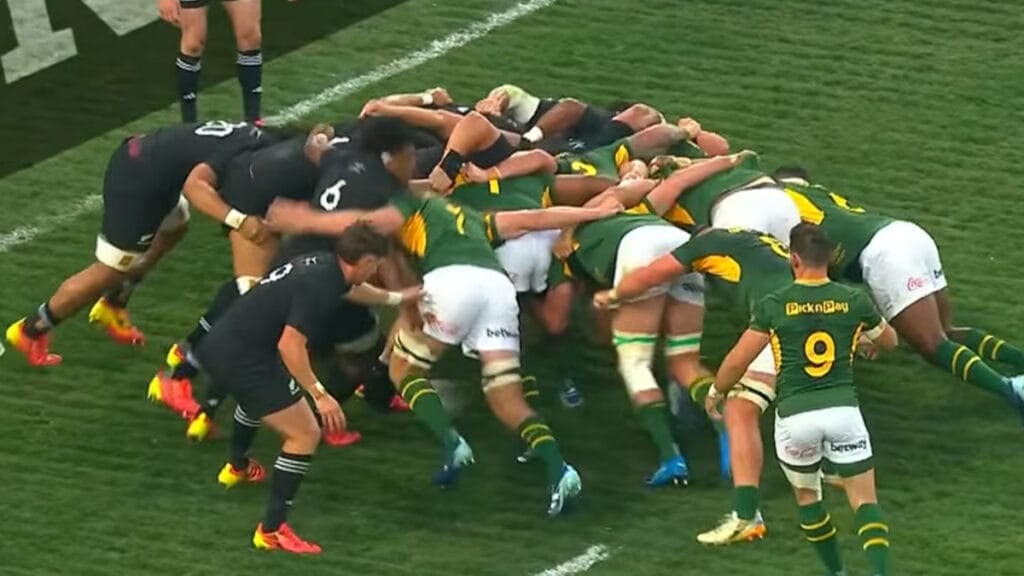
Ellis Park is the complication. Kieran Read, who packed down behind All Blacks front rows for 127 Tests, gave the mechanism of the 56th-minute scrum penalty on Good Bad Rugby: Fletcher Newell held his side static, George Bower’s drive had somewhere to travel, “and Malcolm Marx was the first to pop. Which probably was the signal for the ref to call the scrum penalty.” The best hooker in the world lost a scrum on the tell every referee watches for, the hooker’s hips coming up first. Two weeks later he was in the middle of one that walked New Zealand over their own line.

The clear-out New Zealand is still arguing about
Ardie Savea had scored twice by the half hour. On 31 minutes he went to compete at a breakdown, Marx arrived at speed to clear him, and Savea left the field holding his arm with a dislocated shoulder. He will not travel to Baltimore.
Kitshoff raised it the way a New Zealander would: Marx “was the one that hit Ardie Savea… caused the injury to Ardie’s shoulder.” Nyakane cut across him before the sentence had landed.
“It’s not like he did something wrong. He did not. He did not… He just cleaned him out extremely well.”
Kitshoff: “And aggressively, exactly.”
There was no penalty on the night and no card, and by Monday morning no citing had been reported. Ruck’s round-up of the reaction split down the Tasman: “textbook, legal, legit” on one side, “in on the angle” and “no wrap” on the other. The legal question is the arm and the entry, and it is fair to ask of any clear-out that ends a captain’s series. Two props who have spent their careers on both ends of that contact saw a clean-out that was very good rather than late or high. Until somebody in an official capacity says otherwise, theirs is the reading with the evidence behind it. What Nyakane defended was the technique. He never mentioned temper.
There is a second thing he said that needs explaining, and it is stranger than the clear-out. He no longer watches Marx’s lineout throws. That is at the end.
Count the black jerseys around Malcolm Marx
Now the number Kitshoff counted, and why it matters more than the steal.
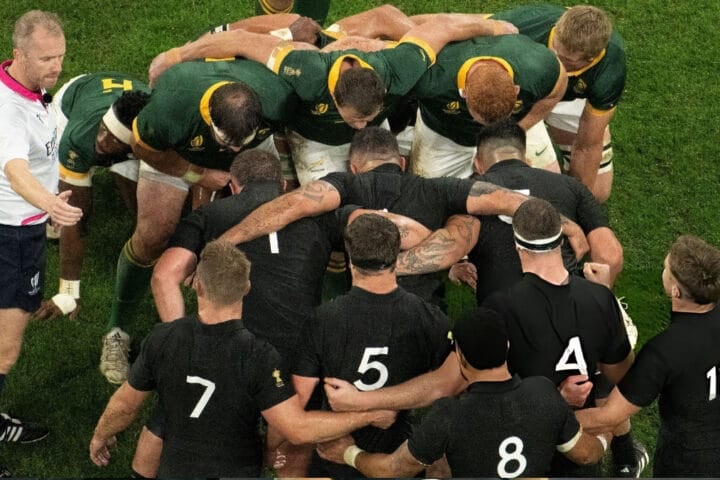
“New Zealand realises that Malcolm is a big poaching threat… So New Zealand has to almost commit an extra number to their breakdown to make sure that they target Malcolm… It almost feels like every time Malcolm is close to a breakdown, there’s a New Zealander that’s just coming from the side, early, just targeting Malcolm, because they know he’s a threat. And what that does to the attack is they’re losing numbers. They’re going out of shape a little bit because they have to commit an extra player.”
Kitshoff, on For The Love Of Rugby: South Africa, Monday 7 September.
You watched the last quarter. Watch it again and count the black jerseys at any ruck Marx is within two metres of. There is one more than the ruck needs, and he arrives before the ball does. Then look at the attacking line outside it. The player who would have been the spare man on the edge is the one who has just gone in to sit on a hooker.
Nyakane finished the thought.
“Even if you say, okay, we’re going to have a plan for Malcolm Marx, that means if he’s around, in and around the breakdown, we must commit. Now you’re breaking your whole shape, or you’re losing a number where it would be an overlap. Now one more person has to resource a breakdown and that overlap is not there anymore. That’s what Malcolm brings… So you have to come up with plans for him. But coming up with plans for him is you have to sacrifice somewhere.”
Ewen McKenzie, 51 Tests as a Wallabies tighthead and a 1991 World Cup winner, had said the same thing from the other side before the Test: “We made Malcolm Marx look really good and he’s good over the ball.”
The cameras got the steal on 61. Nobody counted the overlaps New Zealand never had because a forward was busy guarding a ruck, which is why Nyakane says the turnover count is the wrong measurement.
“If you don’t see him stealing two or three, you ask yourself what the… but you forget that guy’s a hooker. His job is to hit the darts and to scrum and to run over, stop momentum, gain momentum. And when you don’t see him stealing two or three balls… where the hell is Malcolm? No, he’s still playing a flipping seven, eight out of 10 game.”
Keo.co.za noted after Cape Town that Malcolm Marx has won three or more turnovers against New Zealand on four separate occasions. The nights he wins one are the nights somebody has been paid to stop him.
The lineout nobody worries about any more
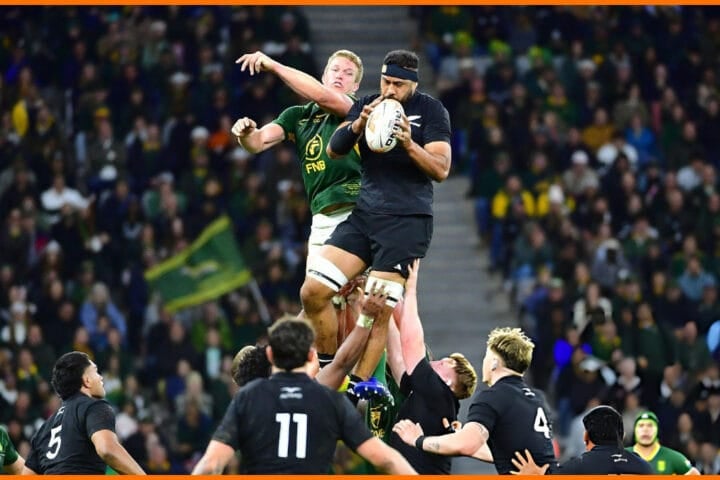
Last September the Springboks lost four of their 18 throws at Eden Park and were running at 79 per cent for the Rugby Championship, the worst of the four nations, and Marx told reporters he had to take “formal responsibility” for it. Twelve months on, Soweto was 11 from 11, and the throw that mattered was the long one over du Toit’s right shoulder, a fraction too far by Kitshoff’s reading, caught anyway, and turned into the maul that scored.
Nyakane learned to throw alongside him years ago, when he was being trained to cover hooker, and remembers Marx’s darts landing almost at once.
“Right now, if there’s a lineout, I don’t even have to worry about anything. So I get amazed when I see maybe an overthrow. I start asking myself, was the lift good or not good, or maybe someone didn’t give the right call, because he’s so good at it right now.”
The most feared breakdown player in Test rugby has a basic job so reliable that a former team-mate checks the lifters before he checks the thrower.
What changes between the bus and the field, on the evidence of three Tests, is timing rather than temper. He gets to the ruck early and he throws early. At Ellis Park he popped early too, and it cost him. The men who know him best cannot square any of that with someone who has never been late to a fight. Asked in Dublin last November what the award meant, Marx said it had not sunk in and that “none of this is achieved without the team environment we have”. That is the man on the bus talking.
The site’s position is straightforward. Hooker had the better Saturday by the official vote. Malcolm Marx has had the better series by every other measure, and in a four-Test contest that is the award that counts.
Frequently asked
Was Malcolm Marx’s clear-out on Ardie Savea legal?
No penalty was given on the night, no card was shown, and no citing had been reported by Monday morning. New Zealand supporters are split between “textbook, legal” and “in on the angle, no wrap”. Nyakane and Kitshoff both called it a clean, aggressive clear-out.
Is Malcolm Marx fit for the fourth Test in Baltimore?
He went off on 70 minutes in Soweto and Kitshoff described what he saw as a shoulder niggle, but Rassie Erasmus’s Sunday injury update named six players staying at home and Marx was not one of them.
How many turnovers has Malcolm Marx won in the series?
The one that mattered most came on 61 minutes in Soweto, at 19-17, and turned the last quarter. In Cape Town he won two breakdown penalties off the bench that Kolbe kicked. Kitshoff and Nyakane argue the count undersells him, because New Zealand commit an extra player to any ruck he is near.
Your turn
Player of the series so far: Malcolm Marx, or somebody else? Ethan Hooker has the Soweto award and Cheslin Kolbe kicked seven from seven in Cape Town. If it is one of them, or anyone else in black or green, name him below and say which Test he won.





Comments
No one has weighed in yet.
Be the first - what did you make of it?