
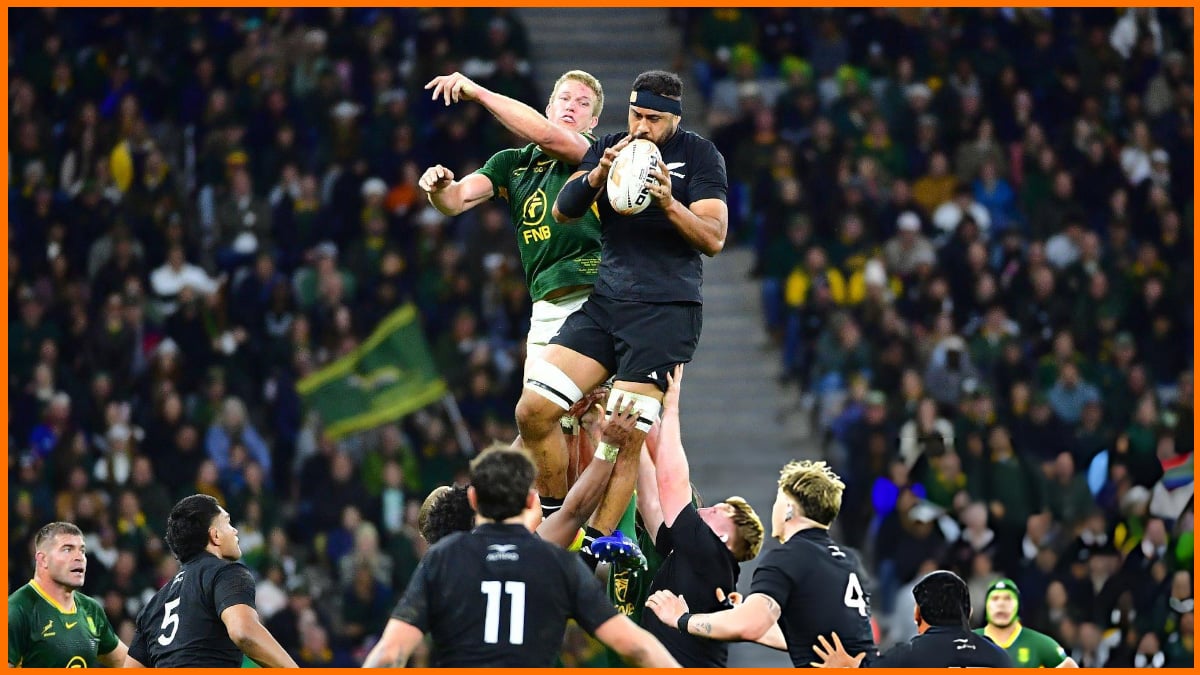
Second Test, DHL Stadium, Cape Town, Saturday 29 August 2026. South Africa 33, New Zealand 26. Series level at 1-1.
New Zealand scored four tries in Cape Town. South Africa scored three.
New Zealand led for none of the 80 minutes.
There is no mystery in that, and there is no bad luck in it either. Four of the five All Blacks key moments below are things New Zealand did to themselves, and the fifth is the one they are entitled to be angry about. Two of the five happened on their own throw-in, on the South African five-metre line, with the Test there to be taken.
1. Roigard under the posts on 15, and the proof the attack was never the problem
The response was excellent, and it came off a lineout.
From a throw just inside the South African half, the ball went off the back and straight into hands. Ruben Love and Jordie Barrett both double-pumped to hold the defence honest, which bought the extra half-second on the outside, and Will Jordan got the ball with an overlap. He stepped through Jesse Kriel, rode Damian de Allende’s tackle, and offloaded to Cam Roigard arriving underneath. Love converted. 7-7 on 16 minutes.
Fast lineout ball, two playmakers holding a rushing defence, a winger one-on-one. The best blitz defence in the world got taken apart by it inside a quarter of an hour, and New Zealand went on to make nine entries into the South African 22 against four.
The problem was never getting there. It was arriving behind every single time, because South Africa had scored inside two minutes and New Zealand spent 79 of the 80 chasing.
READ ALSO: the five moments that won them a Test they were losing at Ellis Park, which is the version of this article nobody in New Zealand minded reading.
2. The try that was checked twice, and never for the thing that mattered
Damian de Allende scored on 21 minutes off a maul. The score itself was reviewed. The part that mattered was not.
Brett Cronan and Angus Gardner went to the screen to check whether Sacha Feinberg-Mngomezulu had knocked the ball forward. “It’s not clearly and obviously forward, so I’m going through to the grounding to confirm that,” the TMO said on the referee’s microphone, as published by SA Rugby magazine.
Both of those were fine. Neither was the question. Simon Parker was chasing across to tackle de Allende and did not get there, and two former All Blacks watching on Sky Sport said the reason was Deon Fourie standing in his way.
“How can you not check that? When you’ve checked everything else? That’s obvious.”Mils Muliaina, 100 caps at fullback for New Zealand, on Sky Sport
James Parsons, an All Blacks hooker himself, was blunter about the intent.
“He didn’t even try to get back. He purposely created that space. I don’t want to sound like a whinger, but that’s not a try.”James Parsons, on Sky Sport
Take the emotion out and one thing survives. The officials went to the TMO, used the review to examine two questions, and the obstruction was never one of them. That is a process failure rather than a bias, and it is the kind that gets corrected by a directive rather than an apology. Angus Gardner was moved onto this fixture late, and Nigel Owens went through the calls from this series a week ago without anybody expecting this one to be the sequel.
Seven points, in a Test lost by seven. New Zealand are allowed to bring that up.
3. The goal-line stand on 26, and the best passage of their night
This is the passage the review will actually enjoy.
South Africa came at the line and got nothing. New Zealand held, forced the error, and the ball came loose off a lineout straight into the hands of Ardie Savea, who slipped through the middle of a set defence and beat two tackles before it was moved wide. Quinn Tupaea sent Damian McKenzie away in the right corner. Love converted from the touchline on 30.
17-14, and that was as close as they got all night.
Nine minutes later Siya Kolisi went over from close range and the half-time margin was ten. New Zealand spent the best passage of their evening drawing level, then conceded the lead back inside the same half. The whole 80 minutes, compressed into eleven.
4. Two lineouts lost on the South African five-metre line, and the number that explains them
South Africa 100 per cent on their own throw. New Zealand 83 per cent.
Percentages are a soft way to describe what actually happened, so here is the hard version. New Zealand lost two attacking lineouts inside the South African 22, one in each half, at the two moments in the match when a try would have changed the arithmetic.
The first came during a first-half siege on the South African five-metre line, with the maul set and the posts in front of them. Eben Etzebeth read it and took the ball. Springbok scrum, siege over.
The second came on 64 minutes, and it was worse, because New Zealand had earned it. Fourteen phases, a penalty, and a lineout a metre out with the deficit at 16 and half an hour of pressure behind it. Etzebeth again. Ball cleared.
Gregor Paul, in the New Zealand Herald, put the deterioration in order: wobbly with Codie Taylor throwing, decidedly fragile once Asafo Aumua replaced him. Neither hooker is a bad thrower. Both were being read, and a lock reading your caller is a week’s work rather than a crisis.
The cost is not fixable retrospectively, though. Two five-metre lineouts inside the opposition 22, against a side that concedes almost nothing, is not a missed opportunity. It is the match.
5. Three penalties, twelve points, and the one on 71 that ended it
New Zealand kicked no penalties in Cape Town. Cheslin Kolbe kicked four, and three of them came from New Zealand infringements after half-time.
| Min | Offence | Kolbe | Score |
|---|---|---|---|
| 48′ | Obstruction | 35 metres | 27-14 |
| 50′ | Holding on | 22 metres | 30-14 |
| 71′ | Holding on | 40 metres | 33-19 |
Twelve points, and South Africa did not have to build an attack for any of them. Two of the three were in the needless category and everyone in the changing room will know which two.
The 71st is the one that ended the Test. Leroy Carter had scored on 65 to make it 30-19, Love had missed the touchline conversion, and New Zealand had a stadium going quiet and fifteen minutes to find two scores. Then Malcolm Marx got over the ball in midfield, won the penalty, and Kolbe kicked it from 40 metres straight in front.
33-19, nine minutes left, and the comeback needed three scores instead of two.
They very nearly got there anyway. Kyle Preston broke the line, Ardie Savea crashed over on 76 and Love converted, and when Lood de Jager was sin-binned on 79 the All Blacks had the final play a man up from halfway. André Esterhuizen and Cameron Hanekom clamped over the ball at a tackle on Will Jordan and that was the match.
Dave Rennie did not need the numbers read to him afterwards.
“We left two or three out there, which in the end is the difference.”Dave Rennie, All Blacks head coach, post-match press conference, Cape Town, 29 August 2026
What Rennie actually has to fix before Johannesburg
Very little of this is structural, which is the strange comfort in it.
The attack created nine entries against the best defence in the game and scored four tries. The blueprint says make the Springboks kick, and for long passages New Zealand did exactly that. The shape is right.
Three things are not, and all three are coachable inside a week. The lineout calling, because a Springbok lock is currently reading it in real time. The discipline, because two needless penalties inside Kolbe’s range is twelve points against this opposition rather than six against most. And the start, because conceding inside two minutes for the second time in the series turns every plan into a chase.
There is also the scrum complaint New Zealand took to World Rugby before this Test, which 80 minutes of evidence did not settle either way, and which now travels to Johannesburg alongside a TMO protocol question nobody wanted to be asking.
All Blacks key moments in Cape Town: the takeaway
Four tries to three, nine entries to four, 111 rucks to 77, and a seven-point defeat.
New Zealand were not beaten up in Cape Town. They were out-converted and out-jumped on their own throw by a side that took every point on offer. Losing a Test while creating more than the winners is a specific kind of defeat, and it is the one South Africa suffered at Ellis Park seven days earlier when they lost by 17 having dominated for an hour.
The series is level. The third Test is at FNB Stadium on Saturday 5 September and the fourth is in Baltimore on 12 September, so whoever wins in Soweto needs only a draw in the United States.
Read next
- All Blacks player ratings: the lowest-rated starting back kicked three from four, and the reasoning is arithmetic
- Springboks player ratings: a replacement hooker is marked above most of the starting pack, and the case is in the turnover count
- The full match report: four tries, no lead, and the front row that was picked off a weather forecast
- Every fixture and kick-off time in Rugby’s Greatest Rivalry: the series is level with two to play
So which is it. Either the obstruction on Simon Parker was a seven-point officiating error in a seven-point Test and New Zealand were robbed of a result, or the two lineouts they lost on the South African five-metre line cost them more than any referee did and the complaint is a distraction from the fix. Both cannot be the main reason. Pick one in the comments, with a minute number attached.