


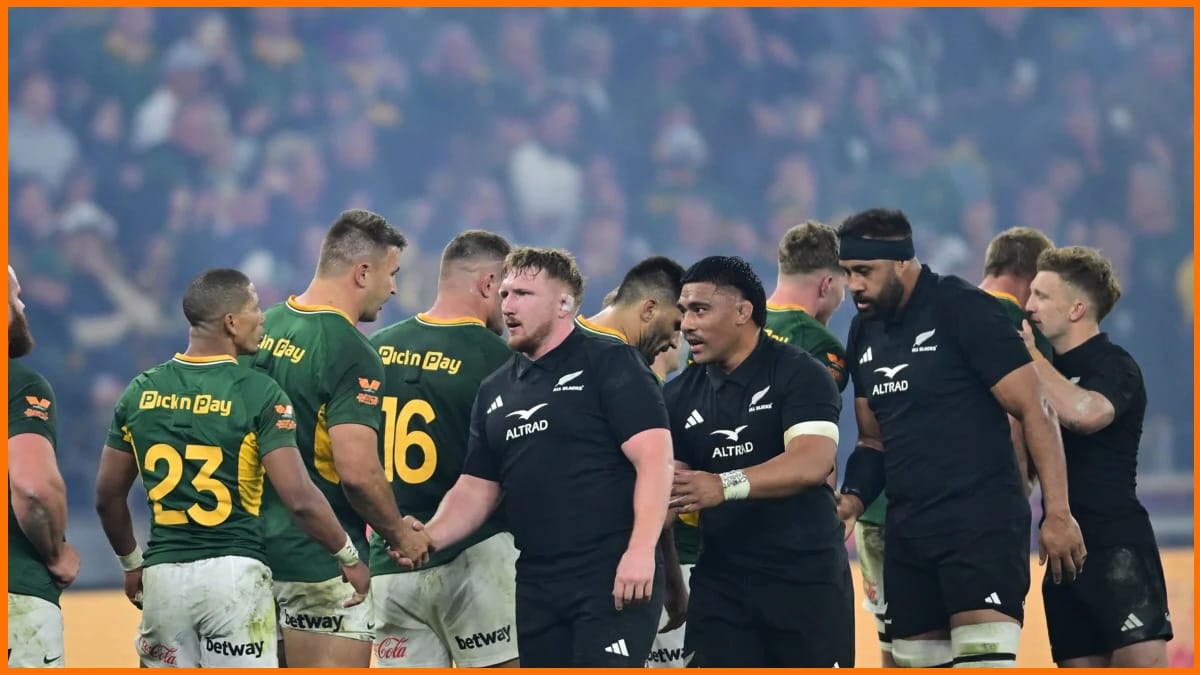
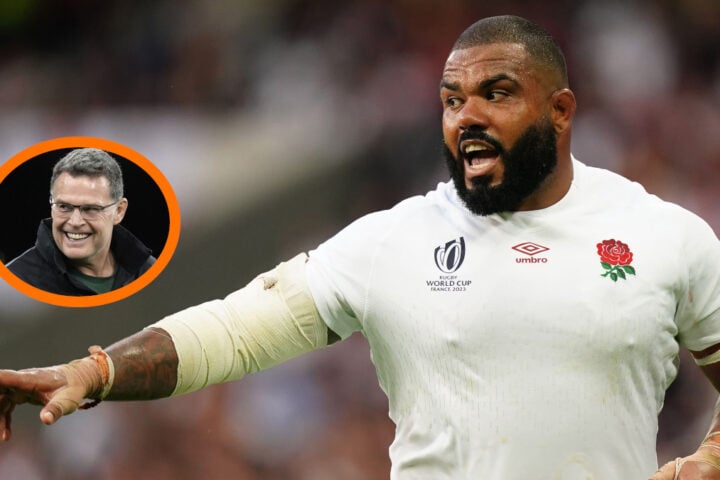
Rassie Erasmus and Mike Blair fronted separate press conferences in Johannesburg on Monday and said the same thing about Saturday. What they want out of it could not be further apart.
Two coaching rooms, a few hours between them, and one point of agreement neither side was asked to reach.
“If you win this one, then you’re not losing the series,” said Mike Blair, the All Blacks attack coach.
“The team that wins this match will be two games up in the series, which will make the clash in the USA the decider,” said Rassie Erasmus, the Springboks head coach.
Both correct. Both describing a Test match at FNB Stadium on Saturday 5 September that cannot end this thing, and a fourth Test in Baltimore seven days later that can.
The Springboks All Blacks series decider is at M&T Bank Stadium on Saturday 12 September, and the two men closest to it have said so within hours of each other. One-all after two Tests, and every fixture, result and kick-off time in Rugby’s Greatest Rivalry confirms the shape of it.
Where they part company is what each is prepared to accept.
The arithmetic neither of them spelled out
Three outcomes on Saturday, and not one of them ends the series before the aeroplane to Baltimore.
| FNB Stadium, 5 September | Series after three | Still live in Baltimore |
|---|---|---|
| New Zealand win | NZ 2–1 | NZ take the series 3–1, or it finishes 2–2 |
| South Africa win | SA 2–1 | SA take the series 3–1, or it finishes 2–2 |
| Draw | 1–1 | Either side wins 2–1, or it finishes level |
Nobody can reach three wins on Saturday. Nobody can be buried either. The third Test simply removes one side from contention for an outright win, which is a different job from deciding anything, and it is why both coaches reached for the negative.
Blair, Scotland’s most-capped scrum-half at 85 Tests and a British and Irish Lions tourist to South Africa in 2009, was asked whether Saturday settles it. He opened with the loose version, that technically you could argue the series is won by whoever takes this one, then corrected himself inside the same breath. “If you win this one, then you’re not losing the series. So it certainly puts you in the driving seat.”
Jordie Barrett, the All Blacks No.12 who has started both Tests, arrived at the same place from the other end an hour or so later.
“If you don’t win this game, you can’t win the series.”

How the Springboks see it: a fourth Test they intend to reach 2-1 up
Erasmus has run this tour as a four-week problem from the start, and he keeps giving away the numbers.
“In the first two games we’ve used 30 players… and I guess by the last game would have used 36, and that’s almost a whole squad that we have here. There will be four players that I think will not get a run in in this series.”
Squad budgeting, not rotation. He is spreading a fixed quantity of human being across four Test matches and telling everyone in advance where the shortfall lands. A coach who thought Saturday was the end would be emptying the tank in Soweto instead.
His reason is attrition, and he says it plainly.
“The series only really gets really, really competitive — not that these two games weren’t competitive — when you start getting injuries in week three, four. And normally the decider is the fourth game.”
He is already one down. Damian Willemse pulled a grade-one hamstring in Cape Town and will miss FNB Stadium, though Erasmus says he should be on the plane to Baltimore on Sunday, which tells you which fixture the medical staff are working towards. He has also had the other side’s mileage counted, and reckons his squad is around 60 minutes lighter than New Zealand’s over the last six weeks. “So hopefully punch drunk wouldn’t come into this game.”
Then the line that separates him from the room across town.
“The desperation must be, let’s make sure this weekend… that we don’t go to Baltimore and play for a draw.”
Read that carefully. Erasmus is not talking about winning on Saturday for its own sake. The point is refusing the one outcome that Saturday makes available to the loser, which is a fourth Test played for a level series. He has named the draw and rejected it.

There was a second reason too, and it is the more human one: “We playing for South Africa, and we don’t want to lose two test matches in a row, which hasn’t happened in a long time. And that was part of the desperation.”
How the All Blacks see it: a knockout week, and a floor they will take
Nobody in the New Zealand room used the word draw.
Barrett described the mood in the language of a tournament. “It certainly feels like a knockout stage in a World Cup at the moment. And it’s a game of chess, really. We beat the Boks week one and they change a few things, and we try to change a few things.” A side thinking one move ahead rather than four weeks ahead, which is reasonable for a team that scored four tries to three in Cape Town and still lost and took Dave Rennie’s first defeat as coach with the attacking numbers going up.
Their fatigue answer points the same way. Blair explained that Phil Healy, the All Blacks head of performance appointed in March, tracks running metres in training and in matches, and that the coaching box spends the closing stages of a Test asking who is still moving well. At 70 minutes in Cape Town, he said, they had backs sprinting to reconnect the line and saw no reason to change it. That is a staff managing a single afternoon carefully. Erasmus is managing a month.
There was one more exchange worth putting next to the Springbok version. A journalist offered Blair the framing that a must-not-lose Test needs bravery.
“I don’t think being brave is the right thing. I think, like, backing our game that we’ve been able to execute over the last couple of months, and trusting what we’ve been doing.”
Later in the same session Barrett, who had not heard the answer, reached for both of the words Blair had put down. New Zealand at their best, he said, had been “mentally free, brave”, and what they need on Saturday is “that fearless approach”.
Continuity from the coach, fearlessness from the senior back, and not one mention of the outcome Erasmus went out of his way to reject.
What “not losing the series” actually gets you
Here is where Blair’s careful negative stops being a turn of phrase and becomes a physical object.
The trophy for Rugby’s Greatest Rivalry was unveiled in Johannesburg on Wednesday 19 August by Sean Fitzpatrick and Gary Teichmann, the two captains from 1996. It comes in two pieces. Two blades of grass, 65cm high, 7kg each, machined from solid aluminium and held together by hidden magnets on a 9.5kg base of black Pakohe stone from New Zealand and green Verdite from South Africa. Pull them apart and you have two trophies.
The design is not decorative. On the same day, New Zealand Rugby and SA Rugby confirmed there will be no tiebreaker if the four Tests finish 2-2. No extra time, no points difference, no sudden death.
“If each team has won two Tests at the end of 320 minutes of intense rugby, it seemed inappropriate to decide a winner on an arbitrary metric,” SA Rugby chief executive Rian Oberholzer said.
Mark Alexander, the SA Rugby president, put it plainly: “If there’s no series winner, you take your part of the trophy, we take our part, and we keep our trophies at home.”
So the thing Blair described as not losing the series has an exact value. Half a trophy, kept for the four years until the next tour. The winner on Saturday keeps the right to take both blades home from Baltimore; the loser plays the last Test for a 2-2 draw and a 7kg piece of aluminium on a shelf in Johannesburg or Wellington. Steve Lancaster, the New Zealand Rugby chief executive, called the sharing “something special to this tour”, and both unions pointed at the drawn tours of 1921 and 1928 as precedent.
Which is a lovely idea, and precisely the outcome Erasmus has told his squad is unacceptable.
The one thing they are actually arguing about
Strip away the arithmetic and the Springboks All Blacks series decider comes down to one question: is half a trophy a floor or a failure.
Erasmus has answered it. He has named the draw, called playing for it a thing to avoid, and built a 36-player plan around arriving in Baltimore able to win rather than able to survive. The All Blacks have answered it too, though only by omission. Their language is about not losing, about the driving seat, about a knockout week that starts and finishes on Saturday. Nobody has said what happens after it.
That gap matters more than it sounds, because it changes what a side does at 60 minutes with three points on offer. A team protecting a floor takes them. A team that has ruled out the draw goes to the corner.
There is one precedent for the manoeuvre Blair is describing, and Fitzpatrick owns it. The 1996 All Blacks won in Durban 23-19 and at Loftus Versfeld 33-26 to make a South African series unloseable with a week to spare, then lost the dead rubber at Ellis Park 32-22 and nobody has raised it since. It worked because three Tests let you seal a series in week two. Four Tests at one-all do not.
Watch what New Zealand do with their first kickable penalty inside the Springbok half on Saturday. It will tell you which sentence from Monday the coaching box actually believes. And watch whether South Africa’s bench is still winning nothing, because the Springbok bench has not won a last quarter in this series, and Erasmus’s whole four-week plan assumes it eventually will.
Frequently asked
Is the Springboks All Blacks series decider at FNB Stadium or in Baltimore?
Baltimore. The series is level at 1-1 with two Tests remaining, so the winner at FNB Stadium on Saturday 5 September can only go 2-1 up. The fourth Test at M&T Bank Stadium on Saturday 12 September stays live in every scenario, and both head coaches said so on Monday 31 August.
What happens if the Rugby’s Greatest Rivalry series finishes 2-2?
Nothing further is played. New Zealand Rugby and SA Rugby confirmed on Wednesday 19 August that there is no tiebreaker. The trophy separates into two halves and each nation keeps one for the four years until the next tour.
Which trophy are the Springboks and All Blacks playing for?
A purpose-built Rugby’s Greatest Rivalry trophy, unveiled by Sean Fitzpatrick and Gary Teichmann on Wednesday 19 August. It is built in two halves held together by hidden magnets, and the series winners take both halves home from Baltimore.
How many players will South Africa use in the series?
Thirty across the first two Tests, and 36 by the end of it on Erasmus’s own count, with four members of the touring squad not getting a run at all.
When did the All Blacks last win a Test series in South Africa?
In 1996, when they won in Durban and at Loftus Versfeld to take an unassailable 2-0 lead before losing the third Test at Ellis Park.

Ardie Savea named the way New Zealand lost in Cape Town two days after it happened, and his answer was not the scrum. The blueprint for beating South Africa is to make them kick, which is harder at altitude than at sea level.
Your turn
Two camps, one agreed fact, two different plans. Either Erasmus is right that a four-Test series is won by whoever still has a functioning 23 in week four, and the All Blacks are quietly banking a draw they will not name; or Blair is running the sensible version, taking Saturday first and refusing to plan a fortnight ahead of a Test match this size.
One of those wins a trophy. The other wins half of one. Which camp is reading it correctly?




Comments
No one has weighed in yet.
Be the first - what did you make of it?