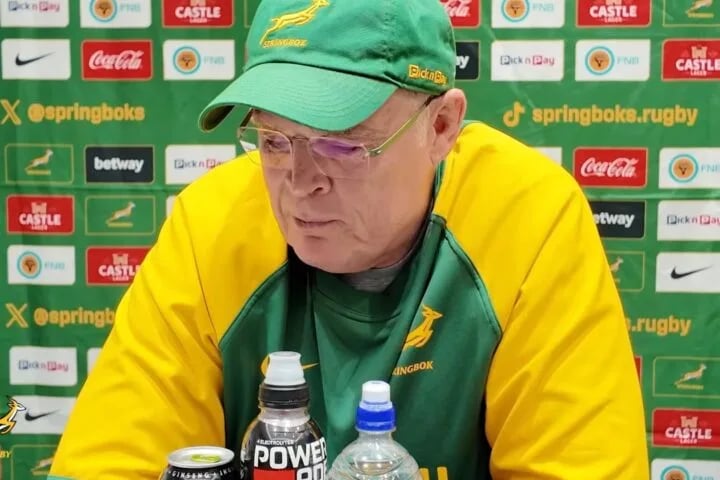

The number was read to Rassie Erasmus on Monday like a charge sheet, and he agreed with it in two words. Then he volunteered a second piece of evidence against his own team that nobody had asked for.
Since the World Cup, the Springboks have outscored New Zealand in the closing half-hour of every Test between the two sides. That was the claim put to Erasmus at the team announcement for Saturday. Then the journalist finished the sentence: except these two.
“Yeah, we definitely not.”
No argument, no deflection. And then he kept talking, into territory the question had not opened.
“I can also tell you that the penalty count… goes the last 20 minutes normally against us, and that’s something that normally sways the momentum a bit. And that’s mainly because of our fault.”
A head coach five days out from the Test that decides a series does not usually add to the case against his own side. Erasmus did it twice in thirty seconds. What he offered afterwards as the reason it will not happen again is the part worth arguing with, because it does not match the problem he had just described.
Two minutes at Ellis Park, and then thirteen men
Go back to 22 August. South Africa led 16-12 just before the hour. Fabian Holland charged down Grant Williams from the restart, New Zealand converted, and the lead was gone.
Then the last twenty minutes happened. Marco van Staden went to the bin on 70 minutes. Cobus Reinach followed on 72. For a stretch South Africa played with thirteen men, and a Test they had led became 33-16 and five tries to one. A twelve-match unbeaten run ended in the period the Springboks are supposed to own.
That is what Erasmus means by the penalty count. Two cards inside two minutes, in the exact window how Erasmus hatched the 7-1 split in the first place was designed to win.
The site has broken down how they dominated Ellis Park and lost by 17. The cards are not the only reason. They are the one that repeated.
Cape Town handed back the same eight minutes
Seven days later, South Africa won 33-26 and still could not close cleanly. Lood de Jager was binned late for head-on-head contact with Leroy Carter, handing New Zealand one more attacking set with the game inside a converted score.
Erasmus referenced it himself: “We got yellow cards in the first match, and also again the yellow card the last eight minutes or whatever.”
New Zealand scored four tries in Cape Town. South Africa scored three. What actually decided it was Cheslin Kolbe’s boot, and he was named player of the match for it. A side whose finishing quarter is functioning does not need its goal-kicker to be the difference in a home Test. The Cape Town match report has the sequence in full.
“The penalty count goes the last 20 minutes normally against us… and that’s mainly because of our fault.”
The defence he reached for has a hole in it
Asked whether he was worried, Erasmus went to 2023 for cover.
“If you take it back to those specific World Cup games, the teams that played against us had seven days turnarounds and we had six day turnarounds, and we were flat, but we managed to pull it through in most of those games.”
It is a real memory and it does not transfer. In France the flatness had a cause outside the players: a shorter week, forced by the draw, against opponents who had a longer one. This series has no such asymmetry. Ellis Park to Cape Town was seven days for both sides. Cape Town to Johannesburg is seven days for both sides. Whatever is happening in the last twenty minutes of these Tests, an unfair turnaround is not producing it.
Read also: how the Cape Town 23 were marked, including the two front rows that were swapped an hour before kick-off.
So he counted New Zealand’s minutes instead
The second answer is more interesting, and it is his own research rather than a line.
“I looked at the six weeks that New Zealand players played minutes over the last six weeks, because for me that’s normally the indication… and we probably [are on] 60 minutes less than them. So hopefully punch drunk wouldn’t come into this game.”
That figure is Erasmus’s own and cannot be checked against public data. Treat it as his claim. Punch drunk is the phrase to keep. It describes a squad that is still physically able but has stopped making clean decisions, and he is betting that his players reach the 60th minute on Saturday with more left than the men opposite.
Here is the problem with the bet. He diagnosed the last twenty minutes as a discipline failure and called it South Africa’s own fault. He is treating it with fitness. Those are not the same illness.
What the bench actually buys, and the tell to watch
The bomb squad has always been sold as power arriving late. That was never quite the mechanism. What a loaded bench really buys is a set of fresh decision-makers entering a period when tired ones start conceding penalties: the late bind that goes down, the ruck entry half a second early, the tackle that rides up because the legs have gone.
When the fresh men are the ones giving the penalties away, the mechanism has inverted.
The 23 he named for FNB Stadium carries five forwards and three backs, with Deon Fourie at 16 as the hybrid who makes that split work. Ox Nché, Malcolm Marx and Wilco Louw start, and Gerhard Steenekamp and Thomas du Toit wait.
So watch one thing on Saturday. Not the collisions. The first scrum after South Africa’s front row changes, and whose put-in it is. If the Springboks are still winning that decision at 60 minutes, the punch-drunk theory holds. If Nika Amashukeli’s arm goes the other way inside two scrums, the problem Erasmus named on Monday is the one he has not fixed.
Your turn
Two ways to read the last twenty minutes of this series. Either South Africa are a fraction off physically and it shows as ill-discipline, which fitness and a fourth-Test squad rotation will fix by Baltimore. Or the bench is being asked to enter games in a state the referee has already decided against, and no amount of fresh legs changes that.
One of those gets solved on Saturday. Which one is it? Every result so far sits in every fixture, result and kick-off time in Rugby’s Greatest Rivalry. Pick a side below before kick-off, not after.