




Rassie Erasmus refused to call South Africa’s 33-16 defeat by New Zealand at Ellis Park a catastrophe, pointing to the 2021 British & Irish Lions series and the 2019 World Cup pool stage as evidence that the Springboks have recovered from worse starts. What he would not do is pretend his team learned anything from it.
Speaking after the opening Test of Rugby’s Greatest Rivalry on Saturday, the Springboks coach was blunt about where the responsibility sits. “We didn’t need to learn from this; we knew what we had to do,” he told the post-match press conference, adding that his side simply did not do it.
Three in a row, or the series is gone
Erasmus set out the arithmetic without softening it. South Africa now have to win three consecutive Tests to take the series, and he credited New Zealand with thoroughly deserving the position they have put themselves in.
A win in Cape Town squares the series, he noted, but the requirement does not change: three straight. That, in his framing, is the difference between a difficult position and a catastrophic one — there is a route through, and it runs through DHL Stadium on Saturday.
He listed the precedents himself. South Africa lost the first Test of the 2021 Lions series and won the next two. They lost their opening pool match to New Zealand at the 2019 World Cup and lifted the trophy. On both occasions, he said, the reaction outside the camp was that the sky had fallen in.
The scrum he picked out as the turning point
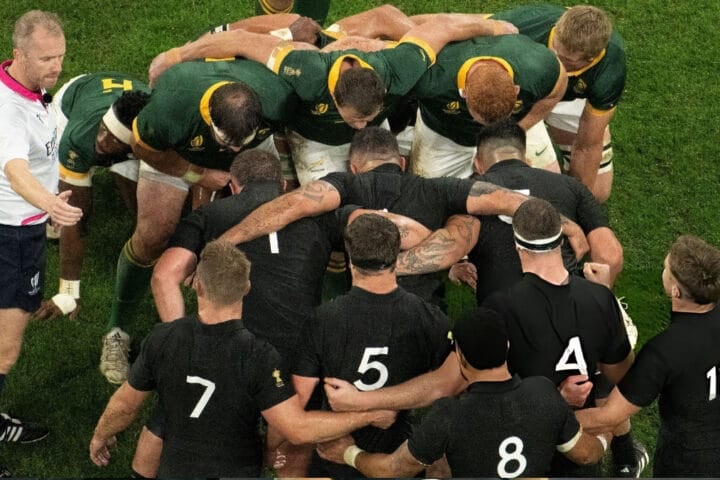
Asked where the Test got away from his side, Erasmus went to the same moment neutral observers did: the 58th minute, South Africa trailing 19-16, the Springboks pressuring a New Zealand scrum that had been collapsing under them all evening — and a penalty conceded on their own feed.

It is a significant admission. The scrum had produced three second-half penalties in a row before that, twice persuading Pieter-Steph du Toit to wave away the posts and scrum again in search of a yellow card. New Zealand had introduced Asafo Aumua, George Bower and Fletcher Newell by then. The set piece stopped paying, and South Africa never scored again.
Erasmus was careful not to hang the defeat on that single scrum. Even with the three points, he argued, the volume of Springboks errors would have made it a poor performance dressed up as a narrow win. He was equally clear that the errors were not self-generated in a vacuum — New Zealand’s intensity and accuracy forced them.

Dominant in one area, beaten in the rest
Erasmus accepted that his pack owned the scrum and pointed out the obvious limitation: dominance in one or two facets counts for nothing when the opposition is on top everywhere else. On his reading, New Zealand were the better side in most areas of the match.
That matches the numbers. South Africa entered the New Zealand 22 eleven times and scored a single try. New Zealand made nine entries and scored five. The Springboks made more post-contact metres off fewer carries in the first half and still trailed by 17 at the end.
He also allowed himself one dry line about the ranking implications, joking that there would be something to enjoy about arriving in Cape Town as underdogs against a side he described as now the best in the world.
What comes next
The tour continues on Tuesday, when the All Blacks face the Lions in Johannesburg in their final fixture against a South African franchise.
The second Test is at DHL Stadium in Cape Town on Saturday 29 August, followed by FNB Stadium in Johannesburg on 5 September and M&T Bank Stadium in Baltimore on 12 September.
Erasmus has six days to decide whether the men who could not convert an hour of forward dominance keep their places.








Comments
No one has weighed in yet.
Be the first - what did you make of it?