


Rugby’s Late Team Change Rules: What Rassie Erasmus Did Not Break In Cape Town —
Sky Sport NZ staged a formal debate on outlawing Rassie Erasmus’s five-minutes-to-kick-off front-row switch. The pundit prosecuting it admitted he had done the same thing, a former All Blacks hooker pointed out it was not a late change at all, and 55% of Sky’s own audience voted it fair game. REVIEW — 31 August 2026.
Angus Ta’avao spent ninety seconds on New Zealand television arguing that changing a front row five minutes before kick-off betrays the integrity of the game. He built it in three parts. He was awarded the debate.
Then he said this:
“I’m going to be honest. I was part of that in the Highlanders. We did it.”
The panel laughed. Nobody followed it up. And in eleven words a New Zealand pundit had done more damage to New Zealand’s best grievance of the week than Erasmus managed in a full press conference.
Join 125,000 rugby fans getting WeTalkRugby’s daily brief. Every match, every hemisphere.
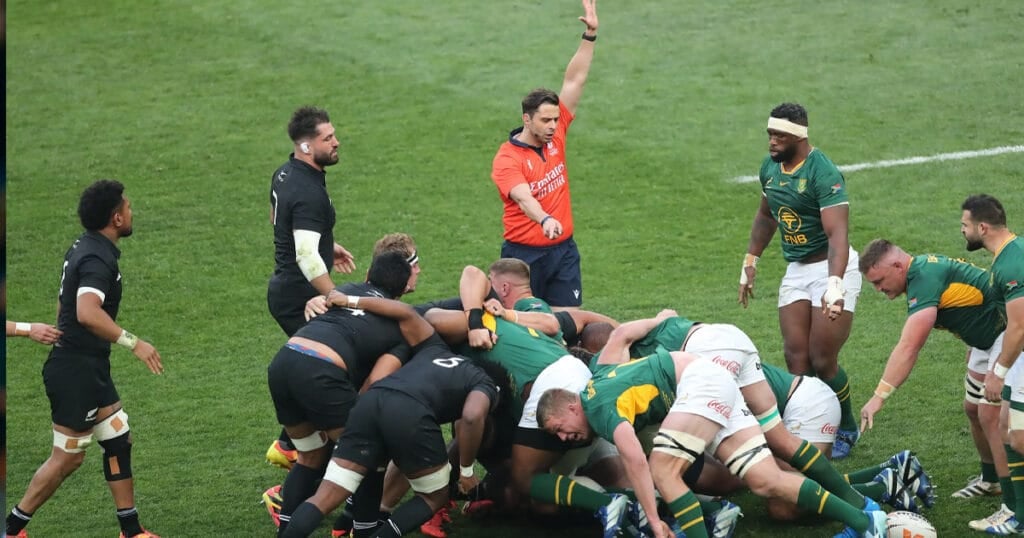
The facts are not in dispute. Roughly five minutes before kick-off at DHL Stadium last Saturday, South Africa’s entire starting front row changed from the side South Africa actually announced on the Friday. Gerhard Steenekamp, Deon Fourie and Thomas du Toit started. Ox Nché, Malcolm Marx and Wilco Louw went to the bench. Fourie packed down at hooker at 39. South Africa won 33-26, and the debate started before the players had finished warming down.
The case for banning it lasted ninety seconds
On The Breakdown on Sunday night, host Kimberley Rich put it to the panel as a straight motion: barring injury or illness, should a team be allowed to change its side on the day of a Test?
Ta’avao, 23 caps as an All Blacks prop, took the prosecution. His argument had a shape to it.
“What’s this game built on? It’s integrity. It’s respect. It’s never being bigger than the game… Number two is the machine — people who put in hard work to prepare, to present… and then it’s ripped away one second. And finally, this one’s for you at home. It’s the people. Some people would see a team list and think, ‘All right, I need to travel. I want to see my favourite player be there.’ Only to find out he’s been removed.”
Aaron Cruden, defending, was flatter and more effective. Dave Rennie had said after the match that he was not worried about late changes, which told Cruden the All Blacks had spent the week on themselves rather than on Erasmus. And then the line that should have ended it: it is not illegal, otherwise they would not be able to do it.
Ta’avao won the room anyway. Ninety seconds later he volunteered the Highlanders.
“It wasn’t a late change”
The sharpest thing said on the subject came from James Parsons, and it was not part of the debate at all. He interrupted the aftermath.

“Can we discuss that they trained all week? If he had 50 Tests, on a 17 jersey, then he ran out… It wasn’t a late change.”
Parsons is a former All Blacks hooker and a former Blues captain, and he is describing something people outside a front row consistently get wrong. A bench prop does not spend the week rehearsing how to sit down. He scrummages against the starting pack every day, on both sides of the shove, in the same session, with the same calls. The man wearing 17 in a Test week is a starting-quality loosehead who has been told he is going on at 50 minutes instead of at 0.
Move him from 17 to 1 and nothing about the preparation changes. The All Blacks front row had spent five days looking at footage of Ox Nché. They got him anyway, thirty-seven minutes later than billed.

The laws are built to make this possible
This is where the grievance runs out of road, and it is worth being precise about why.
World Rugby Regulation 15.1.2 requires that “48 hours prior to the kick-off of an International Match the Participating Unions must announce and exchange a list of the 15 Players who will start the Match and up to 8 replacements/substitutes”. South Africa did that. Every one of the six men involved in the swap was on that list.
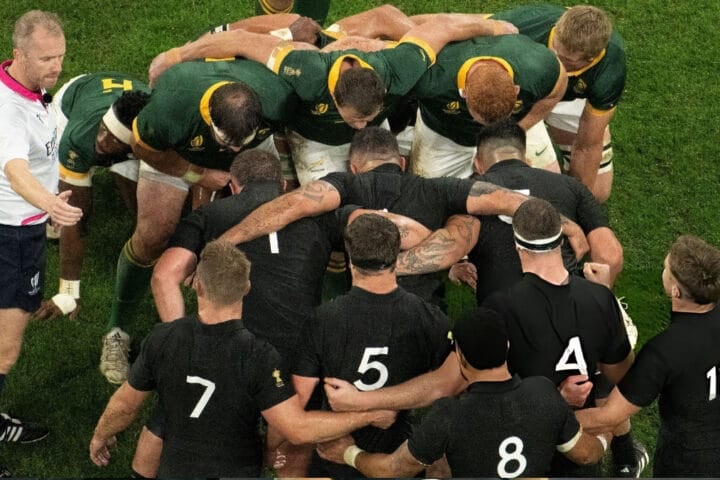
Law 3.8 then does the rest. A 23-man squad must contain a minimum of six front-row players, and the team must be able to replace a loosehead, a tighthead and a hooker at the first request. Law 3.10 requires teams to tell the match officials before kick-off which front-row positions each of those players can cover.
So the laws compel a coach to name six qualified front-rowers and to declare what each of them can do. That minimum is the whole point of the 7-1 bench South Africa built its last two World Cups around. Erasmus started three of his six instead of the other three. There is no loophole in that. It is the design working exactly as written, and any regulation that outlawed it would have to explain why a player nominated as a Test hooker on Thursday is not permitted to be a Test hooker on Saturday.
Erasmus says it was the weather, and that is the boring answer
The mind-games reading is the fun one. It is also the one the coach has already contradicted.
“We thought it was going to be wet, and that’s why we picked that front row… but then, closer to the game, the weather report said it’s going to be dry, and then we felt our front row that’s a little bit lighter would be better on the dry field.”
Erasmus said that to reporters after the match. It is a dull explanation and it fits the evidence: the heavier trio came on later anyway, and Marx came on at 35 and made a break the All Blacks defence simply parted for thirteen minutes later, in a 33-26 win in which South Africa scored one fewer try than New Zealand. If the object was to unsettle an opponent, benching the best hooker in the world for 35 minutes is a strange price to pay for it.
The one argument that survives
Two of Ta’avao’s three points do not hold. The integrity point fails because no regulation was bent. The preparation point fails because Parsons is right that the preparation was identical.
The third one survives, and nobody on the panel picked it up.
Somebody flew to Cape Town to watch Malcolm Marx start a Test match. They found out at the same moment the broadcast did. That has nothing to do with sporting advantage and everything to do with the fact that a Test team sheet is now a marketing document that can be withdrawn without notice. If the sport ever does legislate here, that will be the reason — not fairness, but the ticket.
Sky’s own viewers were not persuaded either way. The live poll came back 55% fair game, 44% dirty tactics, from a New Zealand audience twenty-four hours after a defeat. That is about as close to a split verdict as a national broadcast is ever going to produce.

Your turn
Two ways to see it, and both are defensible. Either Erasmus used a matchday 23 exactly as the laws are written to permit, and the complaint is a losing side reaching for something; or a team sheet published 48 hours out is a promise to the people who paid, and a coach who withdraws it five minutes before kick-off has taken something that was not his to take.
One of those is a rule. The other is a courtesy. Which one broke in Cape Town?






Comments
No one has weighed in yet.
Be the first - what did you make of it?