


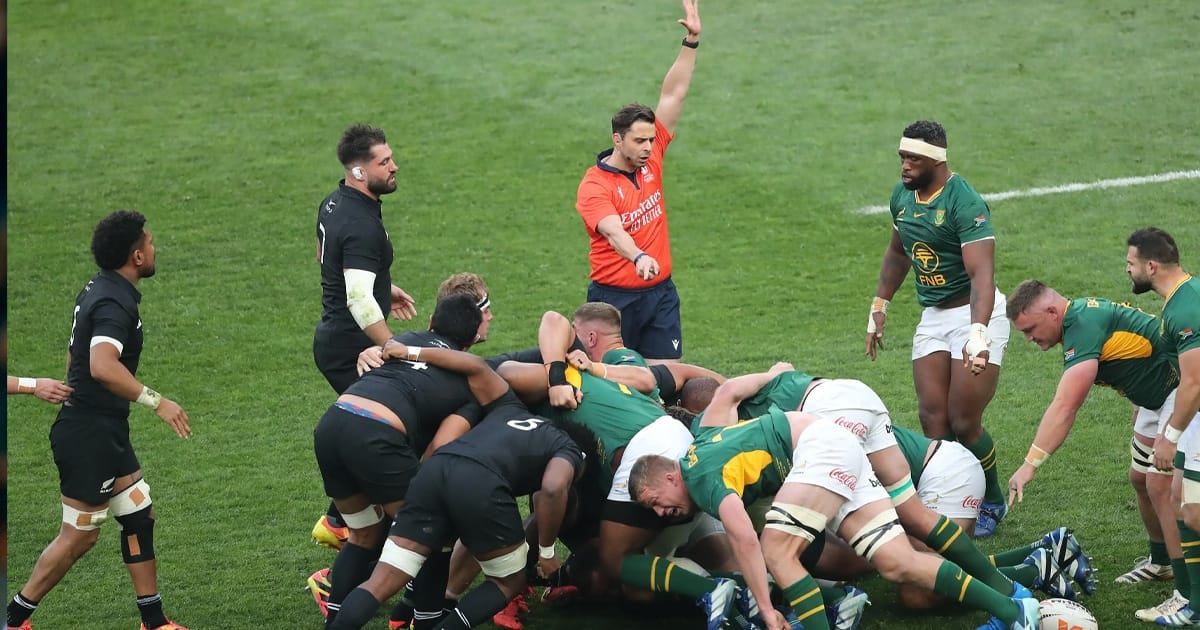
Nick Mallett was booked on Sky Sport’s The Breakdown to talk about a series lead. Three former All Blacks got the Nick Mallett scrum lesson instead: why their pack loses Tests, step by step, and what to do about it.
“One was a penalty try where we demolished your scrum. So that’s power.”
Nick Mallett said it flat, on a New Zealand television show, to a panel that included a former All Blacks prop. Angus Ta’avao, 23 Tests in the front row, sat through it and described the experience afterwards. “It was a shot through the heart. But I mean, that sounds bad, but we were still in it, you know? So it’s tough to take.”
Mallett’s answer came in two halves. The first was the diagnosis, and it took the host, Kirstie Stanway, to point out that the daggers were out. The second was the fix, twenty minutes later, and it was not the fix the panel had been arguing for. It is further down. If you think a scrum penalty is an ugly way to decide a Test, the comments are open at the bottom.
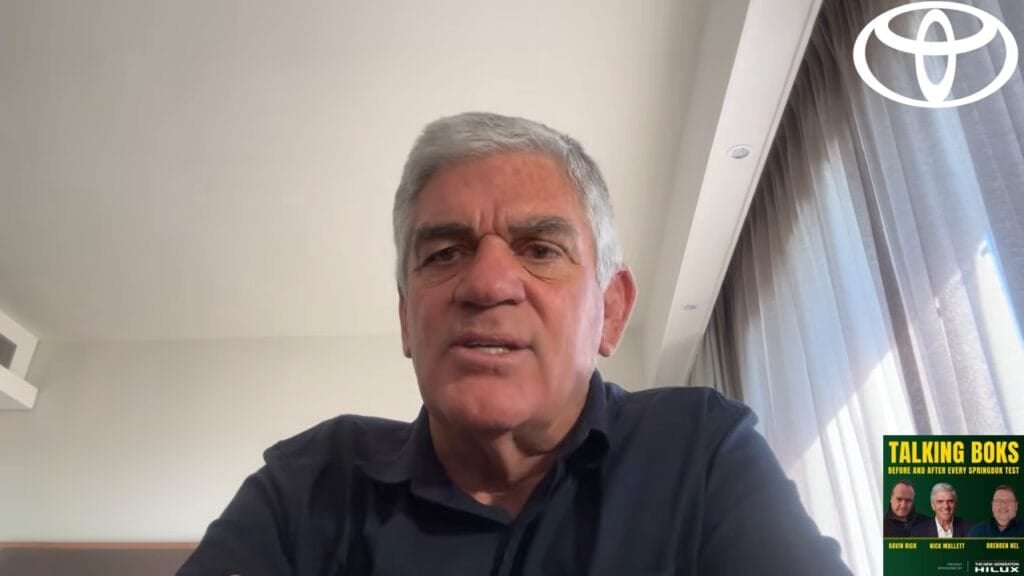
Mallett coached the Springboks from 1997 to 2000. He was live from South Africa on Sky Sport NZ’s The Breakdown on Sunday 6 September, the morning after his old side won 29-24 to lead the series 2-1, with Mils Muliaina (100 Tests), Brad Weber (18) and Ta’avao in the Auckland studio and Jeff Wilson (60) joining later.
“Oh, here we go again”: what Ta’avao saw on the All Blacks’ faces
Ta’avao had spent the morning on the clips, and one of them was not about technique.
“I looked at a clip and it was a penalty, and you could just see the body language from the All Blacks was almost like, ‘Oh, here we go again.’ And people talk about parity, but your mindset shouldn’t be about getting par. It’s about trying to dominate and attack that set piece. And South Africa, that’s what they do. They get their feet on them. They get the weight behind them and they put you under pressure.”
The numbers behind the body language are the four scrum penalties New Zealand conceded at FNB Stadium. Stan Sport’s full-time board had South Africa making more handling errors, 13 to 10, and both sides winning every scrum on their own feed. Ta’avao, who reduced scrummaging to the four questions he asks in order every time he packs down after Ellis Park, read it this way: the errors were the problem before the scrums were. New Zealand had 11 feeds and made nothing of them. South Africa turned the ones that mattered into territory.
“They just allowed them to piggyback out from their own half,” he said. Weber put the same thing the other way round. “We’re a team that needs to keep the ball in play against the Springboks. We need to run them off their feet, and as soon as we give them easy opportunities to get back to their scrum and lose the ball… that’s when we put ourselves under pressure.”
His fifth question on Sunday was about intent. “Every time, you need to be present, you need to go to work.”
The Nick Mallett scrum chain: knock on, scrum, penalty, forty metres
Muliaina, who says he is “not a man that really likes them too much”, asked whether the series had put a warning out to the world about the Springboks scrum. Mallett’s answer started with the coaches and dismissed them.
“You can get the best scrum engineering coach in the world, and I know Mike Cron is that, and Daan Human is very good for the Springboks. But it’s about the ability of the player you’ve got. And we just seem to churn out really big, strong guys there.”
He put the bomb squad in the same category. In his reading, the 7-1 bench Erasmus built from two front rows exists “because we had two front rows that were pretty much as good as, one was as good as the other”. Personnel, not a scheme.
And then the sentence that explains why South Africa never mind a scrum in their own half.
“It’s a huge relief for us when we get ball, scrum on our ball, because we can win it and double shove and force the opposition to either collapse or to wheel, and we get a penalty from that penalty. We can obviously exit our half and get the lineout throw, or else kick into your 22 and get a driving maul possibility, or go for poles.”
Muliaina had already shown the clip that proves it, without knowing he was setting Mallett up. Forty-three minutes on the broadcast clock, Ruben Love in the bin, New Zealand with a penalty and a lineout in the South African half. The maul got counter-shoved, the ball got spilled, and the Springboks had a scrum.
Muliaina’s voiceover for what happened next was South Africa’s thinking, not New Zealand’s. “We don’t want to kick the ball out and give the All Blacks another opportunity to try and score points. We’re just going to go to a scrum. And that’s what they do.”
You can watch for it in Baltimore. When the Springboks get a penalty inside their own half, look at the captain’s arm. Towards touch means they want the lineout. Towards the ground means they think forty metres is already in the bank.
Gardner “managed and coached”. Amashukeli “rewarded good scrummaging”.
The panel let Mallett’s one line about referees go past. Keep it.
“It’s a huge advantage which we didn’t have in that second test, because I thought Gardner managed and coached the scrums, whereas I think the Georgian ref this weekend rewarded good scrummaging, even though on a couple of occasions the scrum did collapse on both sides, and he did let the team play away.”
One former coach’s opinion of two refereeing styles, and it should be read as exactly that.

But it lines up with the record. Dave Rennie got the referee he asked for in Cape Town, Angus Gardner, and New Zealand won every scrum on their own ball in Cape Town and lost by seven. In Soweto, Nika Amashukeli waited for the ball at the five-metre scrum on 36 minutes, watched Ox Nché go through Tyrel Lomax, and walked under the posts without it. Same two packs, one week apart.
Mallett drew the conclusion himself. “It defines the difference between rugby league and rugby union, in my view. So it is an area that you guys are going to have to sort out, because it’s hard to win a World Cup if you’re giving away four or five scrum penalties a game.”
Four is the Soweto number. Nobody on the panel disputed it.
Read also: Rassie Erasmus was offered that vindication in the press room and turned it down an hour after the penalty try, with a line about never picking a scrum.
Parity or dominance? The panel split, and Mallett picked a side
Ta’avao wanted dominance. Wilson, twenty minutes later and on the other side of the world, wanted something smaller.
“To me, they’re chasing par in a lot of things. Just get parity with the likes of a France and South Africa, and then allow your stars to shine.”
Wilson’s case for it is the try count. Mallett had it roughly right on air, “what are you on, 13, and we’re on seven or eight”, and on this site’s count from the three scoring sequences it is 13 tries to 8. New Zealand are the better attacking side in this series by a distance, and they are 2-1 down. A team that scores like that can lose the scrum and still win. Losing Tests at it is the problem.
Mallett agreed with the wing, not the prop. The aim, he said, was not to go out and dominate the South African pack, “but don’t get dominated by them, if you understand what I mean”.
Then he said what “don’t get dominated” means, and this is the part of the interview that should be on the wall at the All Blacks’ hotel in Baltimore.
“Your ball is your ball.” The fix is two scrums, not one
“Make sure that your ball is your ball, and you don’t get double shoved on our put-in so that you’re conceding penalties, because that’s such an easy way to get out when you’re in a difficult… I mean, it’s just simple. We knock on. You have the put-in in the scrum. And we get a penalty because you collapse the scrum on your own ball. Now we get out, having conceded a knock-on. Now that you’ve got to avoid.”
Read it as two separate instructions, because they are two separate scrums.
The first is own-feed stability. Hit timing, the hooker’s strike, holding the shape for the second it takes the halfback to clear. By Stan Sport’s count New Zealand did that 11 times from 11 on Saturday, and Erasmus’s own line afterwards was that he was “glad they got the ball out and didn’t keep on scrumming”. That scrum is not the problem.
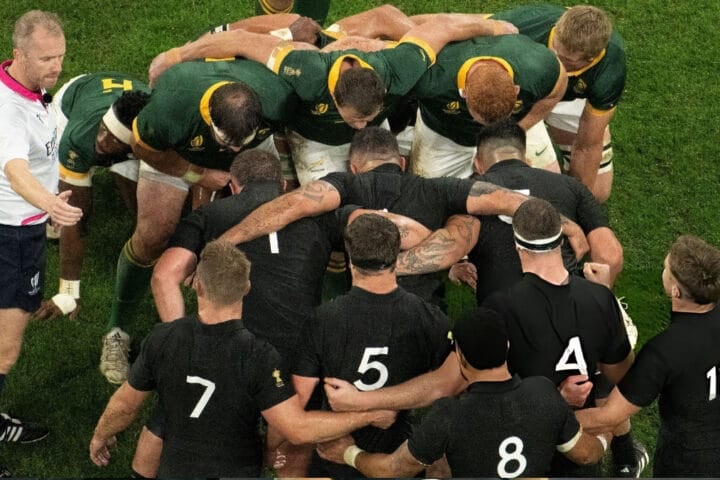
The second is survival on the opposition feed. Nché’s second shove, the deliberate drive once the engagement has settled, is designed to make a tighthead choose between going backwards and going down. Going down is a penalty, which is what George Bower was pinged for on 42 minutes, folding at the hips under the drive, and Fletcher Newell on 65. Going backwards five metres from your own line is a penalty try, and that scrum on 36 produced the seven points that decided a Test lost by five.
So the target Mallett is setting is narrower than Ta’avao’s and more useful. Nobody is asking the All Blacks to shove the Springboks. They are being asked to absorb one drive without folding, on five feeds a match, so that a South African knock-on stays a South African knock-on.
Daan Human’s answer to Rennie’s fortnight of complaints was six years and a farm. The honest New Zealand answer is that six years is what it takes to build the pack that does the shoving, and twelve months is what they have.
Mike Cron, the maul, and the year New Zealand have
Cron’s name came up from a viewer, and Ta’avao did not wait for the end of the question. “We need him back in some way… If there’s one thing that’s come out of this tour, it’s our development program underneath the All Blacks, and bringing someone like Cron to actually produce those guys coming through.”
Cron finished as the Wallabies’ scrum coach after last year’s Rugby Championship and stayed with Rugby Australia as a mentor, so the ask is about the pipeline, not a job vacancy. Jason Ryan, who called the Springboks scrum the best in the world before the series, is coaching the props he has, and Mallett’s view was that no coach fixes personnel anyway. The men who survive Nché’s second drive are made in the provinces years before they meet him.
Mallett gave New Zealand two jobs for the year, not one. “In the scrums, and defending driving mauls, those two you’re going to have to work at.” Marx’s try on 66 came off what Mallett called a 25-metre maul, and Ryan had already timed the Cape Town maul failure at two seconds. The scrum got the headlines because Rennie spent a fortnight on it. The maul has cost as many points.
For Baltimore, and for Australia next year, the site is with Mallett and Wilson. Parity. One scrum fixed, the one on the other side’s ball, to the standard of not folding rather than the standard of winning. Dominance is a project for the next cycle, and chasing it in twelve months produces the body language Ta’avao saw on the clip.
Weber said it in four words after Stanway repeated Mallett’s World Cup line back to the panel. “No scrum, no wins.”
Ta’avao’s amendment was two more. “Not ugly.”

Frequently asked
What did Nick Mallett say about the All Blacks scrum?
On Sky Sport NZ’s The Breakdown on Sunday 6 September, Mallett said the Springboks scrum is about personnel rather than coaching, that South Africa use their own feed to “double shove” for a penalty and exit their half, and that “it’s hard to win a World Cup if you’re giving away four or five scrum penalties a game”. His fix for New Zealand was parity, not dominance: “make sure that your ball is your ball, and you don’t get double shoved on our put-in”.
How many scrum penalties did the All Blacks concede against the Springboks at FNB Stadium?
Four, on WeTalkRugby’s count from the broadcast, including the five-metre scrum on 36 minutes that Nika Amashukeli turned into a penalty try. Stan Sport’s full-time board had both sides winning every scrum on their own feed, 11 from 11 for New Zealand and five from five for South Africa.
What did Nick Mallett say about the referees in Cape Town and Soweto?
That Angus Gardner “managed and coached the scrums” in the second Test, while Nika Amashukeli “rewarded good scrummaging” in the third even when scrums collapsed on both sides. It was his opinion of two refereeing styles, offered on air, and the panel did not challenge it.
Your turn
Two targets for Baltimore. Angus Ta’avao says the All Blacks’ mindset has to be dominance, because parity is how you end up thinking “here we go again”. Nick Mallett and Jeff Wilson say parity is the whole job: hold your own ball, survive one drive on theirs, and let 13 tries to 8 do the rest. One of those is achievable by Saturday, and this site says parity. Which one do you want the All Blacks chasing? Settle it below.






Comments
No one has weighed in yet.
Be the first - what did you make of it?