

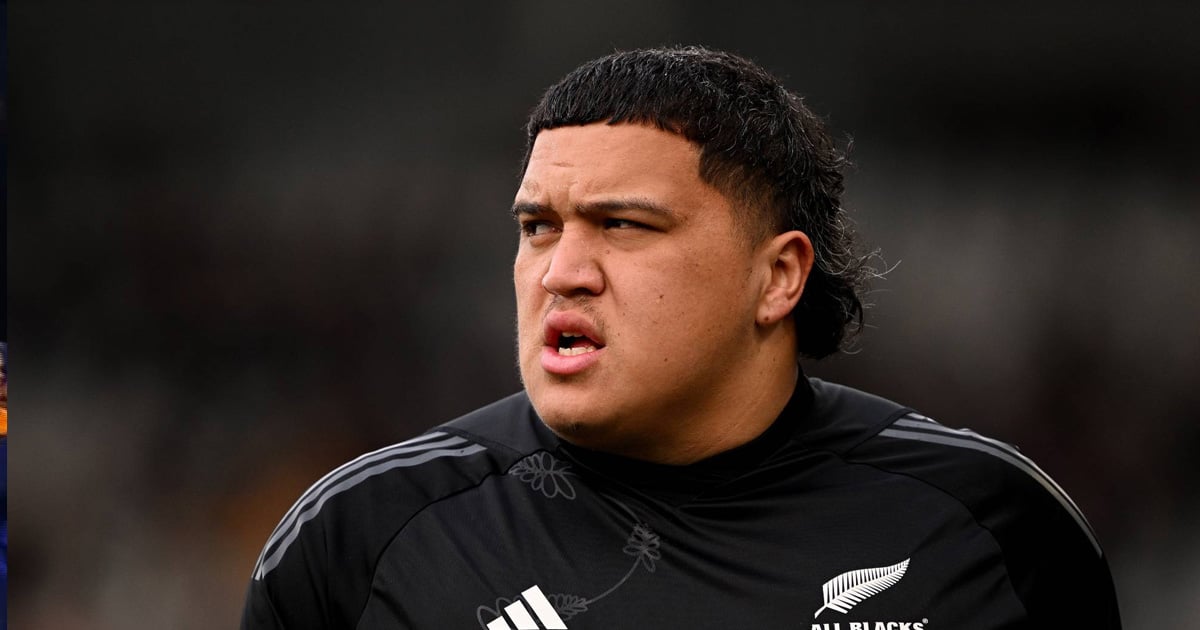
Tamaiti Williams has explained what the word discitis was actually covering, and it involves an antibiotic-resistant infection, a spinal fusion and a night his mother threatened to call the police. He told The Good, The Bad & Rugby ANZ all of it on Tuesday.
Tamaiti Williams weighed 140 kilograms in February. He walked out of hospital at 122, with four screws in his spine and a sentence from a doctor still ringing in his ears.
The sentence was about a wheelchair.
Would you let him pack down against Ox Nché again? Say so in the comments before you read on.
There is one line in that interview that explains why the All Blacks loosehead still has no date to play, and it is not the one everybody clipped. It comes later.
Back at the end of March, the Crusaders put out a short statement. An infection in a disc. Discitis. Antibiotics for a long time, season over, full recovery expected. It read like the kind of thing that happens to a prop, gets treated, and disappears from the injury list by July.
In his absence George Bower carried the loosehead jersey and the questions that came with it. Then Tamaiti Williams sat down with Andy Rowe and Kieran Read on Tuesday and filled in what the statement left out.
What Tamaiti Williams says was actually growing in his back
The timeline starts with a suspension. Williams was banned for three weeks in early March for dangerous play in a ruck against the Chiefs, and it was during that enforced break that the back started talking to him.
“What happened was after round three Super Rugby I got suspended and the next week I was in training and I just thought I tweaked my back. Went and told the physios and the medical team and then over the next probably week and a half it got worse and… I ended up in hospital.”
Then the medication stopped working, which is when a prop’s tolerance for pain becomes a diagnostic problem rather than a virtue.
“Doc had me on some meds and when they started not working, I was like, ‘Oh, bite down on the mouth guard a bit.'”
Tamaiti Williams is 26, he is 1.96m, and he has been packing down at the highest level since his Crusaders debut in 2021. The instinct is to absorb it. That instinct is what put him in a hospital bed for four months.
What they eventually found was not a strain, a bulge or a stress reaction.
“They weren’t too sure what was going on. It’s a bug called MRSA. It’s like a super bug. It’s like resistant to antibiotics.”
The Crusaders statement named the condition. It never named the organism. This is the first time the organism has been said out loud.

The night his mother threatened to call the police
Before the diagnosis there was an argument in a bedroom, and Williams lost it.
“Then I had a bit of an episode one night and I was rolling around in bed in 10 out of 10 pain, crying, arguing with my wife not to go to the hospital. And… my mum gave me a call and said, ‘I want to call the police if you don’t go to the hospital.'”
Nothing about that is an athlete story. Tamaiti Williams is a 140-kilogram international forward, and he is frightened, refusing help, and losing an argument to his mother. It is the most human thing anyone has said about this series.
The description of what the infection did to the bone is the line that travelled.
“Have you ever seen like a tree on fire? How the inside of the tree like burns first? Pretty much what happened to my spine.”
It ate the disc. Surgeons fused the joint and bolted it.
“I got four screws in my spine… T12, L1. I had to get it fused.”
Twice, Tamaiti Williams came close to going septic. His own summary of that is four words long and delivered with a shrug: he is pretty stoked it did not happen. And when Rowe asked the obvious question, whether rugby was suddenly in doubt, the answer arrived before the question had finished landing.
“Oh, yeah. One of the first things they told me is I might be in a wheelchair. So, we love rugby, right? But I like walking, too.”
He is joking. He is also 26 and answering a question about his legs.
Eighteen kilos, and the part he says was hardest
Prop bodies are built on purpose over years. The one Tamaiti Williams took into hospital came apart in weeks.
“So I play at 140. And when I left the hospital I was about 122 kilos… I was on such strong antibiotics I couldn’t eat that much and, yeah, I was literally fading away.”
Eighteen kilograms. A loosehead scrummages with his bodyweight before he scrummages with anything else.
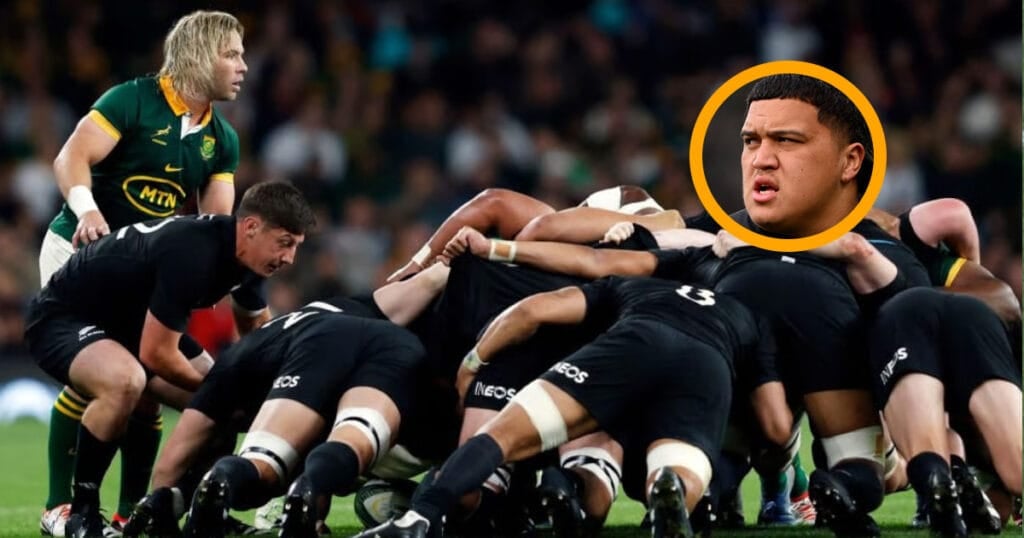
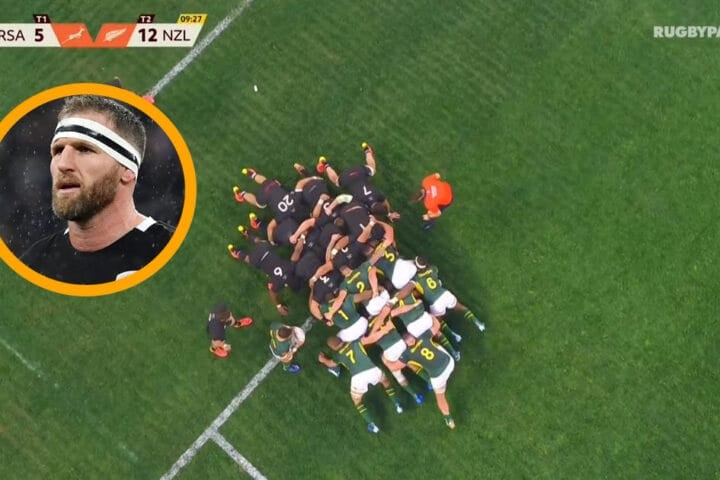
Weight holds a scrum square before technique gets a say. He has watched that argument run all series from a gym floor. Kyle Sinckler thinks no tighthead alive holds that scrum. Others think New Zealand are doing it to themselves.
But the weight is not what he calls the hard part.
“I was in so much pain. I was on drugs, morphine, the whole shebang. And the hardest thing was actually coming off the pain meds. I was getting like panic attacks.”
Tamaiti Williams is careful about that word, and the care is worth noticing. He goes out of his way to say it was not depression and not anxiety, that his body had simply become reliant on morphine and objected when the dose came down. Professional rugby players do not normally talk about withdrawal on camera. He did, unprompted, and then moved on as if it were a hamstring.
Why there is no date, and why nobody can give him one
Here is the line that matters more than the wheelchair.
“It’s not a common thing. It hasn’t really happened much, and especially rugby players. So, yeah, there’s no date.”
Return-to-play protocols exist because thousands of players have done a hamstring, a shoulder, an ACL, and somebody has counted how they healed.
No such evidence exists for a professional front-rower going back to scrummaging loads after an infection destroyed a disc and a surgeon fused the joint. The sample size is close to zero. So his medical team is not working to a date. It is working in blocks.
“I have a pretty mean team, like a few doctors, surgeons. We don’t have a date, but it’s more like do a six-week block of training, get some scans and have another meeting.”
Tamaiti Williams also confirmed something that was never announced: it came back once. Seven weeks of intravenous antibiotics, a holiday in Australia to clear his head, and then a familiar feeling on the way home.
“It’s come back once. So I done seven weeks on antibiotics through a PICC line and then went on holiday to Aussie to kind of refresh the mind, and when I got back, I just knew the pain. So I ended up in hospital again.”
That second admission is what triggered surgery. Tamaiti Williams is on oral antibiotics until the middle of October and has been cleared to run at day one of pre-season in November, which will be his first pre-season since 2021. The explanation he was given for why the fusion should hold is better than most of what gets said about spines on television.
“The way they explained it to me is my spine wasn’t really stable. So it’s like when you break your arm, put it in a cast, keep it still, it heals. My spine was always moving and it just gave it an area for the bacteria to grow. But now it’s all fused together.”
The reframe that took him four months
The most useful thing he said had nothing to do with bacteria.
“It’s given me a lot of perspective. Like at the start you kind of [think] when can I be back, when can I be back? And then it’s like, it’s not an injury, it’s an illness. So it’s actually health related.”
Rugby has a vocabulary for injuries and no vocabulary at all for this. A dislocated shoulder gets a number of weeks attached to it, which is why Ardie Savea will not travel to Baltimore either and nobody had to invent a new category for him. An illness has no number attached to it. It took Tamaiti Williams four months to stop asking for one.
He is back inside the building now, walking laps of the gym because that was the rehab, watching the scrums with the rest of New Zealand and getting four phone calls a day from his father about them. His read on the Springboks pack is generous, which will annoy people. His answer on his own return is shorter: no date, six-week blocks, and a run in November.

Frequently asked
What is wrong with Tamaiti Williams?
An infection in a disc in his spine. The Crusaders named it as discitis at the end of March. Williams has since said the organism was MRSA, that it destroyed the disc, and that surgeons fused the joint at T12/L1 with four screws.
When will Tamaiti Williams play again?
There is no date. He has been cleared to run at day one of the Crusaders pre-season in November and stays on oral antibiotics until mid-October, but his medical team is working in six-week blocks with scans between them rather than to a return-to-play deadline.
Did Tamaiti Williams have surgery?
Yes. After the infection returned following seven weeks of intravenous antibiotics, his surgeon operated and fused T12/L1. Williams says the screws are about as long as his fingers.
How much weight did Tamaiti Williams lose?
He gives his playing weight as 140kg and says he left hospital at about 122kg, a loss of roughly 18 kilograms, which he puts down to the strength of the antibiotics killing his appetite.
Your turn
He was told he might not walk. He has four screws holding a fused joint together.
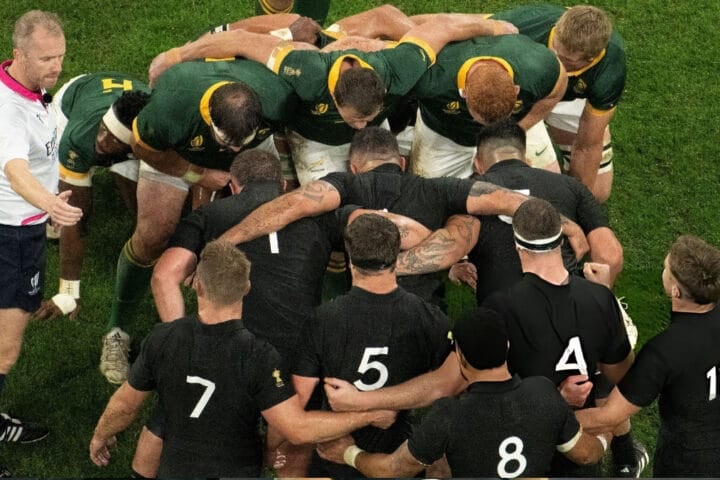
The job he is going back to is putting a 140-kilogram load through it eight times an afternoon against Ox Nché and the pack that has run this series. Two ways to see that. Either the fusion makes the segment safer than the disc ever was, or the sport is asking a question of him nobody has the data to answer. Which one is it?



Comments
No one has weighed in yet.
Be the first - what did you make of it?