


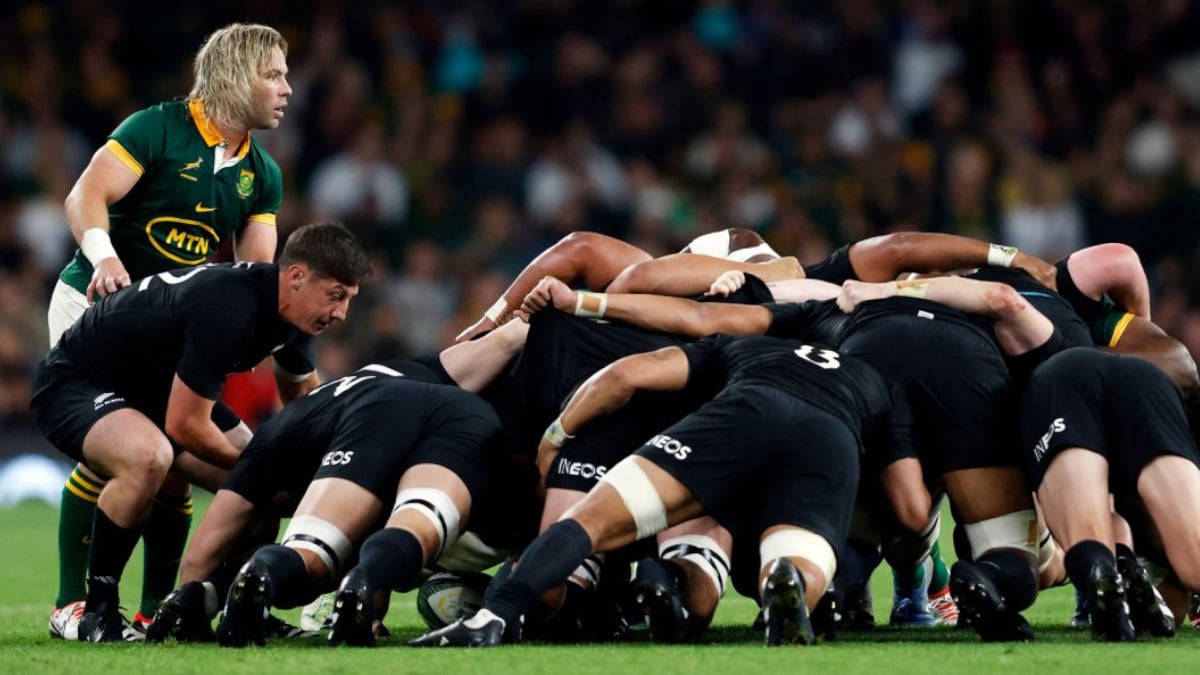
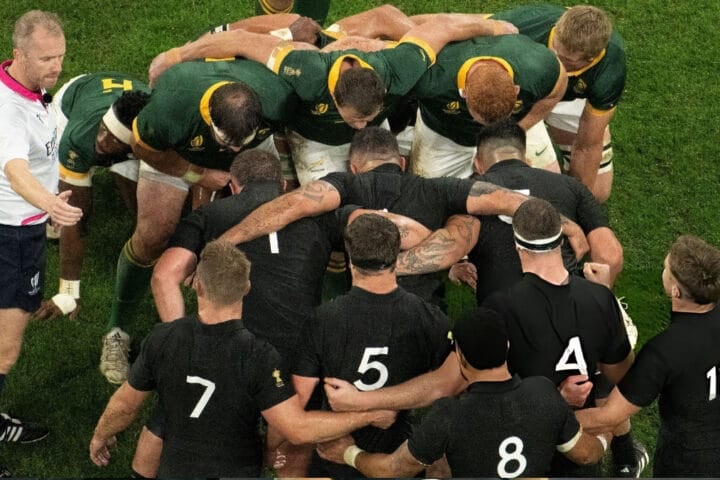
Neil Barnes says the Springboks get “a gravy train of penalties” from their scrum and will not call all of them legitimate. Kyle Sinckler, 68 England caps at tighthead, told Dan Biggar on Monday the penalty try was lost before the ball went in, and what Tyrel Lomax should have done about it.
“There’s no tighthead who’s ever existed on the planet” who holds out the scrum that gave the Springboks their penalty try in Soweto. Kyle Sinckler’s words, and he has packed down against both of these front rows.
He also has an All Blacks scrum fix, and it does not begin with the referee. What Lomax should have done at that scrum is the part New Zealand will like least, and it is not a technique. Kiwis who would rather blame Nika Amashukeli can start below.
Barnes, the All Blacks assistant coach, told Martin Devlin of DSPN this week that “their set piece is pretty damn dominant, and they get a gravy train of penalties from it”, and then: “I’m not going to say they’re all legit, but… we’re going to change the perception for the officials as well.” Five days from Baltimore, the camp is still talking about perception. Sinckler is talking about the setup.
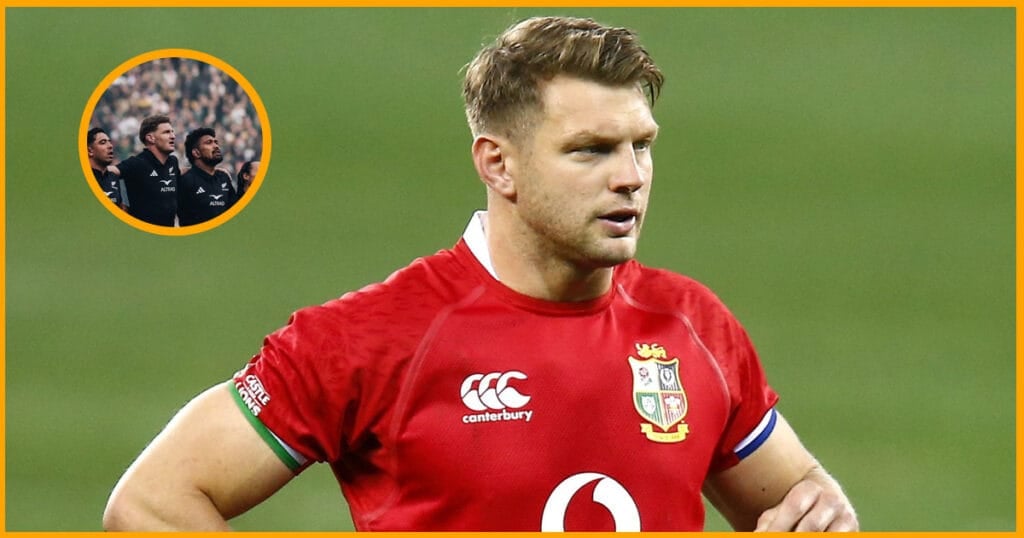
He was on Biggar Thinking, his old Toulon team-mate’s channel, for 44 minutes on Monday 7 September. Biggar has 112 Wales caps; Sinckler faced the All Blacks off the bench in the 2017 Lions series and is still a Toulon tighthead at 33.
South Africa lead Rugby’s Greatest Rivalry 2-1 after the 29-24 win at FNB Stadium, and the reasons the All Blacks lost at FNB Stadium were not only the scrum. New Zealand are in Baltimore for Saturday’s decider without Ardie Savea, who hurt a shoulder in Soweto and is out of the fourth Test, and with six props in a squad trimmed to 36: Ethan de Groot, Lomax, Fletcher Newell, Pasilio Tosi, George Bower and Xavier Numia.
A knock-on that means a scrum is a different knock-on
Biggar’s first observation was not about a scrum. In the fourth minute at FNB Stadium, he said, New Zealand were playing advantage for a Springboks knock-on, with a scrum waiting for them, and chose to run five or six phases 20 or 30 metres behind the gain line instead, because “effectively you could see that they didn’t want to scrum”. Sinckler has been on both ends of that.
“I’ve been fortunate to experience it when you are on top and you are the dominant team, and it’s like, you boys are out the back doing whatever you’re doing, and you drop the ball, and it’s like, well, there’s no problem. We’ve got a scrum now. And then I’ve been on the other side of it, when you guys have messed up, as you normally do, and I’m like, oh my God, I’ve got a scrum.”
The dread does not stay in the front row.
“When you’re under the pump, you’re not playing to win, you’re playing not to lose. Which is a totally different mindset to going out and taking the game by the scruff of the neck, being the aggressors and being on the front foot.”
Which is what the All Blacks looked like for long stretches of Saturday: the pack Angus Ta’avao said was rushing at Ellis Park had, three weeks later, become a pack whose backs would rather run phases backwards than give it a scrum. Sinckler put the reasoning in the players’ mouths.
“New Zealand obviously know, in that game, in that situation, their scrum is under the pump. So it’s like, the last thing we want to do is probably have a scrum 10, 15 metres from our line, in the conditions where you’re under the pump, all the noise from the outside and how much scrutiny has been put on the scrum. It’s like, well, we’d rather chance our arm and play. And then also, you want to take the pressure off your front-row boys as well.”
Why Cape Town looked fine
The argument went quiet for a week after Cape Town, and Sinckler says the reason was the put-in. New Zealand, in his memory of the game, had more of their own scrums at DHL Stadium, and a team on its own ball chooses how long the contest lasts.
“They’ve got a quick strike, the ball’s at the back to the eight. South Africa get a good shove on, but the ball’s already gone. And I remember there was a narrative in terms of collapses and tighthead being on his knees, but essentially the ball’s at the back. The ball can be played. The referee, nine times out of ten, is not going to… it’s just going to play. And that’s probably played into a big factor into why there wasn’t as many penalties, because New Zealand had more scrums on their own ball, so they could dictate the terms of the contest.”
So a quick channel-one ball hid the problem for a week, and five key moments that cost the All Blacks Cape Town came from the lineout instead. In Soweto the scrum that mattered was South Africa’s put-in, five metres out, after Ruben Love’s yellow card, and nobody was clearing the ball quickly.

You know before the referee says set
Sinckler’s account of that scrum starts with a feeling every prop recognises and no coach can see.

“As a prop, before, 95% of the time it’s all about your setup. So before you even go into the scrum, you know if you’re compromised or not. And obviously every prop has different processes, different techniques. For me, if it’s a game of that magnitude, it’s going to decide who goes 2-1 up in the series, the occasion, and obviously all the outside noise, if I didn’t feel comfortable in my setup, stand up straight away and then restart. If the referee pings you and gives a free kick, happy days.”
A free kick five metres out is not seven points. A tighthead who stands up before the engage concedes a restart or a free kick and gets a second setup. A tighthead who stays in a scrum he already knows he has lost concedes what Lomax conceded.
“There’s no way against a pack of that quality that you’re going to be able to get away with not being 100% on your process and setup. So for me, if I don’t feel comfortable, I’m standing up.”
We go up, we go down, but we never go backwards
Then the passage nobody in a New Zealand tracksuit will repeat, and Sinckler knew it as he said it.
“Leicester Tigers used to have this famous saying. It was like: we go forward, we go up, we go down, but we never go backwards. It’s like, in that situation as a tighthead, if you feel that pressure is coming on, the worst-case scenario, and this isn’t me saying, like, advocating for collapsed scrums, but I’m just looking at it from a purely competitive standpoint, is like, okay, take it to the floor. Reset. Make the referee ref it. You might get a reset, you might get a penalty against. However, we’ve got another scrum and I can get my processes right. Because there’s no way, there’s no tighthead who’s ever existed on the planet who’s going to be able to, from a process where they feel compromised in their setup, to then a very poor engage five metres out, to then hold out a pack like South Africa five metres out.”
The professional’s calculation, said out loud by a man who has made it. A collapsed scrum five metres out is a penalty and possibly a card. A scrum driven over the line is a penalty try and a certain seven. Lomax, on Sinckler’s reading, was compromised at the setup, went into a poor engage, and stayed in it, which is the one option with no upside.
This is why referees exist at scrums, and why Barnes is aiming at the wrong target. The Springboks did not need a trick to get that scrum over the line, only a tighthead who stayed in it.
Leave Tyrel Lomax’s knee alone
Sinckler’s next passage is a defence of Lomax, and it is worth more than the front row’s marks from Soweto, because it explains them.
“You have to remember, from a tighthead’s perspective, the loosehead is underneath us. So if you imagine you hit as a tighthead and you get a good engage, and the loosehead pulls back ever so slightly. You’ve got all that weight. You get a good engage, and the loosehead you’re up against pulls back ever so slightly and drops his head. Nine, ten times out of ten, the tighthead’s going to be flat on the floor, face down. But that’s not the tighthead’s fault. So for me, that law, that rule, inverted commas, is a very, very harsh rule on the tighthead, and it allows the loosehead to have a get-out-of-jail card sometimes.”
He declared his bias first: “You’ve got to remember, you’re speaking to a tighthead, so I’m always going to be biased to the tighthead.” He also gave the reason a knee touches the floor without anyone doing anything wrong. Lomax, by his reckoning, is several inches taller than Ox Nché. A taller tighthead hitting and sinking onto a shorter loosehead who is also sinking will have his knee closer to the ground on every engage.
And he gave the reason none of this should be mistaken for a pack that cannot scrummage. The first time he packed down against New Zealand, for the 2017 Lions, he expected a team that “just play away”.
“However, they can play away, they can take you up front. They’re technically as perfect as you can get. But sometimes in a scrum, technique isn’t everything. Like, if you’ve got that bloody-mindedness just to go forward, and you’ve got eight people, large men, who literally want to scrum, sometimes that can overpower the technique.”
Eight men who want to scrum is what South Africa had in Soweto. Technique is what New Zealand had.
The All Blacks scrum fix is a short memory and one line of detail
Biggar asked for technical pointers for Baltimore. Sinckler’s first pointer was not technical.
“If you’re in that scrum meeting Monday, Tuesday, you’ve got to have a short memory. You kind of have to act like it didn’t happen. The worst thing as a prop is to obviously experience what you experienced on Saturday, and it’s not good, and then come in for the meeting on Monday, and everyone’s reviewing it, and you’re getting your pants pulled down.”
Then the detail, and it is one line.
“Purely from my perspective as a prop, I’ll just be looking at my technical detail in terms of my head alignment, what I can do there, and the importance of winning that engage. Because if you win the engage, nine times out of ten there’s only so much the opposition can do. So it’s like, just really stripping it back and just focusing on, I guess, one or two key points.”
Head alignment and the engage. Nothing about the referee. Rennie’s referee-footage campaign and Barnes’s “change the perception for the officials” are aimed at the man with the whistle. Sinckler, asked about the noise coaches make in a scrum week, said what it is like to be the prop underneath it: “No one really knows what’s going on in the scrum apart from the guys who’s in the scrum. So everyone can kind of talk and bring all these narratives up. But we’re the ones who have to cash these cheques.”
The last thing he asked for was buy-in from the other five. “Each scrum, our lives depend on it. You’re going to need every ounce of energy, every ounce of strength from every other person in that pack.” That was the point George Bower said the first scrum in Soweto would do the talking, and it did, for the other side.
Sinckler’s own forecast was generous: “I wouldn’t be surprised if New Zealand come out and they have a solid performance in the final Test.”

Frequently asked
What does Kyle Sinckler say a tighthead should do at a five-metre scrum he is losing?
Stand up before the engage if the setup feels compromised and take the restart or the free kick, because no tighthead holds out a pack of South Africa’s quality from a poor engage five metres out. As a last resort, “from a purely competitive standpoint”, take the scrum to the floor and force a reset rather than be driven over the line.
Why did the All Blacks scrum hold in Cape Town and not in Soweto?
Sinckler’s answer is the put-in. New Zealand had more of their own scrums in Cape Town and used a quick strike, so the ball was gone before the Springboks shove arrived. In Soweto the scrum that mattered was South Africa’s, five metres out, and the drive lasted as long as they wanted it to.
What is Kyle Sinckler’s All Blacks scrum fix for Baltimore?
A short memory in the Monday review, one line of technical detail (head alignment and winning the engage), and buy-in from all eight forwards. He said he “wouldn’t be surprised” if New Zealand produced a solid performance in the final Test.
Your turn
On the record: New Zealand concede three scrum penalties or fewer in Baltimore, and the first stoppage at a five-metre scrum is a front row standing up before the engage rather than going backwards through it. If the count reaches six again, that call was wrong and Barnes was right to talk about perception. Which number is it on Saturday night?




Comments
No one has weighed in yet.
Be the first - what did you make of it?