



Is the Springboks scrum legal? Kieran Read was asked exactly that on a New Zealand rugby podcast this week, reviewing the Cape Town second Test. The former All Blacks captain would not say it is not, and the reason he gave is worse for New Zealand than a yes.
Dave Rennie has been to World Rugby about the Springboks scrum, and said so on the record. Not a coded line about consistency. He named it.
Then his pack went to Cape Town and scrummaged well. They won every scrum on their own ball. And they lost 33-26 having scored more tries than South Africa, after which the argument only got louder.
Then Read was asked the same question Rennie had answered. 127 Tests and two World Cups, speaking from New Zealand, every reason in the world to back his old team’s coach.
He would not say it.
His answer is that it is legal, and the caveat he attaches is worse for New Zealand than an accusation would have been. Rennie says South Africa are doing something wrong. Read says nothing illegal is happening and New Zealand are in deeper trouble because of it. Which one are you with? Say so in the comments, then see whether you still think it by the end.
Rennie said it out loud. Then his scrum got better and he lost anyway.
The complaint was specific. Rennie’s case was that South Africa do not scrummage square. They step sideways and walk around you, and rather than muttering about it he said on the record that the All Blacks had spoken to World Rugby.
Rassie Erasmus rejected it after the second Test, and not politely. His pack were not walking around anybody, he said. They were scrumming through them.
Angus Gardner could be heard on the referee mic during the match telling the front rows not to walk around. Read confirmed as much: “he was telling them, like, on the field you could hear it.”
So the argument ran live on television, with a microphone on it, for eighty minutes. And on the numbers put to Read on the show, the All Blacks won every one of their own scrums while South Africa won 75% of theirs.
That is the part everyone skipped past.
Is the Springboks scrum legal? Read would not say it
He was asked directly whether South Africa are walking around. The answer took a while to arrive and never became the accusation.
“[The Springboks] scrum their own way, and I think that’s slightly on an angle, purely that’s how they have done it for years and years. And they might think they’re going straight.”
Then the line that matters:
“It’s not illegal what they do, potentially, cos you can’t really pick it up. But the outcome, maybe, at the end of it.”
That hedge is the whole story. No referee standing two metres away can see this. It turns up in one place only, in where the ball ends up, and by then there is nobody left to penalise.
A coach can take that to World Rugby every week of the year. It won’t change what a referee can see.
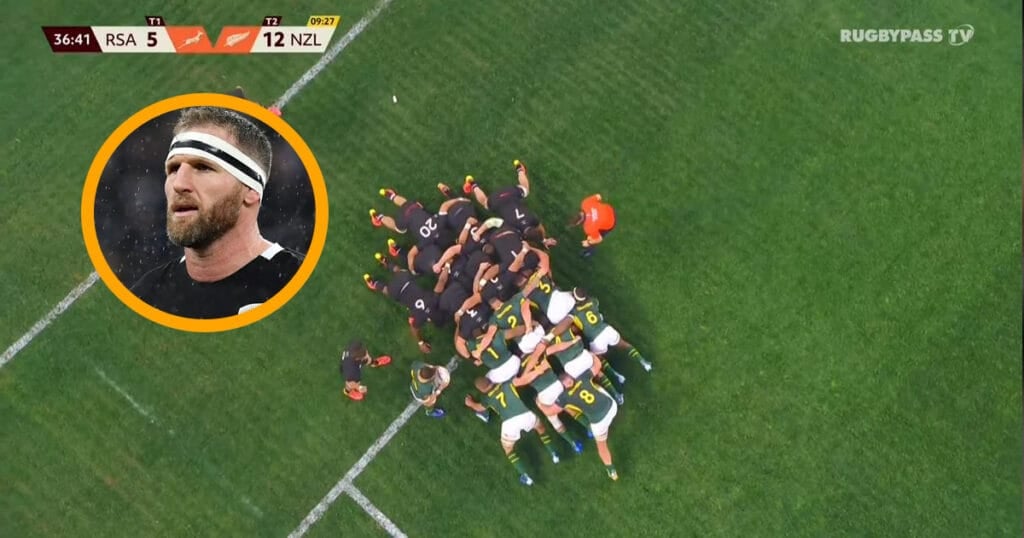
What actually happens to the All Blacks hooker
The camera stays on the props all night, and so does everybody watching it. The whole conversation about this series has been Ox Nché and whoever is opposite him. Read says the contest is being decided one man inside that.
The hooker packs between the two props, loosehead on his left, tighthead on his right.
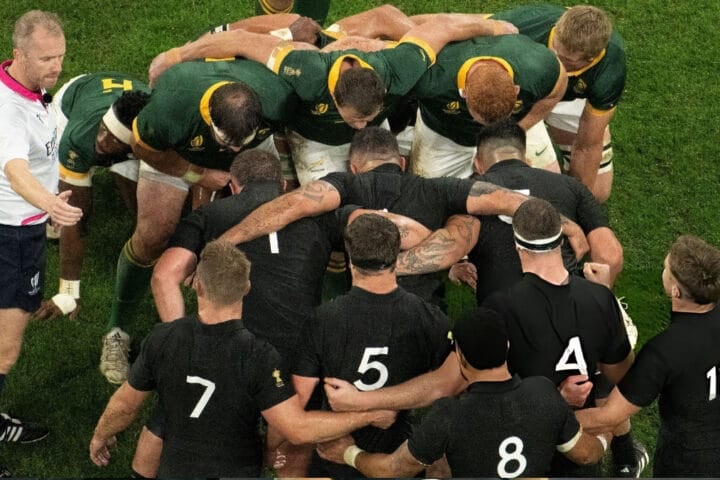
“Their tighthead and their hooker are pushing across to the left. So what they’re trying to do is basically depower our hooker, who’s kind of the connection point between our scrum… so they’re squeezing him, and by going there, our tighthead is a little bit hung out to dry if they get that right.”
Depower means what it sounds like. Take the push out of him.

The hooker is the join. Force from the loosehead side and force from the tighthead side both travel through him, and if he’s being squeezed and turned before the ball arrives, the two halves of the scrum stop being connected to each other. The tighthead is then holding his own side up alone, against a shove coming across him rather than at him.
He goes backwards. On television that looks like a beaten tighthead. Watch the man next to him instead.
The tell, for Saturday: stop watching the props at the hit, the moment the two front rows come together. Watch the All Blacks hooker’s head. If it has been driven left of his own tighthead by the time the ball comes in, the platform is already gone and the next two seconds are a formality.
Lower is supposed to win. So why do they end up on the floor?
“All Blacks, technically, we want to be lower, get in a great position. And that’s why you’ll find a lot of times where we’ll pancake. Because sometimes the opposition might not take the hit. They might be a bit high. The bind might not be strong enough.”
Lower wins. It wins at the maul, it wins at the breakdown, it wins in almost every collision in the sport, and the All Blacks coach it that way deliberately. But it only wins if the other pack meets you there.
South Africa are bigger and they set higher, then sink into the hit once the ball is in. Read’s word for what comes next is a second shove: having started above you, they still have somewhere to go. A pack committed to being underneath has nothing to drive against.
So they pancake, the front row flattening face-first into the turf.
Read had named the front row he wanted in Cape Town days before the Test and did not get it. He gave the call its due anyway. Bower “did an awesome job starting”, he said, and Lomax “had a much better test” off “little techniques changes that we did”.
The scrum improved anyway, and the argument carried on regardless.
Read put Rennie in the same bracket as Rassie Erasmus
This is the part that should have led every write-up of the interview, and nobody used it.
Erasmus had his own complaint after the match: that the All Blacks went down on six scrums out of six on their own ball. Read gave it nothing.
“No. Ball’s out, ball’s gone.”
Once the ball has left the scrum a referee has no interest in what the eight men behind it do next. Eight tired forwards stopped pushing. That’s all that happened.
He was blunt about Ellis Park too. The All Blacks “didn’t deal with it in that first test”, he said, before turning complimentary about what a week of review bought them after Ellis Park: “this morning they dealt with it.”
Then, asked about Erasmus working the officials in the media, he reached across and picked up his own country’s coach with the same hand:
“All he’s trying to do is just influence slightly what’s going to come in the next two tests around refereeing decisions… They’re going to watch Dave Rennie complain about their angles and things. So both of them are just planting little seeds for the refereeing teams to maybe look at when they’re reviewing the footage.”
Both of them. Not Erasmus the agitator and Rennie the man with the legitimate grievance. Two coaches doing the same job on the same officials, and Read’s verdict on all of it was a shrug: “it’s fine. It’s just part of it.”
Rennie’s complaint has a remedy. Read’s version is just harder work.
Rennie’s version is that South Africa are doing something wrong and officials keep missing it. That has an obvious answer: complain harder and get a referee to watch for it. New Zealand tried both. Then they went to Cape Town, scrummaged better than they had at Ellis Park, won every scrum on their own ball, and lost by seven.
Read’s version is that South Africa are doing something clever, and have been doing it for years. It cannot be picked up in real time. Under World Rugby’s Law 19, both packs must be square, stable and stationary before the ball comes in. The law was never written to catch a shear, a sideways slide, that only shows up in where the ball ends up.
There’s no complaint in that version. There’s only a job, and Read named it himself: get your hooker doing the right job on their tighthead, and your own tighthead can scrum straight again.
That’s a harder week’s work than filing a complaint. It’s also the only one of the two that could change anything at FNB Stadium on Saturday 5 September.
The All Blacks loosehead has since asked for more of it. George Bower told the media in Sandton on Thursday 3 September that he loves to scrum, and that “it comes down to that first scrum”.

Frequently asked
Is the Springboks scrum legal?
The Springboks scrum is legal. Asked directly whether South Africa walk around opponents at the scrum, former All Blacks captain Kieran Read said “it’s not illegal what they do, potentially, cos you can’t really pick it up” — his explanation being that South Africa’s tighthead and hooker shear left to depower the opposing hooker, which a referee cannot see in real time. World Rugby’s Law 19 requires both packs to be square, stable and stationary at the feed, but it was never written to catch a slide that only reveals itself in where the ball ends up.
Why did the All Blacks scrums go down in Cape Town?
They mostly did not. New Zealand won every scrum on their own ball. The collapses Rassie Erasmus complained about came after the ball had left the scrum, which Read dismissed outright. Where the All Blacks do go to ground is a height mismatch: they scrummage deliberately low, South Africa set higher and sink into the engagement, and a pack committed to being underneath has nothing to drive against.
What is Dave Rennie’s complaint about the Springboks scrum?
Rennie, the All Blacks head coach, says South Africa do not scrummage square, that they step sideways and walk around the opposition front row, and he said on the record that the All Blacks had spoken to World Rugby about it. Erasmus rejected it after the second Test in Cape Town, saying his pack were scrumming through New Zealand rather than around them.
Your turn
Two readings, and neither is stupid.
Either South Africa have spent years perfecting a technique referees physically cannot police, and the complaint was always a wasted week. Or Rennie is right, it is walking around, and the officials keep missing it because nobody wants to reset the same scrum a fifth time on live television.
One of those lands on Rennie’s whiteboard. The other lands on Amashukeli’s. Pick one and say which below. And if your answer is simply that South Africa scrummage better, deal with the thing that makes that awkward: New Zealand won every scrum on their own ball in Cape Town, and still lost by seven.






Comments
No one has weighed in yet.
Be the first - what did you make of it?