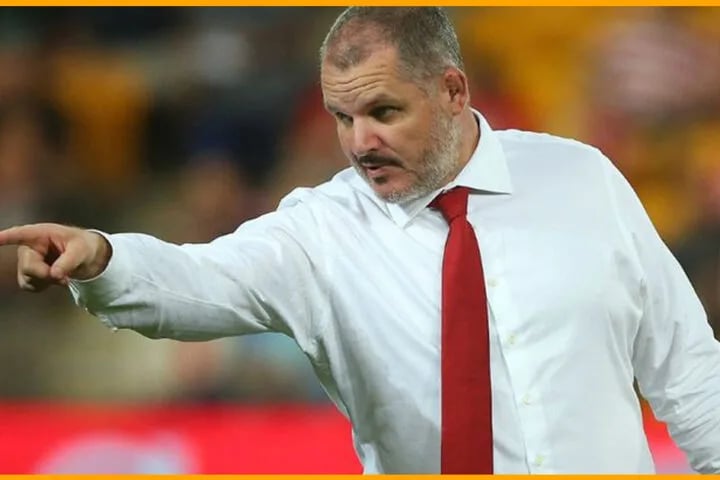
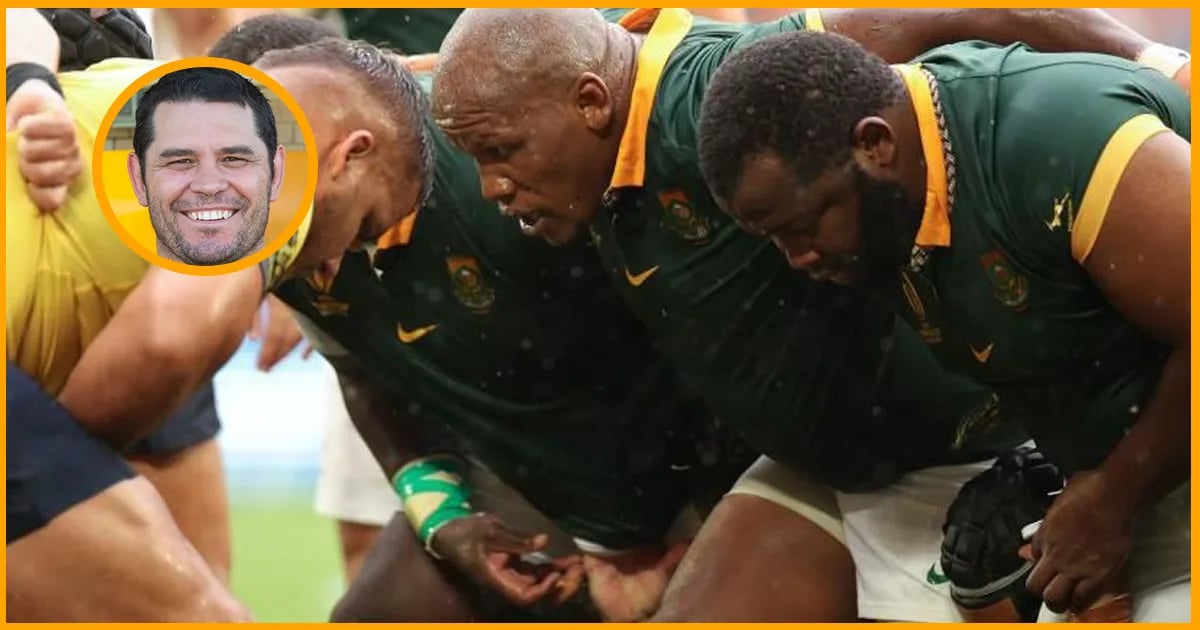
Neil Barnes said nobody gives a s* about the brake foot. Jeremy Paul, 72 Tests at hooker for Australia, watched the same two scrums and said the law will break someone’s neck. World Rugby wrote it to stop exactly that.
“That’s dangerous. You’re going to break someone’s neck.”
Jeremy Paul was not talking about a tackle. He was talking about a law World Rugby wrote for the safety of men in his old position. He had just been read the All Blacks assistant coach’s complaint about it.
The complaint came from Neil Barnes after South Africa beat New Zealand 43-28 in Baltimore to take Rugby’s Greatest Rivalry 3-1, and the NZ Herald printed it on Sunday.
“We get two penalties against us at the start of the game for a brake foot, which no one really gives a s*** about, but the referees are concentrating on. And when you look at the video, both teams have done exactly the same thing at the same time.”
Both calls went against Codie Taylor, for lifting his foot before referee Karl Dickson said set.
Paul’s answer came on The Good, The Bad & Rugby ANZ with Kieran Read on Sunday 13 September, and it goes further than a coach can. He does not think referees are watching the wrong thing. He thinks the thing they are watching is the danger, and he has packed ten thousand scrums. Is a law written to protect a hooker’s neck now the thing most likely to break one?
What the brake foot is
Law 19 says the hooker must have a brake foot positioned “to help stability and to avoid axial loading” when the referee calls crouch. He can adjust it, but it has to keep acting as a brake. Only on set does he remove it and the packs engage. Each of those three clauses carries the same sanction, and it is a free-kick, not a penalty.
It arrived as a trial in the 2022 Six Nations after front-row players asked for it. Axial loading is the load that goes through a hooker’s neck when the front rows lean on each other’s shoulders between bind and set. Dave Heffernan, the Ireland hooker, said at the time that it “seems to be causing neck related issues”. It became full law on 1 July this year.
Paul said on air that he had never heard of it. “What they’ve now made up this rule… I’ve never heard of this thing before.” It is four seasons old. That does not make his objection wrong. It makes it late, and the mechanism he describes is the same one the law was built around.
Read also: Dave Rennie told World Rugby its referees see nothing but the brake foot, which is the other half of this argument and the milder one.
900 kilos and a planted foot
“Can I just state this too, man, that is dangerous as hell. Like you’ve got 900 kilos behind you, mate… what you’re asking the hooker to do is… and we’re going to go back to 5’5 hookers, like cuz anyone over 6’2, like, you’re going to struggle. You have to bring that foot back so you’re on the balls of your feet too. So then that way you actually go in safely.”
“What they’re asking you to do is come up over your front foot. They’re asking you to plant your front foot. Now, it’s actually incredibly hard thing to do, to leave your foot there, because basically you’re just… going in like that, like you’re not actually going in straight and safe. Like, so whoever, whichever idiot in World Rugby decided to bring this rule in about brake foot, like you are up for a massive, massive, like, hurt here. It’s dangerous. It’s absolutely dangerous.”
A scrum engages off the balls of sixteen feet. The brake foot puts one of them flat on the ground, in front of the hooker’s body, until the referee says set. Then the hooker has to get his weight off that foot and drive off the other while the seven men behind him are already moving. A tall hooker, weight over a bent front knee, arrives at the hit late and low. That is what Paul means by “not straight and safe”.
You can check it from the sofa. Watch the hooker’s front foot between bind and set, then watch his hips at the hit. Level with his props and he got there. Below them and he arrived late.
The ten thousand scrums behind the opinion
“You can’t have the hookers… having a flat foot when the other… seven players are all on the balls of their feet… Everyone’s got to be on the balls of their feet. Like, and it’s insane that referees are penalising… the first time I’ve ever seen.”
“When I finished playing… the only thing they could measure our scrummaging to was a mini car crash, right? So that’s why they changed the rules, cuz when we used to be a metre apart. But I’ve had anywhere from 8 to 10,000 mini car crashes, mate, over my career… we were packing 800 to 1,000 scrums a year, like training, playing, all that sort of stuff.”
Read, 127 Tests at No 8 and a man who never had to plant that foot, took the broadcaster’s view.
“It’s a pointless thing… It makes no difference. Like what you want is the scrum up and square, right? Like you want it up off the ground. So no matter how it gets there, keep it up. Get it going. Like people don’t want to watch the reset, the reset, and you want a contest. Yes. The contest has got to be there. But don’t go looking for something.”
Read’s complaint is about the spectacle. Paul’s is about the neck.
Two penalties that the law calls free-kicks
Barnes said penalties. The law says free-kick for every brake foot offence. Andy Rowe called them free-kicks when he read the quote out, and the Springboks ratings here logged a free-kick at a scrum on 15. South Africa’s first points, on 4, came from a high tackle. The two calls cost New Zealand possession and ground, not the scoreboard.
The line that will travel is the other one Barnes gave the Herald. “There’s a perception there that they’re the dominant team, but at the moment they’re getting the rub of the green. When that changes, we’ll have a fair go.”
Rennie said a version of it from Washington a week before Baltimore: “the sole focus at the moment seems to be brake foot.” Both complaints land on the referees. Paul’s lands on the law book, and he brought a fix.
Look at the hips
“When it’s your ball… everything’s to do with your hips in a scrum. Everything. It’s not about across here [the shoulders]… but as soon as your hips start to split, that’s when you start to splinter.”
“So for a referee to referee the walking around… everything else is just look at the hips, mate. Look at the hips, cuz you’re actually on the loosehead side, right, putting in. So you can actually see on the opposite side where that loosehead’s hips are. Then to make a ruling, it’s very simple. If the loosehead on the defensive side is broken away from hips from here, it’s their fault… It’s that simple, mate.”
“No one ever walks around on their own ball. So if everyone scrummaged like they’re scrummaging on their own ball, we could eliminate all this… rules and get rid of this brake foot… And then have that ruling of just… looking at the hips, mate. That’s as simple as, and you fix scrum.”
Three weeks of argument sit behind that. Rennie said the Springboks scrum was walking around. Daan Human answered with six years and a farm. Kyle Sinckler counted exactly one walk-around in four Tests. Paul’s test is the first anyone has offered that a referee can apply from where he already stands.
He is on the loosehead side at the put-in, so the defending loosehead’s hips are in his eyeline. On his own ball a loosehead keeps his hips tight to his hooker. On the opposition’s, he kicks them out, because there is nowhere else to go. Next Springboks scrum on the other side’s feed, watch those hips, not the wheel. If they split before the scrum turns, the turn started there.
The site’s position
Paul’s mechanism is coherent, and so was the welfare case the law was built on. What nobody has published, four seasons in, is what happened to hooker neck injuries after the brake foot came in. World Rugby ran the trial on that claim and should show the numbers. Until it does, “nobody gives a s***” is the wrong response to two free-kicks, and “whichever idiot” is the wrong response to a welfare law.
His fix is not a softer scrum. Nigel Owens warned that depowering the scrum could destroy rugby, and Paul wants the opposite: every man on the balls of his feet, and a referee looking at hips. Why the Springboks scrum is the one everyone is refereeing against is a separate question. The hips answer more of it than the foot does.
Read next: Kieran Read says the Springboks squeeze the hooker, not the prop, which is what happens to the man with the planted foot once the packs meet.
Frequently asked
What is the brake foot in rugby?
Under Law 19 the hooker must have one foot forward in the tunnel on the referee’s crouch call, to keep the front rows stable and stop them loading their necks on each other’s shoulders. He removes it only on set, when the packs engage.
Is a brake foot offence a penalty or a free-kick?
A free-kick. Law 19.10(c), 19.11(e) and 19.12(a) each carry a free-kick sanction. Neil Barnes called the two Baltimore calls penalties; the law does not.
When did the brake foot become law?
It was trialled in the 2022 Six Nations on player-welfare grounds, ran as a global law trial, and became full law from 1 July 2026.
Your turn: welfare law, or welfare risk?
Two ways to see it. Either the brake foot does what hookers asked for in 2022 and keeps the load off their necks before the hit, or Paul is right that a planted foot in front of 900 kilos is the thing that will hurt someone. One of those has four seasons of data behind it that nobody has seen. Settle it below.