



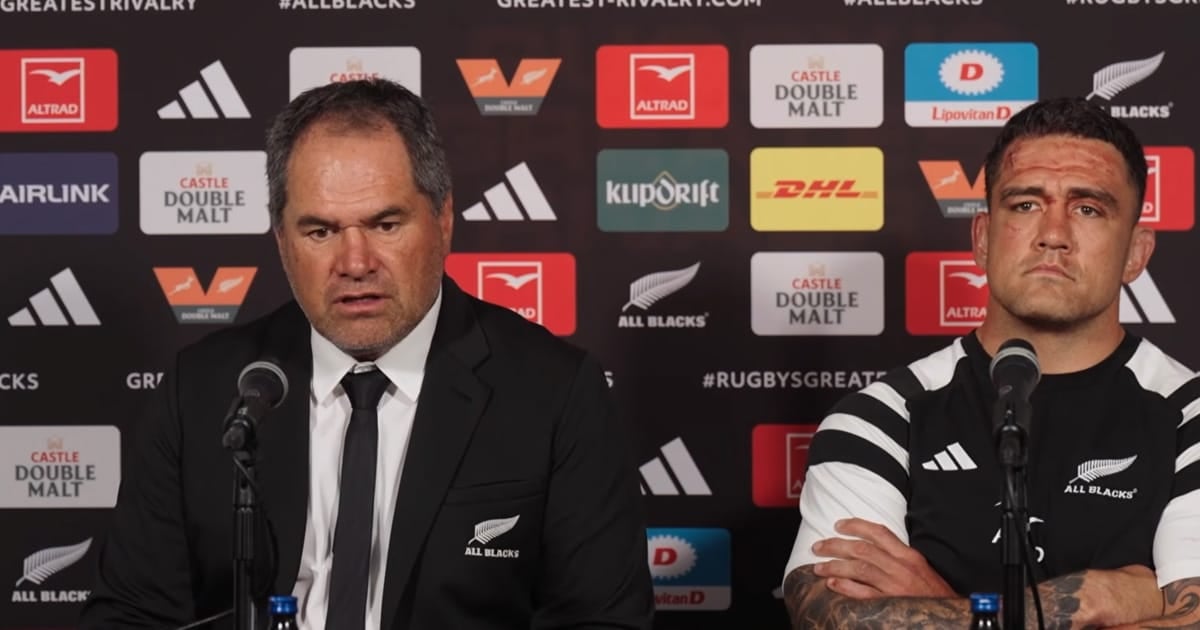
The All Blacks head coach and his captain, Codie Taylor, sat down in Baltimore minutes after the series was lost 3-1. Rennie defended the tour, named his No.2 halfback, and asked one question about the nine-minute blackout that nobody at the top table could answer. Taylor explained where the green jerseys came from.
Dave Rennie looked at the numbers and saw an even game. The scoreboard at M&T Bank Stadium said 43-28, and the series said 3-1.
He and Codie Taylor sat down for the post-match press conference on Saturday 12 September, minutes after South Africa had closed out Rugby’s Greatest Rivalry in a Test that took 105 minutes. Nine of those were spent waiting for a referee who could not hear his TMO. Asked if that cost his side, Rennie said no, then asked a question of his own: “If comms goes down you pull out a spare set, surely.”
Why it took nearly nine minutes is below. So is the halfback he named and the line his captain will be quoted on for a week. First, was Baltimore as even as he says? The clock, the stat sheet and his own captain give three different answers. Pick one in the comments.
Dave Rennie says the numbers were even. They were, for 64 minutes
“You look at the numbers, it was a very even game tonight by the score, and we probably conceded a little bit chasing the game late. But felt even with 15 to go we were right in it. So, disappointed, but still really proud of the effort, and feel that we’re tracking in the right direction.”
Check that against the clock. Ethan Blackadder scored on 64, Damian McKenzie converted, 29-21. Fifteen to go, eight points down, one converted try from level. He is right.
Then Kurt-Lee Arendse picked up a loose ball inside his own half on 72 and ran the length of the field. Cameron Hanekom scored on 78 off a Will Jordan turnover. Fourteen points in six minutes, both from New Zealand ball, and 43-21 before Beauden Barrett’s try on 80 tidied the margin.
The stat sheet agrees with the coach more than the clock does. RugbyPass had carries at 137 to 142 and turnovers won at eight each. Line breaks were 8 to 11. Close enough, for a man who had just lost a series.
Taylor’s version was blunter.
“Reflecting on the first game, we probably created a few more moments in that second half and applied a lot of pressure, and then we probably fell short to a few crucial moments in those last three Tests. And South Africa are just a bloody good side and they’ll punish you if you give them those opportunities.”
New Zealand outscored South Africa across the first three Tests and still flew to Baltimore 2-1 down. Now it is four Tests, four close stat sheets and one win. At some point “even on the numbers” stops being a consolation and becomes the diagnosis.

Rennie did name the thing that was not even. “High ball put us under a little bit more heat again tonight. We couldn’t grab a lot of those.” The word doing the work in that sentence is “again”.
And the penalties. Asked about the silly ones, he did not reach for context.
“Yeah, it’s not good enough. And if it just has no effect on the game either, but it’s dumb. So we’ve got to get that sort of stuff out of our game.”
Wallace Sititi said the same after Soweto, when the count was 12-11 and South Africa won by five. Different week, same sentence.
“If comms goes down you pull out a spare set, surely”
Rennie was asked whether the nine-minute break cost his side momentum.

“No. No. Look, I think it’s just something that probably shouldn’t happen but did happen. If comms goes down you pull out a spare set, surely. So I’m not sure why it took so long, but that’s not an excuse.”
The break came midway through the first half, after Sacha Feinberg-Mngomezulu’s penalty from halfway drifted wide. Karl Dickson had lost his link to the TMO. The NZ Herald timed it at 8 minutes 53 seconds. Play resumed only when both captains agreed to carry on without a TMO unless there was foul play, with a phone call to the touchline as the fallback. The Test took 105 minutes. Soweto, a week earlier, had taken 98, with comms problems of its own.
He is right twice, and the second one matters more.
The All Blacks’ best passage of the night came after the blackout: 32 phases ending in Will Jordan’s try on 38, 17-14 at the break. Whatever the stoppage did to the match, it did not do it to New Zealand’s attack.
And the spare set. The biggest crowd rugby union has drawn in the United States, and the referee’s radio went dead for the second Test running. Nobody could get him talking for nearly nine minutes.
Cortez Ratima had his nose in front. A knee in Pretoria picked Kyle Preston instead
The selection news was hidden in an answer about halfbacks. Cam Roigard’s grip on the nine jersey is not in question, which is the rule Aaron Smith says nobody writes down. The question was who sits behind him, and Rennie answered it with a name that never played a Test.
“Cortez Ratima probably had his nose in front prior to getting injured, and he went home early in the end. Been really impressed with Kyle. He suits our game… the quality of his pass. He’s got a really good running game and he’s a reasonably solid nine. So, look, excited for him, and that’s what this tour is about. We’re learning lots about players who will be scrapping it out for a World Cup spot next year.”
Ratima hurt his knee against the Bulls in Pretoria on 15 August, the first match of the tour, and flew home from Johannesburg on 6 September with a posterior cruciate ligament injury and no Test minutes. Preston sat on the bench for all four Tests and came on for Roigard on 67 in Baltimore.
“Reasonably solid” is faint praise from a coach who has just called the same man’s pass and running game good. He is keeping expectation off a young nine. The point is the order: a ligament settled the No.2 nine for the Bledisloe Cup before any Test could, and the coach said so.
Beauden Barrett, 144 caps and on the bench at 23 with Ardie Savea at home nursing a dislocated shoulder, got the other depth answer. Rennie had started him at fullback against the Bulls and the Lions, and named four playmakers for two jerseys: “Richie and Ruben, Damian and Bod.” The man who started at 10 in Baltimore was picked before Soweto. The queue for next year is short and public.
“I would have liked to see a few more black jerseys”
The line that will travel came from the captain. The question about the atmosphere was put to both men, and Taylor took it.
“It’s been amazing to come over here and just soak up what America has to offer. They obviously love their sports and they got right behind rugby. I would have liked to see a few more black jerseys, but obviously there’s a lot of South Africans over here, which I wasn’t aware of until I see them in the elevator every time you go up and down at the hotel.”
Sixty-seven thousand and more, and most of it green. Taylor found out where the support lived in a hotel lift.
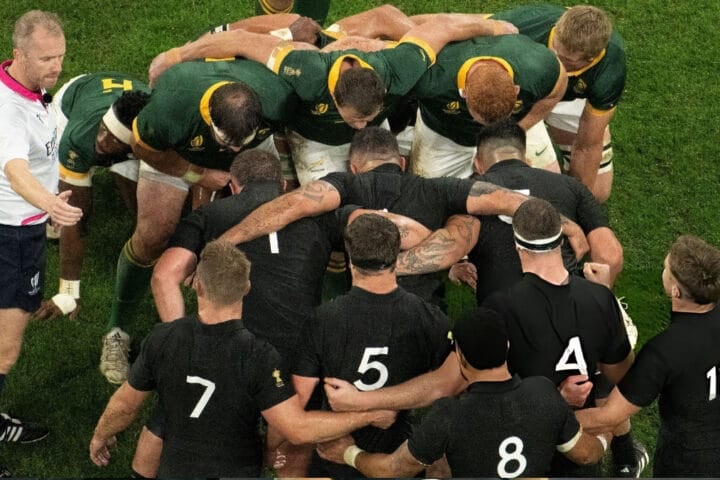
He was also asked about the moment after the whistle, when both squads knelt together in a huddle. “Both teams are full of great men of character, and I think that’s where the respect comes from,” he said.
Then the caveat every captain adds: “When you pull the jersey on for your nation you want to go out there and beat whoever’s in front of you, and unfortunately we’re on the short side of that this tour.” The other captain, Siya Kolisi, was asked what he would sing to celebrate, and sang it.
Next is the Bledisloe Cup, Eden Park on Saturday 10 October and Accor Stadium in Sydney a week later, then the Nations Championship pool phase in November: Scotland, Wales and England, all away. “Tracking in the right direction” gets measured there. One win in four against South Africa is the number the tour leaves behind. Rennie’s argument is that 49 players and a settled game model are the other number, and that nobody will know which one counts until Auckland.
Taylor’s last answer was shorter than the coach’s. “It’s gutting, this tour, but still so proud of the men that we have.”
Read next:
– All Blacks player ratings from Baltimore, where the returning fly-half gets the lowest mark in black.
– The All Blacks team for Baltimore: the panel’s scrum fix went home. The team sheet he explained on Thursday, with Mo’unga at 10 for the first time in the series.
– Steve Hansen and Ewen McKenzie named six things New Zealand were missing in Soweto. Rennie’s “again” suggests the high ball is still on the list.
Frequently asked
What did Dave Rennie say after the All Blacks lost to the Springboks in Baltimore?
That the numbers were even, that the silly penalties were “dumb”, and that the tour had done its job for a squad that grew to 49 players. He also asked why the nine-minute comms failure took so long to fix.
Why was the Baltimore Test stopped for almost nine minutes?
Referee Karl Dickson lost his radio link to the TMO midway through the first half. Play stopped for 8 minutes 53 seconds and resumed after both captains agreed to carry on without a TMO unless there was foul play. The match took 105 minutes.
When do the All Blacks play next after the Springboks series?
The Bledisloe Cup against Australia at Eden Park on 10 October and at Accor Stadium in Sydney on 17 October, then the Nations Championship pool games in November against Scotland, Wales and England.
Your turn: is Dave Rennie right that the All Blacks are tracking in the right direction?
Two ways to read the same press conference. Either the numbers were even, the tour built a squad and a game model, and the Bledisloe will show it. Or four close stat sheets and a 3-1 series are the gap, and calling it even is how a coach avoids saying so. Which one did Baltimore prove? Settle it below.

1 comment
Don’t look for excuses …… The Boks are just too good.
The All Blacks, ESPECIALLY the forwards, HAVE to get more menacing, imposing and skilled.
Did anyone notice the absence of any real pressure when the Boks put up a high kick ? … in two of those instances the Bok kicker could’ve had a cup of tea before he kicked it ! 😂