


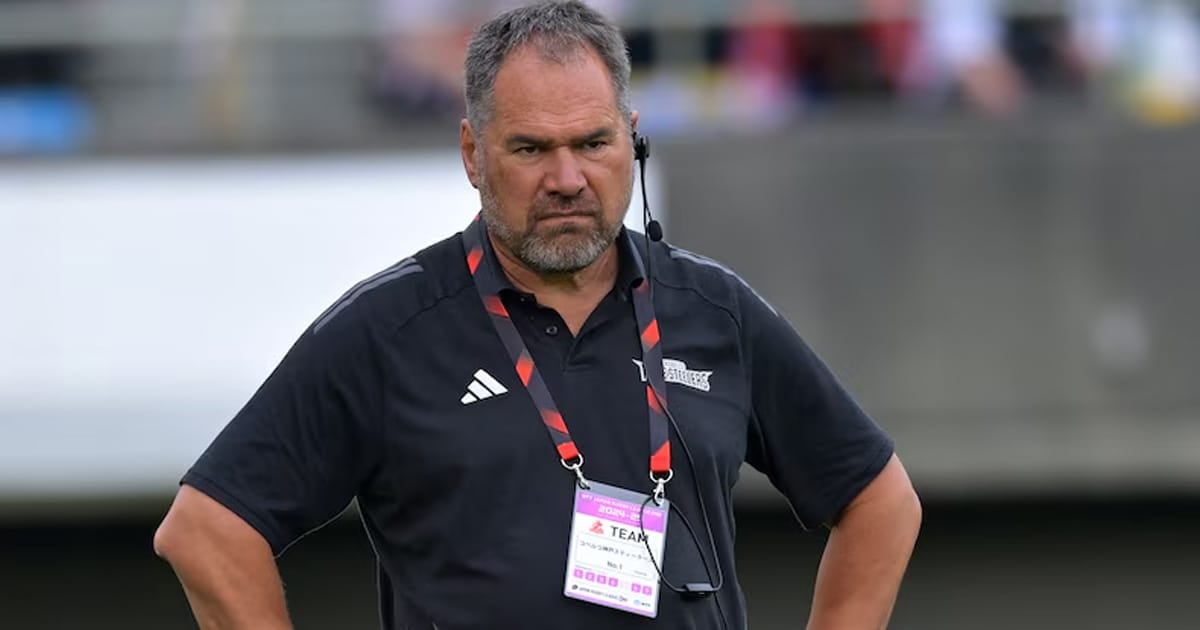
The All Blacks coach fronted the media in Washington DC on Monday with a series already gone. He spent fifteen minutes refusing to blame anybody, and then gave away the one line that moves the biggest argument of this tour somewhere new.
“Not really. I just… yeah, like I just don’t want it to be the big topic.”
He was talking about it again before the answer was over.
The Dave Rennie brake foot answer came at the back end of a press conference in Washington DC that the All Blacks coach had spent being generous to everyone: to the Springboks, to the referee who carded his fly-half, to the winger who missed the tackles. A reporter asked him to expand on the difference of opinion he has with World Rugby about scrums. He said no. Then he expanded on it anyway, and what came out was not another complaint about whether South Africa’s scrum is legal. It was a complaint about where officials are being told to look.
“We’ve said a few things. We’ve spoken to World Rugby about it. They agree, in some parts, but not necessarily everything. And to be honest, the sole focus at the moment seems to be brake foot. I reckon if referees are looking for brake foot, they don’t see all the other things that you’re supposed to be looking at. So I don’t think we’re helping our referees by making their job any easier.”
He has been to World Rugby about the Springboks scrum and said so out loud once already on this tour. This is the first time anyone has heard what came back.
Dave Rennie brake foot: what a referee stops seeing while he is looking down
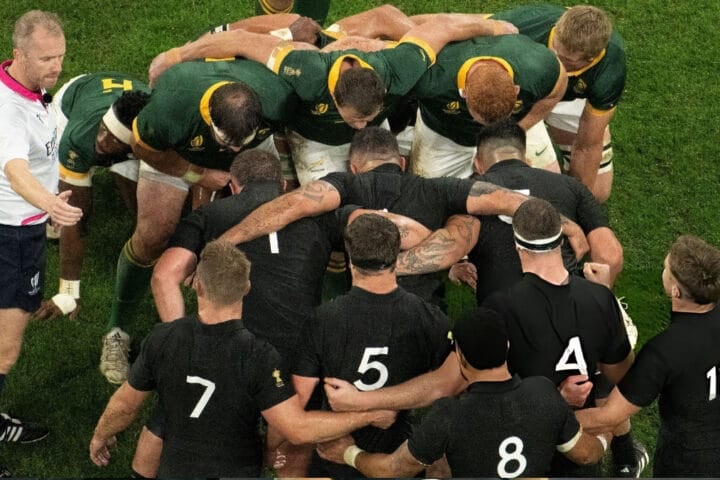
The brake foot is the front row’s leading foot, planted forward on engagement so a scrum has something to hold it square before the ball arrives. It is there to stop a pack driving early, and it sits inside the scrum law World Rugby publishes alongside the bind, the feed and the square. Referees check the foot because it is checkable, and because a foot either is in position or it is not.
Rennie’s point is about attention, not law. A referee crouched at the mark watching feet is not watching binds. He is not watching hip height, or the moment one side stops pushing straight and starts travelling, or which shoulder drops first. Those are the things that decide a Test scrum, and they happen above the knees.
Watch the officials on Saturday rather than the props. If the referee’s eyes are down at the feed, the next penalty is going to be about something he could see from there.
That is what makes this different from three weeks of arguing about legality. Kyle Sinckler watched the same scrums and called them legal, won before the feed and walked around exactly once. Rennie is not fighting that. He agrees the officials are the ones who matter and that his side has to live with the interpretation.
“I mean, I guess we could talk about scrums, but clearly our view and the view of World Rugby and the officials is different, and so you just got to deal with it. They don’t see it the way we do, and they’re the ones that matter on game day.”
He also refused the easy version of his own argument. Asked about the set piece earlier in the session, he said New Zealand’s own ball was “reasonably solid”, that they “got it badly wrong on one and got punished”, and that the answer is fewer scrums rather than better luck at them.
He was handed the Ruben Love grievance and gave it straight back
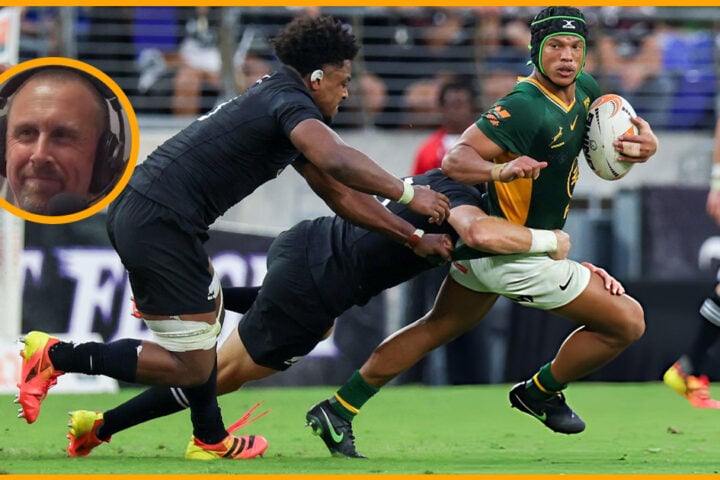
New Zealand has spent four days furious about the yellow card that took Ruben Love off the field a metre from his own line at FNB Stadium. On this site, a Crusaders coach called it the harshest yellow card in Test history and said it was not even a penalty.
Rennie has watched it back. He went through it phase by phase, and he ended up defending Nika Amashukeli.
“They went advantage off the first play off the line, and Ruben was clearly onside, and so was… then they said [number] 12, which is Jordie Barrett, and both of them were clearly onside. But the next ruck, Jord’s got a foot in front of the line, so… not Jordie, Ruben, sorry. So that’s what the penalty is for. It’s definitely a penalty based on law. I think it [could] have been off the first ruck. I understand the yellow card.”
Then the part nobody in a New Zealand jersey had to say.
“But I guess he’d yellow-carded one of your guys for a professional foul, and so he’s consistent.”
Amashukeli had carded Sacha Feinberg-Mngomezulu on ten minutes for knocking down a pass to an unmarked Peter Lakai. Rennie’s read is that a referee who cards one side for a cynical infringement and then cards the other is doing the job properly, and that Love’s foot was over the line on the second ruck, not the first.
A losing coach with a series gone is entitled to take the free hit. He declined it twice more, and by the end of the session he had gone further than anyone expected.
“They’re a very good side and they scramble really well… I think the better side probably won in the end.”
The throw to the front is not a mistake. It is the price.
The most useful ninety seconds of the press conference had nothing to do with referees.

New Zealand’s lineout has been criticised all series for the same thing: it wins its own ball and launches nothing off it. Rennie was asked whether throwing to the front so often had stymied the attack. He agreed that it had, and said they are doing it on purpose.
“Lineout-wise, we’re trying to play tempo, and ideally we’d like to play it off the middle or off the back. But the thinking is we’ll take it where we can, and the way South Africa were defending middle and back… just going off our thrower. It’s free ball at the front, so we’re prepared to take it just to get ball on our hands and get a bit of continuity.”
South Africa’s lineout defence keys off the thrower’s eyes and contests the middle and the tail. So the front is uncontested, and New Zealand take it.
What that costs is everything a lineout is normally for. Front ball arrives early and low, the maul option disappears, the scrum-half is under the throw instead of behind a platform, and the first carrier gets it with the defence already set and moving. Possession, but no launch pad. Rennie has decided that is a better trade than losing the ball in the air against a pack that punishes turnovers with penalties and field position.
There is a tell for Saturday in it. Count how many All Blacks lineouts start inside the five-metre channel, and watch where South Africa’s front jumper stands before the throw goes in.
“Give him a cuddle”
The best answer of the fifteen minutes was the shortest. Asked what a coach does with Leroy Carter, outstanding in attack all series and beaten for two Springboks tries, Rennie did not reach for a technical fix.
“Give him a cuddle. He’s such a good man, and I tell you, he was hurting.”
Then he explained why the position is judged the way it is.
“A winger misses tackles and it’s out in the open and you concede points. It hurts. And a big fella around the edge of a ruck misses a tackle and no one notices. But it’s part of the responsibility of him defending out wide, and I know he’ll be better.”
Every player who has ever played on a wing knows that sentence is true, and almost nobody says it out loud. A missed tackle in midfield gets covered by the next man. A missed tackle at 14 gets a replay, a slow-motion angle and a week. Rennie has already explained the structure that put Carter in that position in the first place, so this was not a coach hiding behind a system. It was a coach pointing at the job description.
The breakdown is where he pointed at his own players
For a man accused of blaming officials all tour, Rennie spent most of the session doing the opposite. On the two breakdown penalties that hurt New Zealand most, he sided with the referee both times.
Ardie Savea was penalised at a ruck, and Rennie’s read was that the officials had it right, because there was “a tackler involved before it goes to the ground”. A tackler in the contact makes it a ruck, and the option then is to back out and get into the defensive line. Fabian Holland hit a defender who was already backing out of the contact and ended up sealed off behind it. “So we got to be smarter. Can’t bring the ref into the game that way.”
He wanted a number attached to it, and could not remember Saturday’s.
“Certainly the week before, we lost five out of 116, and even that number needs to be better.”
Five losses from 116 rucks in Cape Town, by his count, is a retention rate most sides would take. Rennie thinks it is not good enough, because of who is standing over the ball.
“They’re so good over the ball. It’s not just a couple of their players. They got a lot of players 1 to 15 who are very good over the ball.”
The one he kept returning to was Sam Darry, isolated after Cam Roigard dabbed through and offloaded to him. Ball in the hands of a lock with nobody arriving. Against this South African side that is a penalty every time, and it is the same lesson as the maul, where Jason Ryan timed the Cape Town maul failure at two seconds. Rennie’s plan for Baltimore is built entirely on subtraction.
“You can’t just make their strengths disappear, but our job is to limit the amount of opportunities they get.”
Two mornings, 32 degrees, and a series that cannot be won
The All Blacks flew to the United States on the same charter as the Springboks, out of Johannesburg at 2am on Sunday, delayed ninety minutes, down in the Canary Islands for a couple of hours, roughly 24 hours door to door. They did not train on Monday. Rennie’s reason was blunt.
“If we tried to train today after 24 or 26 hours of travel, I think we’d be beating a dead horse.”
What that leaves is two training mornings before a Test that decides whether the trophy is shared or lost, one of them mostly a review of Soweto, both cut short by heat he put at 32 degrees, with a move from Washington to Baltimore squeezed in on Thursday afternoon. A 2-2 finish splits the trophy and 3-1 hands it to South Africa outright, which is a thin week to prepare for either.
Changes are coming, and not only the forced ones. Ardie Savea, Quinn Tupaea and Luke Jacobson all flew home from the squad named on Sunday, but Rennie said the fourth Test was always going to look different.
“We sort of always thought that we’d make changes on the fourth Test regardless of whether we won that third one or not… make sure we bring in guys with plenty of energy and share the load.”
And when a South African reporter asked what he made of Rassie Erasmus naming almost the same side again, Rennie answered with the sharpest structural point of the day, which is that continuity is not a coaching philosophy so much as a head start.
“They have played three Tests together, and our guys have had four provincial games in front of that too. So I look, it makes sense, doesn’t it? You stick with the guys who are performing well.”

Frequently asked
What is a brake foot in rugby?
It is the front row’s leading foot, planted forward on engagement so the scrum has something holding it square before the ball comes in. It stops a pack driving before the feed. Dave Rennie’s argument is that it has become the first and sometimes the only thing referees look for at a scrum.
What did Dave Rennie say about World Rugby?
That the All Blacks have raised their scrum concerns with World Rugby and been partly, not fully, agreed with: “They agree, in some parts, but not necessarily everything.” He also said he did not want the scrum to be the main story of the fourth Test.

Did Dave Rennie blame the referee for Ruben Love’s yellow card?
No. He said the penalty was correct in law, that it could have been given a phase earlier, that he understood the yellow card, and that Nika Amashukeli was consistent because he had already carded a South African player for a professional foul.
When is the fourth Test between the Springboks and the All Blacks?
Saturday 12 September in Baltimore. South Africa lead the four-Test series 2-1 and New Zealand can no longer win it.
Your turn
Two ways to read the brake foot line. Either a coach with a series already lost has identified something real about how scrums are being refereed and has done the sport a favour by saying it, or he has spent three weeks losing a set-piece battle and has found a more sophisticated way of saying the same thing he said in Cape Town. Both are available on the evidence. Which one is it, and does the answer change if New Zealand’s scrum holds up in Baltimore?






Comments
No one has weighed in yet.
Be the first - what did you make of it?