

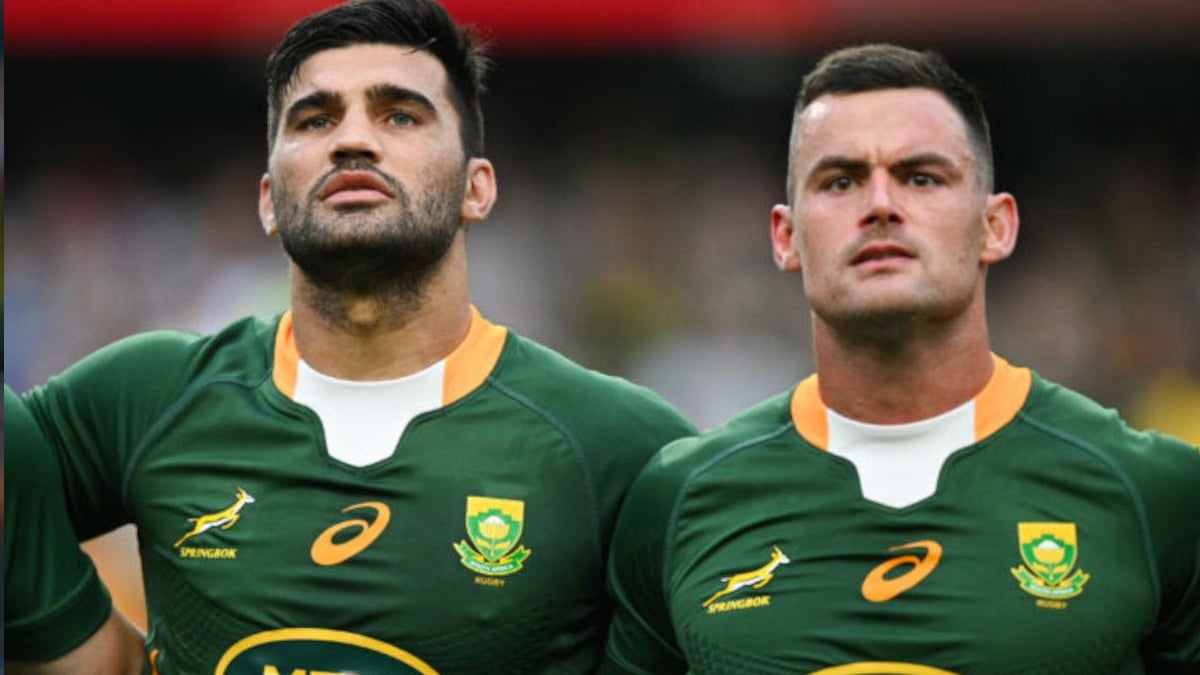
Nick Mallett was asked on Sky Sport where Damian de Allende and Jesse Kriel sit among Springboks midfields. He put them above the pair South Africa spent fifteen years calling its best, and explained why in terms no stat sheet gives you.
Jesse Kriel will never complain about not getting the ball. Nick Mallett offered that as the highest compliment a former Springboks coach can pay an outside centre, and then ranked him above Jaque Fourie.
He also got the caps of de Allende and Kriel wrong, by about twenty each. The right numbers are further down, and they settle it.
The question came from Brad Weber, 18 Tests as an All Blacks halfback, on Sky Sport NZ’s The Breakdown on Sunday 6 September: where do de Allende and Kriel sit in the all-time conversation? Mallett, Springboks coach from 1997 to 2000, was on a live link the morning after his old side beat the All Blacks 29-24 at FNB Stadium with a try from one centre and an assist from the other.
He did not hedge. If you still have de Villiers and Fourie top, the comments are open at the bottom.
“They would go down probably the best we’ve ever had”
“Well, they would go down, probably, the best we’ve ever had, winning two World Cups. They were there in 2015, actually, when we got knocked out by you guys in the semi-final. So they’ve been around for more than 10 years for South Africa. And what’s unbelievable, they’re incredibly unselfish players who set a wonderful example for the young guys.”
They were there. Twickenham, a wet Saturday in October 2015, Kriel at 13 and de Allende at 12, and a semi-final South Africa lost 20-18 without scoring a try. Kriel had made his Test debut three months earlier. De Allende had fourteen months of Test rugby behind him.
Eleven years on, both have two winners’ medals, and the 2023 final in Paris is the one they started together.
The record de Villiers and Fourie held has already gone
Jean de Villiers and Jaque Fourie started 29 Tests together in the Springboks midfield, and for a decade that was the number every other pairing chased. De Allende and Kriel had already passed it by August two years ago, when Rugby365 counted their 31st start together, and they have not stopped.
They started all three Tests of this series, and at Ellis Park de Allende’s hundredth cap was the headline of the team sheet that SA Rugby described as a record-breaking pairing.
So the record book had ruled before Mallett did. He added a ranking, and he made it carefully.
“We always spoke about Jean de Villiers and Jaque Fourie as our two centres who had played the most games together, and probably were recognised as the two best. But these two, I think, have gone past them.”
That is not a small claim in South Africa. Fourie started the 2007 final in Paris. De Villiers’s tournament had ended six weeks earlier with a torn bicep in the opening match against Samoa, and he still went home with a medal and a reputation as the most complete 12 the country had produced. Conrad Smith, who marked them for New Zealand for the best part of a decade, said he did not think the All Blacks ever had their better.
De Villiers passed off either hand and read a game like a 10. Fourie ran the outside line as well as anyone alive at the time. Nobody ever ranked them for what they did without the ball, which is exactly where Mallett starts with the new pair.

De Allende and Kriel: why not complaining is the whole point
“Physical. If we decide we’re going to play a very direct game, de Allende, the whole game, will just carry the ball up. And Jesse Kriel, an outside centre, will never complain about not getting a ball at all. He’ll just concentrate on his defensive role, and chasing up-and-unders, contestables, chasing back to make sure that if there is a possibility of a counterattack, he’s there.”
Read that as a job description, because it is one. In the Springboks system the 13 is the hinge of the whole defensive pattern: the first man up outside the inside centre when the line goes, the chaser under the contestable kick, and the cover runner when the kick is returned.
Most outside centres in world rugby are picked for what they do with the ball. Kriel is picked for the eighty minutes he spends without it, and he has been doing it for long enough that the sacrifice has stopped looking like one.
FNB Stadium on Saturday 5 September was the pattern in miniature. Kriel knocked on twice, on 35 and 62 minutes, and would still have been in most people’s top three Springboks on the night, because on 58 he took Manie Libbok’s long pass, wrestled free of Leroy Carter and ran it in from 40 metres for the first South African lead of the match.
Before that he had broken the line in the build-up to Kurt-Lee Arendse’s try. After it he was still chasing.
De Allende’s night was the other half of the same pattern. On 21 minutes he fended and stepped past Carter to put Arendse in. On 75 he gave Kriel a catch-and-release through a gap. In between he made 11 tackles on RugbyPass’s count and nothing the broadcast noticed came through his channel. This site’s ratings gave Kriel an 8 and de Allende a 7.5, and the gap between them is one pass.
Eighty caps. Mallett undersold them by twenty each
Mallett’s last point was about what the pair do for the man inside them.
“Imagine playing flyhalf, someone like Sacha going into the team for the first time, and you’ve got Damian there with 80 caps and Jesse Kriel there with over, the same number of caps. It provides a huge amount of security for a young flyhalf.”
He was working from memory and he was short. De Allende won his 100th cap at Ellis Park and his 102nd in Soweto. Kriel was on 90 when SA Rugby published the Ellis Park team sheet and has started every Test since, which puts him on 93. Between them, de Allende and Kriel have 195 Tests, and a record for starts together that nobody else in South African rugby is within reach of.
The security point is the one that matters for the next twelve months. Sacha Feinberg-Mngomezulu started all three Tests of this series at 10. Libbok ran the position for seventy minutes in Soweto after the early sin-bin. Handré Pollard was withdrawn on the Friday before Cape Town and did not feature. Three fly-halves, one midfield, and the midfield never changed.
Rassie Erasmus said in the press room on Saturday that his squad has “been together since 2018” and that he knows the players inside out. The two men outside his 10 are the clearest example of what he means.
New Zealand have the opposite problem, and Angus Ta’avao, 23 Tests as an All Blacks prop, named it on the same show. “Jordie and Quinn have been some of the best midfield pairings,” he said of Jordie Barrett and Quinn Tupaea, while running through the injury list that starts with Ardie Savea’s shoulder. Tupaea flew home on Sunday with a knee ligament tear. The Springboks midfield for Baltimore has started more Tests together than any pair in the country’s history.
Willemse and Moodie have the shoes. They have a year to grow into them
Mallett named the succession without being asked.
“The guys who could step in, maybe not this next weekend, but a guy like Damian Willemse, who’s got great feet, beautiful hands, very physical centre as well at inside centre, and Canan Moodie, who’s got some silky skills there. They’ve got big shoes to step into.”
Here is where the site parts company with the easy version of Mallett’s argument. De Allende was born in November 1991 and will be 35 by the time the World Cup in Australia reaches its knockout rounds. Kriel is 32 now and will be 33.
Erasmus went back to the same front row he had picked for Ellis Park for Soweto and it produced a penalty try, so continuity is winning its argument on the field every week.
Willemse and Moodie may already be the better ball-players. The jersey has never been about that. The system is built on what de Allende and Kriel do without the ball, and neither of the young men has spent a Test doing those things yet.
So the call is Mallett’s, with one condition. De Allende and Kriel have gone past de Villiers and Fourie, on the record and on the tape. The year ahead asks whether Willemse or Moodie will chase a kick he was never going to get, on 78 minutes, with the lead already safe, because that is what the jersey has meant since 2015.
Frequently asked
Who are the best Springboks centre pairing of all time?
Nick Mallett, Springboks head coach from 1997 to 2000, said on Sky Sport NZ’s The Breakdown on Sunday 6 September that Damian de Allende and Jesse Kriel have “gone past” Jean de Villiers and Jaque Fourie, the pair previously regarded as South Africa’s best. De Allende and Kriel also hold the record for the most Tests started together in the Springboks midfield.
How many Tests have de Allende and Kriel played together?
De Villiers and Fourie held the record at 29 Tests together. De Allende and Kriel had passed it by August 2024, when Rugby365 counted their 31st start together, and started all three Tests of Rugby’s Greatest Rivalry against the All Blacks together in 2026.
Did de Allende and Kriel play in the 2015 World Cup semi-final?
Yes. Kriel started at 13 and de Allende at 12 when South Africa lost 20-18 to New Zealand at Twickenham on 24 October 2015. Kriel was three months into his Test career and de Allende fourteen.
Your turn
Two pairs, and the argument is really about what a centre is for. De Villiers and Fourie could do anything with the ball, and one of them never played the final of the World Cup they won. De Allende and Kriel have the record, two finals, and a job description built on chasing kicks they will never catch. De Villiers and Fourie are second now. Mallett says so, the record says so, and this site agrees. If you think the record is doing the talking and the eye test says otherwise, settle it below.

Comments
No one has weighed in yet.
Be the first - what did you make of it?