


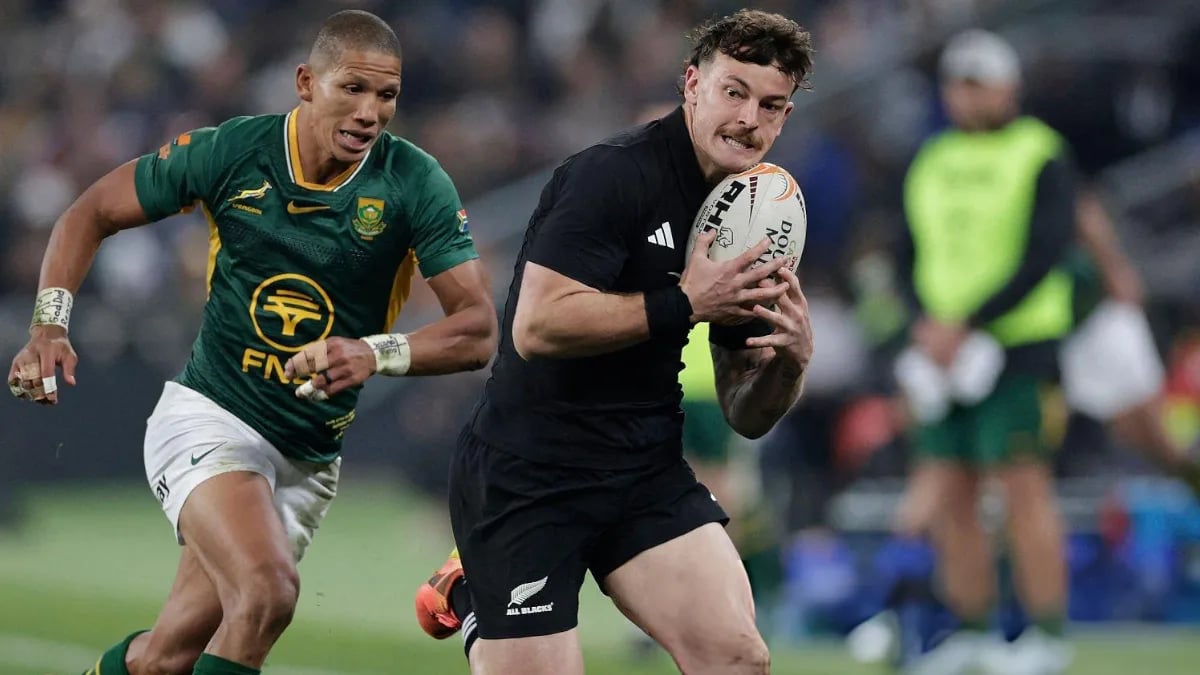
Dave Rennie was asked about Leroy Carter twice at the FNB Stadium press conference on Saturday 5 September. He defended the man with the first answer and explained the system with the second, and the second is the one worth a row.
Jesse Kriel wrestled out of Leroy Carter’s arms 22 metres from the line and the whole of New Zealand knew whose fault it was.
Dave Rennie, an hour later, did not agree with them.
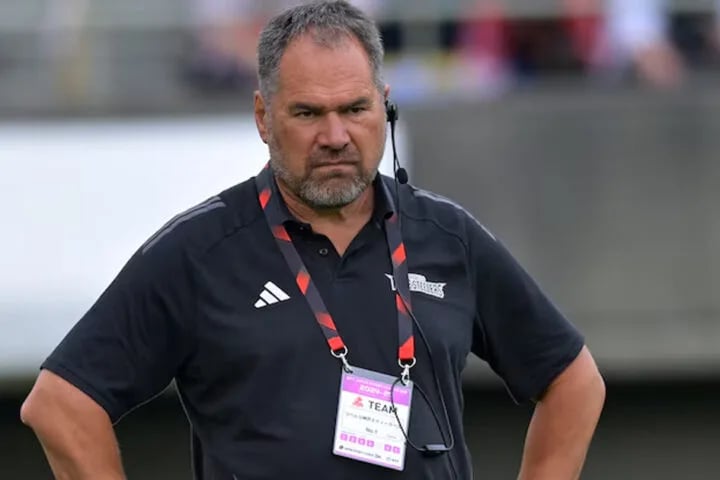
The All Blacks head coach took two questions about his left wing after South Africa’s 29-24 win in Soweto. One was about the tackle. The other was about where Carter had been standing when he missed it, and the answer contains a word that turns the two Springboks tries through his channel into something other than two missed tackles. What it turns them into comes later. The tackle comes first.
Structure or tackle? Pick a side below, then read on.
Leroy Carter made two, gave away two, and took all the blame
Carter had a night that does not fit on a scoreboard. He made two tries, for Ardie Savea and Will Jordan, and two went through his channel, Kurt-Lee Arendse’s and Kriel’s. The ratings gave him a 5 and said the site would defend him again. This is that.
RugbyPass’s Henry Lee counted three missed tackles by half-time, the most on the field, and noted that Rennie had picked Carter ahead of Josh Moorby for his defence. The reaction in New Zealand wrote itself from there. A week earlier half the country wanted Cheslin Kolbe banned for grabbing him. By Saturday night the same people wanted his jersey.
Rennie was asked at the post-match press conference how much the one-on-one misses had hurt in the third Test of Rugby’s Greatest Rivalry.
“Big fella misses a tackle around the fringe and no one notices. Your winger misses a tackle out wide and they score. I feel for Leroy. He’s a bloody good man, he’s a very good defender, and I’m sure he’s hurting about that.”
A coach protecting a player is not news. The first sentence is.
A prop who misses two metres from a ruck costs his side a metre and a half, because four men are standing behind him. A wing who misses costs seven points, because nobody is. In the tackle count they are the same miss. On the scoreboard one is a metre and a half and the other is seven points, and only the seven gets clipped.
Then he went to the ten minutes that followed it.
“Our job once they’d scored was to bounce back and try and take control of possession, but they were able to dominate the next sort of ten minutes, and that was pivotal.”
The same channel, two different ways through
| Minute | Try | Where Carter was | What beat him |
|---|---|---|---|
| 21 | Arendse | In the centre channel, up in the line | De Allende’s step and fend |
| 57 | Kriel | Up in the line, on the edge of the Springboks attack | A long Libbok pass, then a one-on-one he rushed |
Source: WeTalkRugby match report from the broadcast; RugbyPass for the tackle count.
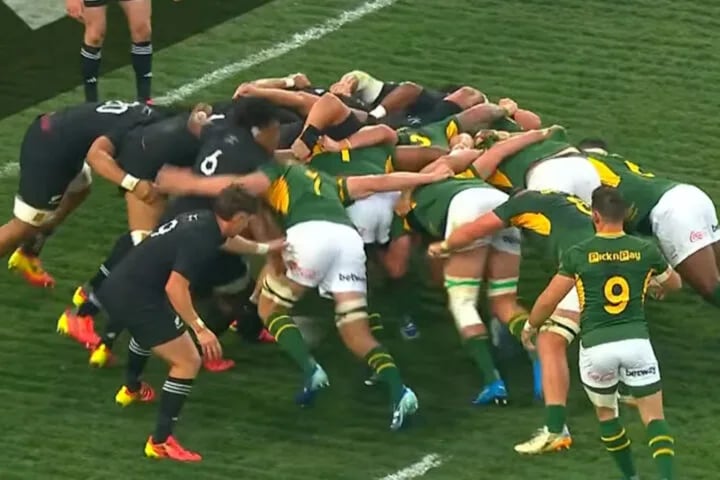
The first came off New Zealand’s own lost lineout ball on 21 minutes. A skip pass found Kriel on the right, Manie Libbok’s long pass found Ethan Hooker on the left, and de Allende, in his 102nd Test, took the next pass with a wing in front of him rather than a centre. One step, one fend, and Arendse had a gap.
The second came off the restart after Jordan’s 56th-minute try, two tries in ninety seconds that turned the Test. South Africa won the restart, went down the short side, then swung it right. Sacha Feinberg-Mngomezulu fired long to Libbok, Libbok fired long to Kriel, and Carter rushed up and missed. Kriel ran in from 22 metres and South Africa led for the first time all night.

Both times the last All Black in the line had left his touchline behind him.
A journalist had noticed, and asked whether Carter defending in the centre in the first half was accident or design.
“It’s part of a structure about him defending high”
“Found himself defending in the centre. It’s part of a structure about him defending high, and so the idea is to force him to throw one over the top, or go in and try and nail the ball carrier and kill it there.”
Design, then. And the word is high.
In the All Blacks system, defending high means the wing pushes up level with his outside centre as the ball goes wide, so the playmaker has to throw long over him or carry into him.
In a conventional drift the wing is the last man and stays the last man. He holds the touchline, gives his outside centre a shoulder to push the ball towards, and lets the attack run out of grass. It is safe and it is slow, and against a side that carries like South Africa it turns every wide phase into a 15-metre gain and a fresh set of hands at the next ruck.
Defending high is the other bet, and it starts the moment the ball leaves the ruck. The wing comes up hard and in, and the distributor, Libbok or Feinberg-Mngomezulu on Saturday, sees a wing in his face and grass behind it.
Rennie’s own sentence gives the two things the structure wants to happen next. The playmaker throws one over the top, a long pass that hangs in the air long enough for the fullback and the drift to arrive under it. Or he keeps it and carries into a wing who has come up with speed, and the tackle is a dominant one that kills the phase where it stands.
It worked, in the sense that matters to a coach. Twice on Saturday the Springboks did exactly what the shape was built to make them do. De Allende carried into the high wing. Libbok threw the long one over the top. The structure delivered the two outcomes it was designed for, and then asked Leroy Carter to win two one-on-ones, against a centre with 102 Tests and a centre who has run that line for a decade, with nobody outside him if he lost either.
He lost both. Ten points.
So the accident-or-design question has its answer, and neither camp will like it. The design worked. What it needed after that was the tackle, and twice the tackle was not there. Rennie owns the first half of that sentence. Carter owns the second.

What the rest of the line was doing
Carter was not freelancing. RugbyPass had Quinn Tupaea rushing out of the line on Kriel in the first half, in the same shape. Jordie Barrett made 14 tackles beside them, the most on the field on RugbyPass’s count, a fortnight after 15 tackles and five turnovers at Ellis Park. The whole midfield was up. One man in it was beaten twice, and he was the one with the touchline behind him.
Tana Umaga, 74 Tests for the All Blacks and the man Rennie appointed to run their defence, owns the shape. Rennie said his side would “have a look from a scrum point of view” on Saturday night. Nobody asked whether the wing structure would get the same look, and he did not offer it.
The tell for Baltimore is simple, whoever wears 11. Watch the All Blacks’ left wing at the first Springboks phase off a lineout in New Zealand’s half. If he is level with his 13 when the ball reaches the first receiver, nothing has changed, and the Springboks will throw the long ball again, because both routes just produced a try. If he is five metres deeper and hugging the touchline, Rennie has moved off the structure, a week after calling it one.
Leroy Carter’s 5 stands. So does the structure.
Twice the ball came to Carter’s channel in the way the structure intended, and twice he lost the one-on-one. A wing who came out of the All Blacks Sevens programme and made his Test debut against this side in Wellington last year has to make those tackles, and on Saturday he did not.
But swapping his name for Moorby’s changes the tackler and not the shape. The shape is what put a wing in the centre channel opposite de Allende and rushing at Kriel with nothing behind him. A coach who wants a wing defending high has to want the risk that comes with it, and has to stop being surprised when a Springboks centre wins a collision with a wing. Rennie is right that the fringe misses go unclipped. He is also the reason the wide ones cost seven.
Frequently asked
What did Dave Rennie say about Leroy Carter after the third Test?
At the All Blacks post-match press conference at FNB Stadium on Saturday 5 September, Rennie said “big fella misses a tackle around the fringe and no one notices, your winger misses a tackle out wide and they score”, called Carter “a very good defender”, and said Carter defending in the centre was “part of a structure about him defending high”.
What does defending high mean in rugby?
The wing pushes up hard and comes in as the ball moves wide, arriving level with his outside centre rather than holding the touchline. The aim is to force the playmaker into a long pass over the top, which gives the fullback and the drift time to cover, or into a carry that the wing can stop with a dominant tackle. The cost is that a beaten wing has nobody outside or behind him.
How many tackles did Leroy Carter miss against the Springboks?
RugbyPass counted three missed tackles by half-time, the most of any player on the field, and a fourth on Jesse Kriel for the try that gave South Africa the lead. Carter also made the breaks that produced Ardie Savea’s second try and Will Jordan’s.
Your turn
Structure or tackle? Rennie says the shape put Carter in the centre channel and he was where the system wanted him. The 5 says the tackle on Kriel was there to be made. One of those is the reason South Africa lead 2-1. Settle it below.




Comments
No one has weighed in yet.
Be the first - what did you make of it?