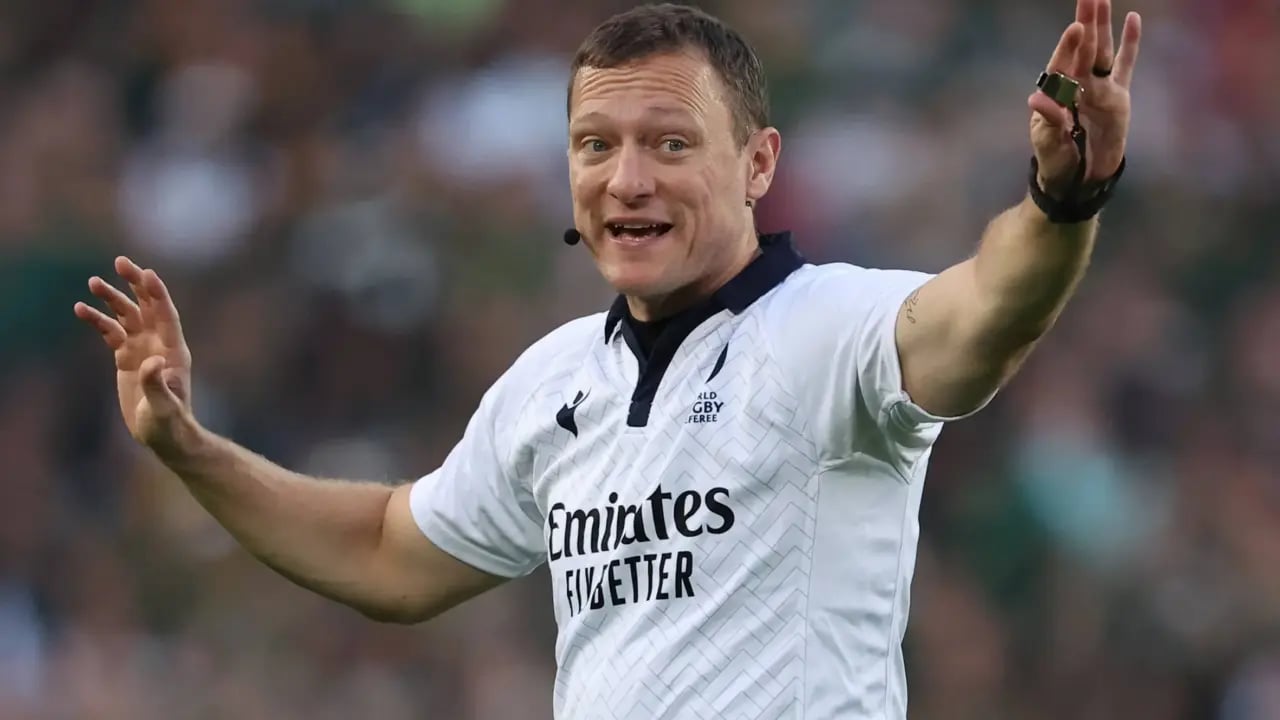
Matthew Carley Didn’t Let The Scrum Referee Itself. That’s Why Ellis Park Turned.
Referee Matthew Carley overruled his own TMO, then penalised the pack that was going forward. Ardie Savea’s tackle on Jasper Wiese has had four days of airtime and it was not the call that decided the first Test. On the Aotearoa Rugby Pod, James Parsons went looking for the one that was.
Sixteen-twelve. Five metres out. South Africa have already waved the posts away twice, because when a pack is going forward at Ellis Park the three points feel like an insult.
Third scrum. The hit lands, the Bok shove arrives, the All Blacks front row starts travelling backwards, and Matthew Carley’s arm goes up the other way.
There is a reason referees almost never give that penalty, and it has nothing to do with who was winning the scrum.
New Zealand won 33-16 on Saturday 22 August, five tries to one, in the opening match of the four-Test Rugby’s Greatest Rivalry series. They were behind for most of an hour. The scoreline is not the argument. The argument is what happened at that scrum, and at a TMO screen twenty minutes later, and whether both of those calls survive contact with Cape Town on Saturday.
The scrum nobody blows
Gerhard Steenekamp was penalised for walking around.
That phrase gets thrown around on broadcasts as if it means the same thing as being strong. It doesn’t. A loosehead who cannot win the contest straight steps his outside foot back and around, swinging the whole scrum on an axis rather than driving it down the mark. It drags the opposition tighthead off his own hooker, and it produces exactly the picture South Africa were producing: a front row folding, a ball nowhere near coming out, an eruption from the stands. From row 40 it looks like dominance. Deliberately wheeling a scrum is a penalty offence, and it is the single hardest one in rugby to punish, because the man committing it is winning.
Watch the flank of the scrum against the mark next time. If the tunnel finishes pointing at the touchline it started square to, somebody walked. It is usually the man going forward.
Which is why referees reset. When one pack is that far on top, the official’s instinct is that the beaten side must have caused it, and momentum quietly becomes the evidence. That is refereeing the picture instead of the cause, and it is standard practice across the game. It is also, incidentally, why the Springbok scrum remains South Africa’s single biggest Test advantage: the reward compounds, because the referee starts expecting it.
Parsons, two All Blacks caps and 115 games at hooker for the Blues, put it plainly on Monday’s show.
“That scrum penalty that Matthew Carley gave to the All Blacks when [South Africa] were walking around, nine times out of 10 when a scrum’s that dominant the ref would not give that penalty. He’ll reset it. Because he’ll say, oh, there’s no way New Zealand could have. But what I liked is he reffed that scrum at every scrum. He was not moved by the momentum.”
Not moved by the momentum. That is the whole piece in four words.
Read also: the All Blacks scrum was not out-muscled at Ellis Park, it was rushing — which is a different problem, and a fixable one.
Parsons had already called it wrong, on air, a week earlier
The reason this reads as analysis rather than flag-waving is that Carley made a fool of the man praising him.
Seven days before the Test, on the same podcast, Parsons had said the first two or three scrums dictate everything that follows and a beaten pack never claws it back. Then Ellis Park happened, and the beaten pack got the penalty.
“I said last week, remember, those first two or three scrums will dictate the future of the game and you won’t get it back. Well, he proved me wrong. He watches it, he goes, no James, you’re wrong. I’m going to watch every scrum and make the decision.”
Ex-players do not usually hand back a prediction that cheerfully. The concession is the point: the received wisdom about scrum refereeing is that it is cumulative, and Carley refused to let it be. Rassie Erasmus named that scrum as the one that lost the Test. He is not wrong about its importance. He is arguing with the wrong part of it.
What referee Matthew Carley actually said into the microphone
The 70th minute is the one the internet chose.
Savea hit Jasper Wiese, Wiese’s head came forward into the contact, and Scottish TMO Mike Adamson asked for a look. Carley took it, watched it, and talked himself out of the card in real time.
“The head drops forward and there is contact with the head. It’s not the high tackle, it’s the player in a whiplash motion that creates the contact.”
Dave Rennie, who had every reason to say nothing, went further after the game.
“So technically, it’s the right call. You’ll see the footage that when Ardie hits him, his head comes forward, and so that means that your first impact’s on the body, if the head goes forward. If it goes backward, it means first impact is straight on the head. So it’s a really good refereeing, and good to see at this level.”
Savea himself did not pretend.
“I’ll be pretty biased tonight that I’m happy for the decision. But yeah, I was nervous, but they made the decision, they made the call, and they worked in our favour.”
Parsons, again, refused the free win.
“That went our side. I agree that’s not a yellow card. But for everything we’ve seen in the last four or five years, that’s going to the bin. What we’ve got to do as Kiwis is acknowledge that.”
Both things are true at once, and that is uncomfortable. The decision was technically correct under the framework. The same contact has produced yellow cards for four years, which tells you the framework has been applied by rote rather than read, something Jean de Villiers has been saying about the law nobody can define for longer than this series has existed. Change the official and the same picture goes the other way. Nigel Owens said he would have given a yellow for a shoulder that arrived high last season, and nobody accused him of not knowing the framework either.
The bit that outlives this series
Here is the argument worth keeping once the tour is over.
Carley declined the card after his own TMO had gone looking for one, in the biggest Test on the calendar, with two coaching groups and a global broadcast watching. Parsons thinks that changes behaviour upstairs.
“I think for the game of rugby, what he did is going to allow way more free flowing, because TMOs don’t want to be embarrassed like that. And I know he didn’t do it to embarrass him, but it’s going to make you think as a TMO. Am I going down? Am I just being nitpicky, niggly? Or is there an issue here?”
That is a governance argument dressed as match analysis, and it is correct. The TMO protocol was written for the clear and obvious. It has drifted into a second opinion offered on everything, and the drift happened because nobody in the middle wanted to wear the consequence of waving it off. Carley wore it.
Matfield and Mallett have a case. It just isn’t this one.
Ignoring the South African complaint would be dishonest, because parts of it are good.
On SuperSport, Victor Matfield and Nick Mallett went at the consistency rather than the courage. Eben Etzebeth was penalised for offside at a charge-down; Fabian Holland, they argued, was in the same position at another and played on. Marco van Staden was sin-binned for illegal clearing at a ruck; Luke Jacobson, in their reading, did something comparable and got nothing.
Mallett, on the two charge-downs:
“At the beginning, there’s Etzebeth; I thought he was offside, but I also thought that Holland was offside too. So, two situations where I thought both players were offside and it should have been called back. One is let play on, and the other is a penalty against South Africa.”
Matfield, on Jacobson:
“How can that not be a penalty? What’s the difference?”
Mallett again, and this is the sentence that will follow Carley around:
“Same actions, different call. That’s all we say.”
The Holland one is the strongest thing they have, and it deserves more than a mention. Holland read Grant Williams’ box kick in the 48th minute, charged it down and scored. Converted. Seven points, at the exact moment South Africa needed the game to stay tight. If Mallett is right that he was offside, and that Etzebeth had been pulled up for the same offence earlier in the same match, then that is the biggest scoreboard swing of any decision on Saturday, and it is bigger than the scrum by four points.
It is also the hardest call in the game to get right. The chaser is moving forward, the kicker is retreating, and the assistant is watching a line that stopped existing the moment the ball left the boot. Referees miss these, and they miss them in both directions.
That is a real charge and it deserves a real answer, which is: they are probably right, and it does not touch the two decisions that shaped the match. Consistency inside a category is a refereeing standard. Refusing to be led by momentum, and refusing to be led by your own TMO, is a refereeing judgement. Carley was arguably weak on the first and unusually strong on the second. Matfield’s own verdict on the scrum was that “this was so important in the game; this was a game-breaker,” and on that he and Parsons are describing the same moment from opposite ends of the ground.
Worth remembering, too, that neither coach took up World Rugby’s offer to meet the officials beforehand. Both camps arrived without having asked a single question about interpretation, then spent Sunday discussing interpretation.
Fourteen penalties, and New Zealand still won
The numbers do not flatter the winners.
South Africa won the penalty count 14-10. Bryn Hall, a title-winning Crusaders halfback and eight-time Māori All Black, ran the audit on air and found the shape of it more damning than the total.
“We had 14 penalties as well and I think the first nine penalties were within the first 30 minutes. The 13th penalty was in the 54th minute, the next one, the last one, was in the 76th minute. So that wiggle room around us being really squeaky clean then led to the penalties for the South Africans, and that’s where we won the game.”
Nine in half an hour, then a 22-minute stretch without conceding one. That is a team that fixed something at the break.
What buried the Springboks was everything else. Twenty-three turnovers conceded, most of them knock-ons. New Zealand won 14 turnovers to five. South Africa held 61% of the territory and turned nine visits to the All Blacks 22 into 1.1 points each; New Zealand made six visits and scored 4.3 points a time. Average recycle speed at the ruck: 4.4 seconds for the Boks, 3.1 for New Zealand. A side that slow at the breakdown with that much of the field is not being refereed out of a Test match.
He got the ball-in-play number wrong. He is right about the game.
Parsons finished with the broader gripe.
“International rugby is too slow. And I don’t mean because the backs are playing quick, it just moves too slow. Like 23, 29 minutes ball in play. Come on. We don’t need TMO always coming in. Let’s just get this game going.”
The figure is off. World Rugby’s own data puts ball-in-play in elite men’s Test rugby at roughly 34 minutes, and the 2023 World Cup averaged 34 minutes 18 seconds. So call it 40% of the clock rather than a third.
The complaint stands anyway, and this site’s position on it is not complicated: the TMO should be a fire alarm, not a smoke detector. Clear and obvious, or stay off the channel. Every additional referral trains the man in the middle to stop trusting his own eyes, and a referee who has stopped trusting his own eyes will always reset the scrum, because resetting is the decision nobody reviews.
Cape Town hands it to the man who refereed 43-10
Saturday at DHL Stadium belongs to Nika Amashukeli, with Karl Dickson and Angus Gardner on the touchlines and Eric Gauzin in the box.
Amashukeli was in the middle for New Zealand’s heaviest defeat in history, the 43-10 in Wellington that started the Springbok run Ellis Park has just ended. He will arrive to a Bok camp that believes it was refereed out of a Test it led, and a New Zealand camp whose own analysts spent Monday saying the opposite out loud.
Parsons said it before anyone asked him to.
“There’s going to be a day in this tour that potentially it goes the other way and we can’t have a cry about it. We got our day now. It’s how we survive when maybe the rub of the green goes the other way.”
That is the most useful sentence anyone in New Zealand has said this week, and it will be tested inside seven days.
Read next: Five moments explain how the Springboks dominated Ellis Park and still lost by 17 — the scrum is only the second-biggest of them.
Frequently asked
Who refereed the first Test between the Springboks and All Blacks at Ellis Park?
Matthew Carley of the RFU, with Scotland’s Mike Adamson as TMO. New Zealand won 33-16 on Saturday 22 August 2026.
Why was Ardie Savea not carded for the tackle on Jasper Wiese?
Carley ruled the first contact was shoulder to shoulder and that Wiese’s head moved forward into the collision afterwards. In his words, “it’s the player in a whiplash motion that creates the contact.” Dave Rennie called it technically the right call.
What was the scrum penalty against Gerhard Steenekamp for?
Walking around: stepping the outside foot back and around to swing the scrum off the mark rather than driving straight. South Africa were 16-12 up, five metres out, and had twice turned down shots at goal to keep scrummaging.
Who referees the second Test in Cape Town?
Nika Amashukeli, at DHL Stadium on Saturday 29 August, with Karl Dickson and Angus Gardner as assistants and Eric Gauzin as TMO. Amashukeli refereed New Zealand’s record 43-10 defeat in Wellington.
So here is the verdict, and it is not the popular one in either country.
Carley had the best afternoon any official has had in this fixture in years, and he had it by doing the two things the job punishes you for. He refereed a scrum that nobody referees. He told his own TMO no, on the biggest stage the sport has, with a card sitting there for the taking and every camera in the world pointed at him.
He missed things. Holland was probably offside and Jacobson probably should have walked. Every referee misses things, in every Test, in both directions. What almost none of them do is decline the easy decision twice in the same eighty minutes.
Name another official who has taken both of those calls in one Test in the last five years. The list is short, and how short it is, is the thing the game should actually be worried about.
James Parsons and Bryn Hall were speaking on the Aotearoa Rugby Pod, episode 29, published Monday 24 August. Victor Matfield and Nick Mallett were speaking on SuperSport. Match statistics from Opta via Planet Rugby, covering the first Test only.