



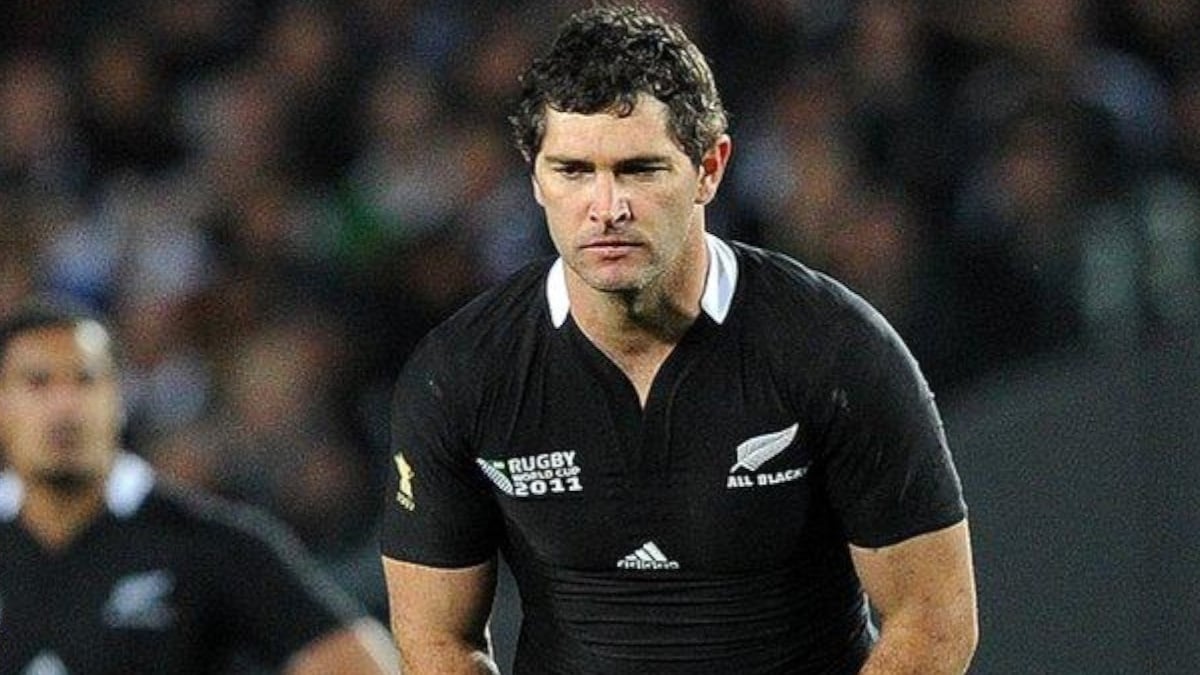
Stephen Donald kicked the penalty that won a World Cup. On The Aftermatch he told Kirstie Stanway that what the All Blacks are attempting this month is harder than that, and then explained the one number that decides it.
Four times.
That is how often South Africa got into the All Blacks 22 in Cape Town on Saturday 29 August. They scored three tries, Cheslin Kolbe kicked everything he was given, and they won by seven. New Zealand crossed into the Springbok 22 nine times, scored four tries, and lost.
Somewhere in those four entries is the whole All Blacks Springboks Soweto Test. Stephen Donald, 23 Tests as an All Blacks first five-eighth and the man who kicked the winning penalty in the 2011 final, thinks he knows what happens inside them, and why it keeps happening. His explanation is below. First, the claim that got the episode its title.
The All Blacks Springboks Soweto Test is harder than a World Cup, says a man who won one
Kirstie Stanway put it to him flat on Sky Sport NZ’s The Aftermatch, recorded in the days after Cape Town: winning two of three Tests in South Africa is harder than winning the World Cup next year, because a World Cup can be won on neutral ground and this cannot. “Tell me I’m wrong,” she said.
He would not.
“I’ve heard people in the past say winning the Six Nations is tougher than winning the World Cup and all these sorts of bright sparks,” Donald said. “So I don’t want to cause international issues with the world of rugby, but you would think this is as tough as it gets. To be in South Africa, to beat them two times out of three, it’s a huge ask. And they’re at the peak of their powers, aren’t they? They’re the defending two-times world champions.”
The Six Nations comparison is the tell. He knows how that argument sounds from the northern hemisphere and he made it anyway. And on one specific point he is right: this is a fixture the World Cup never asks anyone to play. No side has been asked to beat the double champions twice in their own country inside three weeks, at altitude, in front of 94,736 people. New Zealand have already won at Ellis Park, and the series is still 1-1. Two wins in South Africa cost exactly that much.
Every fixture, result and kick-off time in Rugby’s Greatest Rivalry is on the series page. The Test that decides whether Baltimore matters kicks off at FNB Stadium at 17:10 on Saturday 5 September.
Four entries, and it was enough
Go back to the number.
South Africa got into the All Blacks 22 four times in Cape Town. Jesse Kriel scored in the first minute, Damian de Allende on 21, Siya Kolisi on 37. Three tries from four visits, and Kolbe added four penalties from further out. New Zealand won 111 rucks to 77 and had the faster ball, and none of it mattered. When South Africa reached the 22 they scored. When New Zealand reached it they mostly did not.
Donald’s phrase for it was “coach-speak”, and he apologised for using it. Then he used it.
“I reckon it’s a lot around the 22 entries,” he said, “because where their points came from in Test two, and where they’re at their absolute destructive, powerful best, is where they get a set piece in your 22.”
This site has argued since before Cape Town that the blueprint for beating South Africa is to make them kick. Donald’s version is the defensive half of the same idea. Do not worry about stopping them inside the 22. Stop them arriving.
The easy way in
So how do you keep them out?
“It’s a lot to do with the discipline,” Donald said. “You can’t afford to give away penalties, because that’s the easy way in.”
It sounds like a coaching platitude until you check the Cape Town scoring. Kolbe went seven from seven off the tee, four of them penalties, and Donald admitted the kicking itself surprised him. “When you think about the Bok goal kickers, he’s just never been really required. Him off the tee was quite the revelation.”

He also noticed something the press box missed. After Ellis Park, South Africa were hammered at home for turning down shots at goal. In Cape Town, every time a Springbok pointed at the posts, the crowd applauded. A fanbase correcting its own coach in real time.
Kolbe moves to fullback at FNB Stadium because Damian Willemse is injured, and he keeps the tee. A penalty conceded inside the New Zealand half is three points. A penalty conceded inside the New Zealand 22 is a lineout, a drive, a de Allende carry, and the fold.
What actually happens once they cross the line
Here is the mechanism, in his words, because a former Test 10 describing a pattern he has defended is worth more than any diagram.
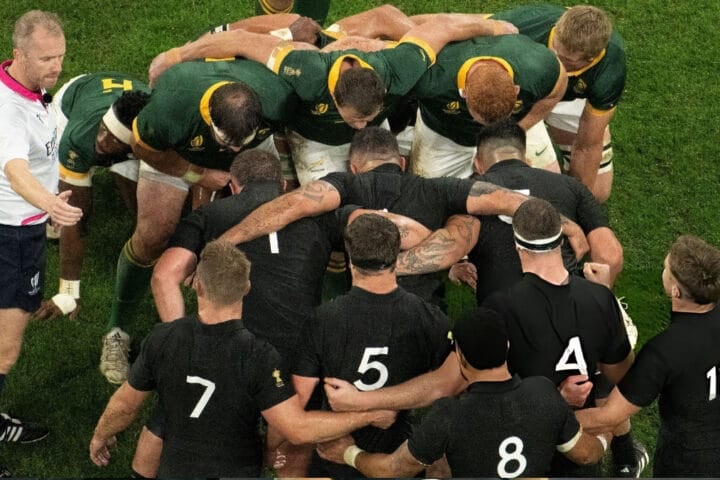
“They win their set piece. If they don’t drive, or they don’t get something out of that set piece, then they’re going to have a big ball carrier come down, a de Allende or a Jesse Kriel, and then it’s just folding around the corner with these monster forwards. And when they get that burst of energy, because they get invigorated once they’re in the 22, because they know that this is their time to shine, they get around quickly, and then it’s just a matter of can the All Blacks withstand it.”
Then the example. Kolisi’s try, close range, three minutes before half-time.
“It was just a case of nothing left,” Donald said. “The boys had been going up against it trying to stop these massive Africans come around the corner, and then by the time Siya comes around it’s sort of three or four phases deep into it. There’s just no one there and the line’s just getting thinner and thinner.”

Watch for this on Saturday, because the broadcast will not point it out. When a Springbok forward carries short inside the 22, look past the tackle to where the next two forwards are standing. If they are already around the corner of the ruck before it has formed, the defence is a phase behind and it will stay a phase behind. Nobody on the New Zealand side is being beaten in a tackle. They are being beaten to a position, over and over, until the man who should be there is not.
So the number has an answer. Four entries produced three tries because each one was defended by a line that was one forward shorter than the previous phase.
Tempo is a consequence, not a plan
The other half of Donald’s preview was about the All Blacks attack, and it contained a correction to the way that attack is usually described.
The offloading is not the plan. Going forward is the plan. The offloads are what happens when it works.
“If they can win that advantage line by getting their set piece right and getting their first carry, well, then the Springbok defensive line will never get set,” he said. “That is what all of this stuff around tempo and playing with pace has always been about for Dave Rennie’s team. It just becomes so much easier if you’re going forward to everything and the defence is going backwards, because they never get the chance to come forward at any pace, and then that’s when the offloads and the line breaks can result.”
Dan Biggar reached the same conclusion from the shape of the passing. Two former Test 10s from different hemispheres, one read.
His second key was what happens after a high ball is caught, not the catch. “The ability to take the high ball but then shift it as quickly as you can,” he said, citing Leroy Carter’s run from a receipt in Cape Town. A catcher who stands still is a ruck in his own half.
Leave Ruben Love where he is
He expects two changes, and only because of medicine. Ethan de Groot and Josh Lord went off together at Ellis Park after colliding with each other tackling Jasper Wiese, and two head knocks picked the All Blacks pack for Cape Town. Both are expected back for Soweto once they clear the return-to-play protocols, though de Groot is also reported to have a knee ligament problem. The team was not confirmed when this was written.
The one selection argument he was asked about, he shut down.
“Richie’s experience is known. He doesn’t need to prove he’s an experienced pressure footballer. He’s been there, done it all. So I think Ruben’s going so well at the moment, you just leave him there. And what he’s banking through all of this just adds to the greater picture, moving forward to a World Cup. Three or four starts against the Springboks in South Africa, there’s nothing tougher to do.”
Note what the argument is. Nobody is claiming Love is better than Richie Mo’unga this week. Starting in Soweto teaches Love something Mo’unga already knows, and the All Blacks need both men to know it by next October. A selection made for 2027, and it sits alongside Dan Carter’s view that Love has not been thrown in at the deep end as the second former All Blacks 10 in a fortnight to say leave him alone.
And the man to win it? Stanway said Ardie Savea, as she has all series. Donald went to the wing. Will Jordan scored twice at Ellis Park and Donald thinks the combination with Damian McKenzie and whoever is on the other wing is sharpening every week. “He is our superstar out in the back division, isn’t he? So get him some ball. Johannesburg, it’ll be hard and fast. There’ll be altitude coming in at the last 20 minutes.”
The last 20 minutes at altitude, with a line getting thinner by the phase. Donald has described how New Zealand lose this Test. Whether they do depends on a number he can count from the commentary box.

Your turn
On the record: if South Africa get into the All Blacks 22 six times or more on Saturday, they win in Soweto and the series with it. Five or fewer, and New Zealand go to Baltimore 2-1 up. The number to count is above. Take it apart below.
Frequently asked
How many times did the Springboks enter the All Blacks 22 in Cape Town?
Four, according to the RugbyPass match feed. They scored three tries from those entries. New Zealand entered the Springbok 22 nine times and scored four tries, but lost 33-26 because Cheslin Kolbe kicked seven from seven, including four penalties.
Did Stephen Donald say beating the Springboks is harder than winning the World Cup?
Kirstie Stanway made the claim on The Aftermatch and Donald agreed that two wins in South Africa against the double world champions is “as tough as it gets”, while noting he has heard the same said of the Six Nations.
When is the All Blacks v Springboks third Test?
Saturday 5 September at FNB Stadium, Soweto, kicking off at 17:10 local time. The series is 1-1 after New Zealand won 33-16 at Ellis Park and South Africa won 33-26 in Cape Town. The fourth Test is in Baltimore on 12 September.







Comments
No one has weighed in yet.
Be the first - what did you make of it?