



“This really is the test. This is the test that decides the series, because whoever wins this wins the series in South Africa.”
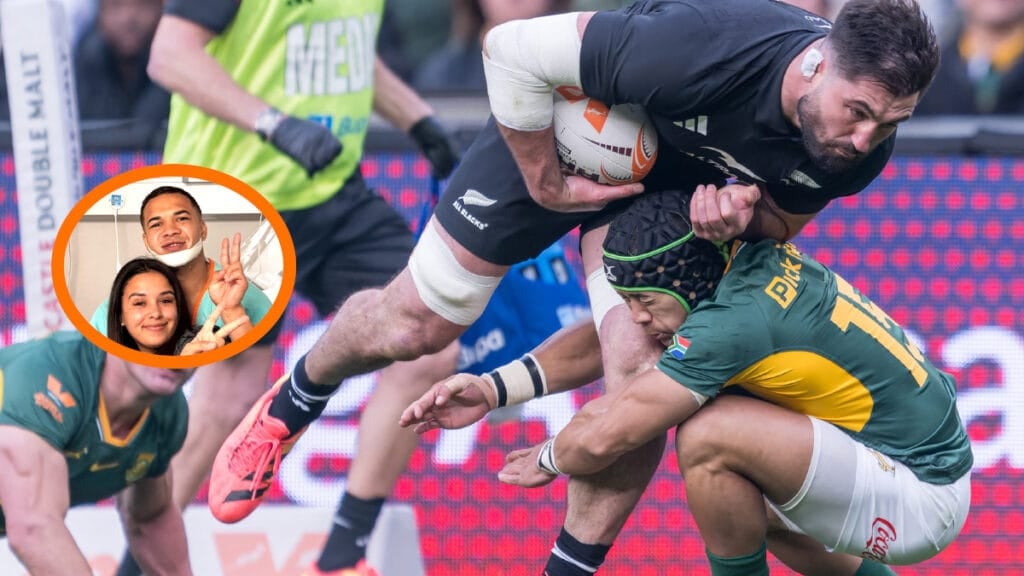
John Smit said that at the end of a fifteen-minute answer about scrums, and the producers cut it for the cold open, which tells you they knew what they had. Two sentences earlier came the line that will travel further. “That fourth game, I think we all know, is a money game.” A World Cup-winning captain has just told you the Springboks All Blacks third Test is the series, and if that reads like a South African writing off a Test his side might lose, the comments are open at the bottom. Read the three reasons first.
Smit, 111 Tests and the 2007 World Cup-winning captain, was on I Love Rugby on Monday 31 August with George Gregan, 139 Tests for Australia, and Jean de Villiers, 109 Tests for South Africa and 37 as captain. That was two days after the Springboks beat the All Blacks 33-26 in Cape Town to level the series at 1-1. One of the three reasons will annoy New Zealand more than Rassie Erasmus swearing did.
Call it before you read the rest. Winner, margin, and the exact score if you are feeling brave.
Add a winning margin for points
Who was best on the day?
No votes yet. Have the first word.
The six scrums nobody in black wants to talk about
Dave Rennie’s “walking around” charge has had three Springboks answers. Rennie got the referee he asked for in Cape Town and made the same complaint anyway, Erasmus told a press room the Boks were “scrumming through”, and Daan Human had already answered him with six years of scrum coaching.
Smit’s answer is different. He is not defending the Springboks scrum. He is describing the All Blacks one.
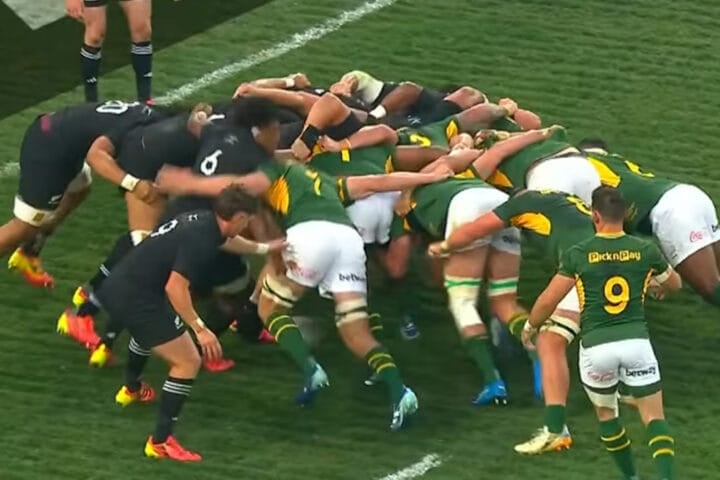
“Not one penalty for walking around, or swimming around is what they call it, and then angling in,” Smit said. “But the reality is they dropped six scrums, got away with it in terms of resets, and so that sort of depowers the opposition scrum… We saw knees going down. The first one got penalised and then they sort of started dropping scrums quite regularly when the pressure came on. And no better way to do that than bring up the opposition in terms of what they’re doing.”
His conclusion: “I think it was just a ploy, and a clever one from Rennie, to be able to deflect some of the things that they did on the weekend to depower the Springbok scrum.”
The count is not Smit’s alone. Erasmus said on Saturday night that New Zealand’s first six scrums on their own feed collapsed and were reset. South Africa won one scrum penalty in Cape Town. They won six at Ellis Park.
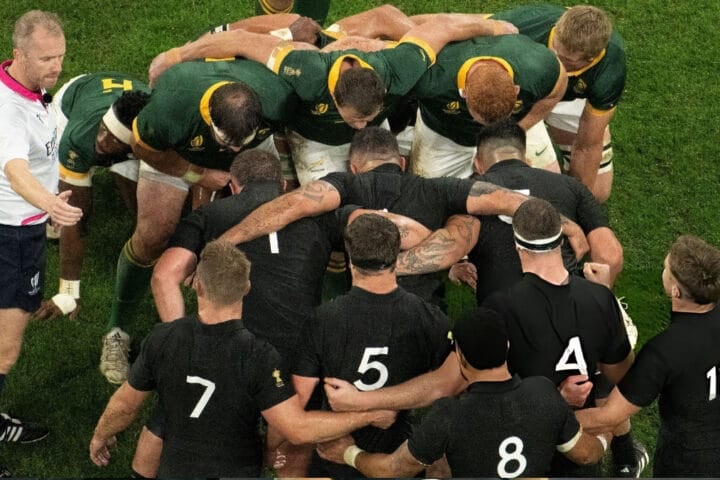
A reset costs nothing. A penalty costs three points or forty metres. When a pack under pressure can put a knee down and get the same scrum again, the stronger unit is being taxed for being stronger. Whether anyone planned it is Smit’s claim, not this site’s. What Saturday brings is a referee who treats it differently. De Villiers made the point: Nika Amashukeli, moved to the third Test after illness took him out of Cape Town, “he’s actually one that’s not scared to make calls also from a scrummaging point of view.”
Watch the first collapsed scrum on All Black ball at FNB. Penalty rather than reset, and the argument is over.

The half-second that let the All Blacks round the rush
On the panel’s reading, three of New Zealand’s four Cape Town tries finished in the outside channel, and the stadium’s read was that the All Blacks were getting round the Springboks rush too easily. De Villiers thought so too, live. Then he watched it again.
“Reviewing the game again, I also felt cheap, as they’re getting around us so easily in real time,” he said. “But then reviewing the game again… what we do really well is that if we get it right, our scramble defence is so good that they throw that bridge ball or they get the ball in that outside channel, but our scramble is so good that eventually they only make five to ten metres… But what happened on the weekend is we’ve got that check. What that then creates is another set of hands to be able to get the ball away.”
The bridge ball is the long pass that skips two men. A blitz defender who presses, checks, then presses again looks like he is defending. He is actually giving the second receiver the half-second he needs to get his hands on the ball, and after that the pass beats the line instead of the line beating the pass.
“If you’re going to go that hard in from the outside, you need to commit to that,” de Villiers said. “It’s actually the fact that in the second half we actually did the press and checked a little bit and then only pushed through that gave them the opportunity to get it wide.”
Smit supplied the other half. The All Blacks are taking front-of-lineout ball, swinging it through a prop to Cam Roigard, and Roigard is throwing what Smit called “a 35, 40-metre bullet”. They are, in his words, “one of the first teams in the last couple of years that are really giving that ball width to get around that rush defence.” Dan Biggar’s read of the All Blacks attack structure lands on the same pass, and how the All Blacks planned to break the Springboks blitz before the series started now reads like a script.

Lose first, then win everything
Now the reason New Zealand will hate. De Villiers did not sell it. He listed it.
“2019, losing first game against New Zealand, then you’ve got backs against the wall, you have to win everything to win the World Cup, they do that. 2021 Lions series, lose the first game, backs against the wall, you have to win all the remaining to win it, they did it. 2023, biggest pool game, lose against Ireland, you have to win everything after that to win it, they do it. And you almost get the sense that it’s the same feeling now for them as well.”
Every one of those is true. And Smit, who watched Ellis Park from the stand and said the Springboks had run out of questions, put the first Test in the same file.
“I genuinely believe that South Africa were about the poorest we’ve seen them for a long time that they lost that first Test, and this is going to irritate a lot of New Zealanders, but New Zealand have been so, so good and they deserved that 15, 20-odd point win in Ellis Park,” Smit said. “…This team has been in this place before. British and Irish Lions, they lose the first one, come back, win the series, get better and better and better… They’ve had a sniff of blood.”
Which is why Smit calls Baltimore a money game, and why this site agrees. A side that arrives there 2-1 up with the home leg banked does not lose the series. The series in South Africa ends on Saturday, and the three defeats de Villiers listed all ended the same way.
Three World Cup winners call the Springboks All Blacks third Test
Gregan was asked to be the neutral, gave New Zealand the dry ball and the quicker route to the width, and still said: “I do think the Boks will get this by a really small margin. I think this will be quite high scoring. I think it’ll be in the 30s for both teams.”
De Villiers: a Springboks win, “their best performance of the three”. Smit: “something pretty special from South Africa”, and “it’ll require a massive response from the All Blacks, which I know we’ll get.”

Frequently asked
When is the Springboks All Blacks third Test?
Saturday 5 September at FNB Stadium, Johannesburg, kick-off 17:00 South African time, with the series level at 1-1. The fourth Test is in Baltimore on Saturday 12 September.
Who is refereeing the third Test?
Nika Amashukeli. He withdrew from the Cape Town Test through illness, was replaced by Angus Gardner, and World Rugby has moved him to FNB Stadium.
Your turn
On the record, alongside the Australian on the panel: Springboks by a score, both teams past 30, and the first collapsed All Black scrum at FNB is a penalty, not a reset. Screenshot it. If Baltimore turns out to matter after all, the comments are open on Saturday night.





Comments
No one has weighed in yet.
Be the first - what did you make of it?