



The Rassie Erasmus front row switch was two moves, and Kyle Sinckler, 68 England caps at tighthead, told Dan Biggar on Monday what each one does to the man opposite.
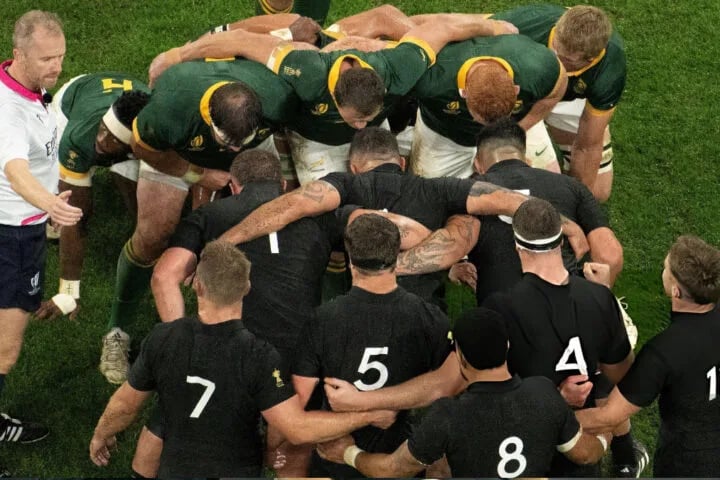
Kyle Sinckler switched the television on five minutes late in Cape Town, and so did Dan Biggar. Both saw Gerhard Steenekamp, Deon Fourie and Thomas du Toit packing down against the All Blacks, and both assumed three Springboks had been hurt in the warm-up.
“I tuned in, I think, five minutes into the game, and I was like, oh my God, the whole front row’s been… I was like, what’s happening?”
Nobody was hurt. Erasmus had named a heavier front row on the Monday, handed in a different team sheet an hour before kick-off on the Saturday, and by 35 minutes Malcolm Marx and Ox Nché were on for Fourie and Steenekamp. Sinckler’s reading is the opposition’s, and it is blunt: the switch “would have affected the New Zealanders big time”. The part that followed at 35 minutes, he says, is a plan only one team in the world can run, and the reason has nothing to do with who the players are. Anyone who still thinks the swap was gamesmanship can make the case below.
Sinckler, a Toulon tighthead who toured with the Lions in 2017 and 2021, was on Biggar’s channel for 44 minutes on Monday 7 September, two days after South Africa beat New Zealand 29-24 in Soweto to lead Rugby’s Greatest Rivalry 2-1. Biggar, 112 Wales caps and his Toulon team-mate in 2024-25, had already worked out how the All Blacks attack the Springboks blitz on the same channel. Monday was about the other pack.
The Rassie Erasmus front row switch, from the other side of the tunnel
A tighthead’s week, in Sinckler’s telling, is built on a name. South Africa name their side on a Sunday evening or a Monday, and from then on the man opposite is a known quantity: his height, his bind, his angle, the way he sets. Then the team sheet changes.
“Fair play to, obviously, Rassie. He’s always going to push the envelope. And I’m assuming he wouldn’t be able to do that if it wasn’t allowed. But from an opposition point of view, it kind of throws a massive spanner in the works. Because you’re preparing for the starting side all week, because South Africa typically name their team on a Sunday evening or Monday. So it’s like, okay, thanks for that information. I can prepare. I know who I’m starting up against. And then, an hour before kick-off, it’s done a complete 360. So you’re like, okay, what’s going on here?”
Erasmus’s own explanation, given to reporters after the match, was the forecast. “We thought it was going to be wet, and that’s why we picked that front row,” he said. “The whole week, the prediction was it was going to be wet, and we thought then we’ll need our heavier front row for the first half of the game. But then, closer to the game, the weather report said it’s going to be dry, and then we felt our front row that’s a little bit lighter would be better on the dry field.”
On the Monday he added the procedural point: “An hour before the match you can hand in your team sheet. If those players are in your 23, you can swap the whole bench around and start the other guys. That’s not against the laws of the game.”
Sinckler was not asking for a ruling. Biggar called it “a brilliant coaching play, whether you think it’s right or wrong or against the rules or whatever”, and said the best coaches push boundaries. Both men have played for the sort who do.
“We played in teams where we had Eddie Jones, Warren Gatland, who would describe a narrative and put a narrative out there in the week to gain an advantage.”
That was Biggar, who won most of his 112 caps under Gatland. Sinckler won most of his 68 under Jones. They know what a coach’s week looks like from the inside. The Rassie Erasmus front row switch belongs to the same family. It is legal, and it is aimed at the opposition’s preparation.

Eighty per cent on yourself
The defence against it, Sinckler says, came to him in France, where teams are named late and props who have not played for months appear on a Saturday.
“I remember when I first came to France, I would be preparing for this prop, and then some guy’s starting who’s not even played in six months. And it’s like, well, what’s going on? And it throws a real spanner in the works. So I’ve had to really just focus in on myself. I would always just focus, I’d say, 80% on myself, on my setup, on my technique. And then later on in the week I would focus on the combinations and who’s playing. But in terms of what Rassie did there, that is a massive spanner in the works. And I would say it would have affected the New Zealanders big time.”
The logic underneath is a tighthead’s. Get the nuts and bolts right, own your space at the setup, win a clean engage and chase your feet low, and, in Sinckler’s words, “there’s not really much looseheads can do”. A prop who has spent 80 per cent of his week on himself can absorb a new name at 4pm. A prop who spent it on Ox Nché’s bind is now scrummaging against a stranger.

The conversation that happens on a Tuesday
Then the part that looked like improvisation from the stands. Fourie and Steenekamp were replaced by Marx and Nché at 35 minutes, and Wilco Louw came on for du Toit at 56. Sinckler is certain it was planned, because of what happens when it is not.
“They’re just so innovative, South Africa, in the way that they do things and the way they use their front-rowers. So I’m pretty sure that would have been pre-planned, and they would have said, look, you guys, Steenekamp, Fourie, Thomas du Toit, you’re playing 35 minutes and you’re going to give everything you have in those 35 minutes. And then the guys on the bench, you’ve got five minutes to go as hard as you can, then you’ve got half-time to kind of get your second wind and get your bearings, and then you go again for 40. Because, as you know, as a player, if you don’t have those conversations before, and then you’re getting hooked at 35 minutes, you’re going to be like, what is going on here?”
Erasmus confirmed the shape of the plan without being asked for it. “Deon Fourie, he’s 39 years old, he’s played 65 minutes against the All Blacks in six weeks, so he was going to get tired,” he said, and then the rule: “If the guys stay productive on the field, and they keep doing their job, then we pull it back and we do it at a moment where they’re not productive and helping anymore.”
Marx, on at 35, won three breakdown turnover penalties in his 45 minutes on the field. South Africa won 33-26. Everyone in green knew what 35 minutes meant before the board went up.
The batsman who cannot hit a six first ball
Which raises the question every other coach in the world asked on the Saturday night: why not copy it? Sinckler’s answer is that most props cannot do what the Springboks bench did, and it is not a matter of talent.
“From a prop perspective, I’ve always found it hard. It’s like a batsman in cricket just going out, in his first ball, trying to hit a six. It takes time. You have to get a feel of the game. Whereas these guys, I think because, again, it comes down to the cohesion, and how long that whole group has been together. They would obviously train this. Their training would be specified around, okay, you front-row boys, you’re playing 20 minutes, 30 minutes to start the game, you go as hard as you can. Everything would be catered around it. So they’re built for that. Whereas you see some other teams try to do it and it doesn’t have the same effect. Because it essentially, I guess, only really kind of works for South Africa, in my opinion.”
The reason is the training week. A pack that is told on Tuesday it has 35 minutes trains for 35 minutes, in the gym and on the field, and a pack that comes on cold at 35 has trained for coming on cold. Nobody else builds a week that way, because nobody else has the same eight men to build it around.
“There’s no better feeling for a prop and a front row, when you’ve played together for a long time and it’s just intuitive. It’s intrinsic. You just know what he’s doing and what needs to be done in a situation, and no words need to be said. It’s a feel thing, and they have that. Whereas New Zealand are in the middle of that journey, obviously, with their coaching changes. So they’re kind of mixing and matching their combinations within the front row and within their back five.”
Rennie has started a different front row in every Test of the series. Erasmus has used the same six front-rowers since Cape Town and changed only the order.
Then he changed it back
For Soweto, Erasmus went back to the front row he first picked: Nché, Marx and Louw to start, Fourie, Steenekamp and du Toit on the bench. “This week we’re going to do it the other way around,” he said on the Monday, and gave continuity as the reason for “one of the most important games of the series”. The starting three produced the penalty try on 36 minutes, and the bench three finished the job.
Sinckler’s wider point about the Springboks is where the argument about the switch ends.
“In my experiences playing against South Africa, they’re not the type of team where they’re going to manipulate or mess around. When you’re playing South Africa, when you’re playing New Zealand, when you’re playing France, those big packs, they’ve got so much quality. They don’t need to manipulate or make something happen. They trust their processes. They trust their training. They trust the individuals that they have in the team. They’re not going to get to the Test match and try to make something happen.”
He is right, and the two Springboks arguments of the fortnight are the same argument. The scrum does not need a trick because the training week is the trick. The team sheet does not need a trick either, because handing it in an hour before kick-off is in the regulations, and the only thing it exploits is an opponent who has been studying the wrong loosehead. Sinckler, for the record, thinks the fortnight’s noise from New Zealand “really revved up the South African boys”. The switch did not need any help.

Frequently asked
Why did Rassie Erasmus change the Springboks front row before the Cape Town Test?
The weather, in his own words. South Africa expected a wet game and named a heavier front row on the Monday; when the forecast changed to dry, Erasmus started the lighter trio of Steenekamp, Fourie and du Toit, then brought Marx and Nché on at 35 minutes and Louw at 56.
Is it legal to change a starting team an hour before kick-off?
Yes. Erasmus’s explanation was that the team sheet is handed in an hour before the match, and any of the 23 named can start. The 23 did not change; the order did.
What did Kyle Sinckler say about the Springboks front row switch?
That it “throws a massive spanner in the works” for a prop who has prepared all week for a named opponent, that it “would have affected the New Zealanders big time”, and that the 35-minute substitution only works for South Africa because their training week is built around it.
Your turn
On the record: the front row Erasmus names on Thursday is the one that packs down first in Baltimore, and Fourie, Steenekamp and du Toit are all on before the hour. If he swaps the team sheet again an hour before kick-off, that call is wrong and the comments will say so. Which way does he go this time?







Comments
No one has weighed in yet.
Be the first - what did you make of it?